Showing posts with label trinity. Show all posts

Saturday, May 30, 2015

"Festival Te Deum in E": Benjamin Britten

In honor of the Sunday of the Trinity, here's the Guildford Cathedral Choir singing this piece; pretty dramatic! 


Some parishes sing the Te Deum at the end of the mass on Trinity Sunday; at St. Mary's, two thurifers stand at each end of the altar and swing their thuribles throughout.   Always wonderful, and I highly recommend this to anybody.  The smoke swirls up, up, up....

In my new parish, we've been singing the Te Deum (#S205 in the 1982) in place of the Gloria all throughout Easter; I've never seen that done before, but I like it.

Here, apparently, is Arvo Pärt's Te Deum - and as with everything else I've heard of his, I find it extremely compelling and beautiful.  It's 32 minutes long!


The YouTuber writes that the performers are the Akademisk Kor and the Akademisk Orkester, with Nenia Zenana conducting and Marianne G. Nielsen, solist.  S/he also writes that:
Te Deum employs Pärt's signature tintinnabuli compositional style. Tintinnabuli is often described as a minimalistic compositional technique, as its harmonic logic departs from that of the tonal tradition of Western classical music, creating its own distinct harmonic system. Tintinnabulation is a process in which a chosen triad encircles a melody, manifesting itself in specific positions in relation to the melody according to a predetermined scheme of adjacency. In its most rudimentary form, Pärt's tintinnabuli music is composed of two main voices: one carries the usually stepwise melody (M-voice) while the other follows the trajectory of the melody but is limited to notes of a specific triad (T-voice.) In the case of Te Deum, it is a D triad that is featured in the T-voice, and as such provides the harmonic basis for the entire piece.

The work is scored for three choirs (women's choir, men's choir, and mixed choir), prepared piano, divisi strings, and wind harp. According to the Universal Edition full score, the piano part requires that four pitches be prepared with metal screws and calls for "as large a concert grand as possible" and "amplified." The wind harp is similar to the Aeolian Harp, its strings vibrating due to wind passing through the instrument. Manfred Eicher of ECM Records "recorded this 'wind music' on tape and processed it acoustically." The two notes (D and A) performed on the wind harp are to be played on two separate CD or DAT recordings. According to the score preface, the wind harp functions as a drone throughout the piece, fulfilling "a function comparable to that of the ison in Byzantine church music, a repeated note which does not change pitch."

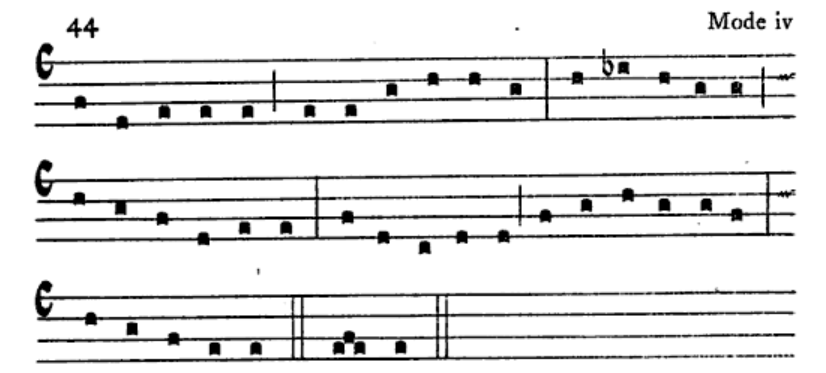
Here's the Gregorian Chant version - the Solemn Te Deum - sung here by the monks at Solesmes:


Here are all the words, in Latin and English, from Wikipedia:

Latin text Translation from the Book of Common Prayer
Te Deum laudámus: te Dominum confitémur.
Te ætérnum Patrem omnis terra venerátur.
Tibi omnes Angeli; tibi coeli et univérsae potestátes.
Tibi Chérubim et Séraphim incessábili voce proclámant:
Sanctus, Sanctus, Sanctus, Dóminus Deus Sábaoth.
Pleni sunt coeli et terra majestátis glóriæ tuæ.
Te gloriósus Apostolórum chorus;
Te Prophetárum laudábilis númerus;
Te Mártyrum candidátus laudat exércitus.
Te per orbem terrárum sancta confitétur Ecclésia:
Patrem imménsæ majestátis; Venerándum tuum verum et únicum Fílium;
Sanctum quoque Paráclitum Spíritum.
Tu Rex glóriæ, Christe.
Tu Patris sempitérnus es Fílius.
Tu ad liberándum susceptúrus hóminem, non horruísti Vírginis úterum.
Tu, devícto mortis acúleo, aperuísti credéntibus regna coelórum.
Tu ad déxteram Dei sedes, in glória Patris.
Judex créderis esse ventúrus.
Te ergo quǽsumus, tuis fámulis súbveni, quos pretióso sánguine redemísti.
Ætérna fac cum sanctis tuis in glória numerári.

[added later, mainly from Psalm verses:]
Salvum fac pópulum tuum, Dómine, et bénedic hæreditáti tuæ.
Et rege eos, et extólle illos usque in ætérnum.
Per síngulos dies benedícimus te.
Et laudámus nomen tuum in sǽculum, et in sǽculum sǽculi.
Dignáre, Dómine, die isto sine peccáto nos custodíre.
Miserére nostri, Dómine, miserére nostri.
Fiat misericórdia tua, Dómine, super nos, quemádmodum sperávimus in te.
In te, Dómine, sperávi: non confúndar in ætérnum.
We praise thee, O God :
    we acknowledge thee to be the Lord.
All the earth doth worship thee :
    the Father everlasting.
To thee all Angels cry aloud :
    the Heavens, and all the Powers therein.
To thee Cherubim and Seraphim :
    continually do cry,
Holy, Holy, Holy :
    Lord God of Hosts;
Heaven and earth are full of the Majesty :
    of thy glory.
The glorious company of the Apostles : praise thee.
The goodly fellowship of the Prophets : praise thee.
The noble army of Martyrs : praise thee.
The holy Church throughout all the world :
    doth acknowledge thee;
The Father : of an infinite Majesty;
Thine honourable, true : and only Son;
Also the Holy Ghost : the Comforter.
Thou art the King of Glory : O Christ.
Thou art the everlasting Son : of the Father.
When thou tookest upon thee to deliver man :
    thou didst not abhor the Virgin's womb.
When thou hadst overcome the sharpness of death :
    thou didst open the Kingdom of Heaven to all believers.
Thou sittest at the right hand of God : in the glory of the Father.
We believe that thou shalt come : to be our Judge.
We therefore pray thee, help thy servants :
    whom thou hast redeemed with thy precious blood.
Make them to be numbered with thy Saints : in glory everlasting.

[added later, mainly from Psalm verses:]
O Lord, save thy people :
    and bless thine heritage.
Govern them : and lift them up for ever.
Day by day : we magnify thee;
And we worship thy Name : ever world without end.
Vouchsafe, O Lord : to keep us this day without sin.
O Lord, have mercy upon us : have mercy upon us.
O Lord, let thy mercy lighten upon us :
    as our trust is in thee.
O Lord, in thee have I trusted :
    let me never be confounded.

Sunday, May 26, 2013

For Trinity Sunday: Te Deum

Sung by Schola Bellarmina:


Te Deum laudamus:
te Dominum confitemur.
Te aeternum Patrem
omnis terra veneratur.
Tibi omnes Angeli;
tibi caeli et universae Potestates;
Tibi Cherubim et Seraphim
incessabili voce proclamant:
Sanctus, Sanctus, Sanctus,
Dominus Deus Sabaoth.
Pleni sunt caeli et terra
maiestatis gloriae tuae.
Te gloriosus Apostolorum chorus,
Te Prophetarum laudabilis numerus,
Te Martyrum candidatus laudat exercitus.
Te per orbem terrarum
sancta confitetur Ecclesia,
Patrem immensae maiestatis:
Venerandum tuum verum et unicum Filium;
Sanctum quoque Paraclitum Spiritum.
Tu Rex gloriae, Christe.
Tu Patris sempiternus es Filius.
Tu ad liberandum suscepturus hominem,
non horruisti Virginis uterum.
Tu, devicto mortis aculeo,
aperuisti credentibus regna caelorum.
Tu ad dexteram Dei sedes, in gloria Patris.
Iudex crederis esse venturus.
Te ergo quaesumus, tuis famulis subveni:
quos pretioso sanguine redemisti.
Aeterna fac cum sanctis tuis in gloria numerari.

Salvum fac populum tuum,
Domine, et benedic hereditati tuae.
Et rege eos, et extolle illos usque in aeternum.
Per singulos dies benedicimus te;
Et laudamus Nomen tuum in saeculum, et in saeculum saeculi.
Dignare, Domine, die isto sine peccato nos custodire.
Miserere nostri Domine, miserere nostri.
Fiat misericordia tua,
Domine, super nos, quemadmodum speravimus in te.
In te, Domine, speravi:
non confundar in aeternum.

We praise thee, O God :
    we acknowledge thee to be the Lord.
All the earth doth worship thee :
    the Father everlasting.
To thee all Angels cry aloud :
    the Heavens, and all the Powers therein.
To thee Cherubim and Seraphim :
    continually do cry,
Holy, Holy, Holy :
    Lord God of Sabaoth;
Heaven and earth are full of the Majesty :
    of thy glory.
The glorious company of the Apostles : praise thee.
The goodly fellowship of the Prophets : praise thee.
The noble army of Martyrs : praise thee.
The holy Church throughout all the world :
    doth acknowledge thee;
The Father : of an infinite Majesty;
Thine honourable, true : and only Son;
Also the Holy Ghost : the Comforter.
Thou art the King of Glory : O Christ.
Thou art the everlasting Son : of the Father.
When thou tookest upon thee to deliver man :
    thou didst not abhor the Virgin's womb.
When thou hadst overcome the sharpness of death :
    thou didst open the Kingdom of Heaven to all believers.
Thou sittest at the right hand of God : in the glory of the Father.
We believe that thou shalt come : to be our Judge.
We therefore pray thee, help thy servants :
    whom thou hast redeemed with thy precious blood.
Make them to be numbered with thy Saints : in glory everlasting.

O Lord, save thy people :
    and bless thine heritage.
Govern them : and lift them up for ever.
Day by day : we magnify thee;
And we worship thy Name : ever world without end.
Vouchsafe, O Lord : to keep us this day without sin.
O Lord, have mercy upon us : have mercy upon us.
O Lord, let thy mercy lighten upon us :
    as our trust is in thee.
O Lord, in thee have I trusted :
    let me never be confounded.
(English translation from the 1662 Book of Common Prayer.)

Saturday, June 02, 2012

A Matins Invitatory for Trinity: Deum verum

Sung by Psallentes, a great Belgian chant group:


Below is the full text of the Matins Invitatory, from Breviary.net.  [EDIT:  That site requires registration and asks for a subscription fee now, but Divinum Officium will give you the text for Trinity Matins; just enter 5-26-2013 for this year's date of Trinity Sunday.]

Deum verum, unum in Trinitáte, et Trinitátem in Unitáte, * Veníte, adorémus.
Very God, One in Trinity, and Trinity in Unity, * O come, let us worship.
Deum verum, unum in Trinitáte, et Trinitátem in Unitáte, * Veníte, adorémus.
Very God, One in Trinity, and Trinity in Unity, * O come, let us worship.
Psalmus 94.
Venite, exsultemus Domino
Psalm 94.
Venite, exsultemus Domino
Veníte, exsultémus Dómino, jubilémus Deo, salutári nostro : præoccupémus fáciem ejus in confessióne, et in psalmis jubilémus ei.
O come, let us sing unto the Lord ; let us heartily rejoice in the God of our salvation.  Let us come before his presence with thanksgiving ; and shew ourselves glad in him with psalms.
Deum verum, unum in Trinitáte, et Trinitátem in Unitáte, * Veníte, adorémus.
Very God, One in Trinity, and Trinity in Unity, * O come, let us worship.
Quóniam Deus magnus Dóminus, et Rex magnus super omnes deos : quóniam non repéllet Dóminus plebem suam : quia in manu ejus sunt omnes fines terræ, et altitúdines móntium ipse cónspicit.
For the Lord is a great God ; and a great King above all gods:  For the Lord will not cast off his people:  In his hand are all the corners of the earth, and the strength of the hills is his also.
Veníte, adorémus.
O come, let us worship.
In the following verse of the Psalm, at the words veníte, adorémus, et procidámus ante Deum (O come, let us worship and fall down, and kneel before the Lord our Maker) all genuflect.
Quóniam ipsíus est mare, et ipse fecit illud, et áridam fundavérunt manus ejus : veníte, adorémus, et procidámus ante Deum : plorémus coram Dómino, qui fecit nos, quia ipse est Dóminus Deus noster ; nos autem pópulus ejus, et oves páscuæ ejus.
The sea is his and he made it ; and his hands prepared the dry land.  O come, let us worship and fall down, and kneel before the Lord our Maker: For he is the Lord our God ; and we are his people, and the sheep of his pasture.
Deum verum, unum in Trinitáte, et Trinitátem in Unitáte, * Veníte, adorémus.
Very God, One in Trinity, and Trinity in Unity, * O come, let us worship.
Hódie, si vocem ejus audiéritis, nolíte obduráre corda vestra, sicut in exacerbatióne, secúndum diem tentatiónis in desérto : ubi tentavérunt me patres vestri, probavérunt et vidérunt ópera mea.
Today if ye will hear his voice, harden not your hearts, as in the provocation, and as in the day of temptation in the wilderness ; when your fathers tempted me, proved me, and saw my works.
Veníte, adorémus.
O come, let us worship.
Quadragínta annis próximus fui generatióni huic, et dixi : Semper hi errant corde ; ipsi vero non cognovérunt vias meas : quibus jurávi in ira mea : Si introíbunt in réquiem meam.
Forty years long was I grieved with this generation, and said, It is a people that do err in their hearts, for they have not known my ways:  unto whom I sware in my wrath, that they should not enter into my rest.
Deum verum, unum in Trinitáte, et Trinitátem in Unitáte, * Veníte, adorémus.
Very God, One in Trinity, and Trinity in Unity, * O come, let us worship.
Glória Patri, et Fílio, et Spirítui Sancto.  Sicut erat in princípio, et nunc, et semper,  et in sæcula sæculórum.  Amen.
Glory be to the Father, and to the Son, and to the Holy Ghost:  as it was in the beginning, is now, and ever shall be, world without end.  Amen.
Veníte, adorémus.
O come, let us worship.
Deum verum, unum in Trinitáte, et Trinitátem in Unitáte, * Veníte, adorémus.
Very God, One in Trinity, and Trinity in Unity, * O come, let us worship.
Hymnus Summæ Parens cleméntiæ,
Mundi regis qui máchinam,
Uníus et substántiæ,
Trinúsque persónis Deus :
Da déxteram surgéntibus,
Exsúrgat et mens sóbria,
Flagrans et in laudem Dei
Grates repéndet débitas.
Deo Patri sit glória,
Natóque Patris único,
Cum Spíritu Paráclito,
In sempitérna sæcula.  Amen.
The Hymn O God of mercy passing thought,
Who hast the world contrived and wrought ;
In might, essential Unity,
In Persons, blessed Trinity :
Uplift us with thine arm of might,
And let our hearts rise pure and bright,
And, ardent in God's praises, pay
The thanks we owe him every day.
Glory to thee, O Father, Lord,
And to thy Sole-begotten Word,
Both with the Holy Spirit One
While everlasting ages run.  Amen.
As soon as the introductory part of Matins is finished, there is begun The First NocturnThe Psalms with their Antiphons are those of the Common of the Blessed Virgin Mary, as given below.

The hymn listed above is not included on the video, and does not appear in  Hymn melodies for the whole year, from the Sarum service-books as one of the Sarum Trinity Office hymns (see this last link for the Sarum hymns).  TPL describes Summæ Parens cleméntiæ this way:
The author of this 7th century hymn is unknown. In the Roman Breviary this hymn is used at Saturday Matins during Ordinary Time. In the Liturgia Horarum the hymn is used on the first and third weeks of the Psalter for the Office of the Readings during Ordinary Time.
The Te Deum is sung at the end of Matins - and often at the Mass on the day, too.  Here's a Solemn Te Deum, sung by "Monks of the one of the Abbeys of the Solesmes Congregation," it says at the YouTube page.


Here's a post on the Te Deum.   And here is the Latin, and the English translation from the 1662 Book of Common Prayer:


Te Deum laudamus:
te Dominum confitemur.
Te aeternum Patrem
omnis terra veneratur.
Tibi omnes Angeli;
tibi caeli et universae Potestates;
Tibi Cherubim et Seraphim
incessabili voce proclamant:
Sanctus, Sanctus, Sanctus, Dominus
Deus Sabaoth.
Pleni sunt caeli et terra
maiestatis gloriae tuae.
Te gloriosus Apostolorum chorus,
Te Prophetarum laudabilis numerus,
Te Martyrum candidatus laudat exercitus.
Te per orbem terrarum
sancta confitetur Ecclesia,
Patrem immensae maiestatis:
Venerandum tuum verum et unicum Filium;
Sanctum quoque Paraclitum Spiritum.
Tu Rex gloriae, Christe.
Tu Patris sempiternus es Filius.
Tu ad liberandum suscepturus hominem,
non horruisti Virginis uterum.
Tu, devicto mortis aculeo, aperuisti
credentibus regna caelorum.
Tu ad dexteram Dei sedes, in gloria Patris.
Iudex crederis esse venturus.
Te ergo quaesumus, tuis famulis subveni:
quos pretioso sanguine redemisti.
Aeterna fac cum sanctis tuis in gloria numerari.
Salvum fac populum tuum,
Domine, et benedic hereditati tuae.
Et rege eos, et extolle illos usque in aeternum.
Per singulos dies benedicimus te;
Et laudamus Nomen tuum in saeculum, et in saeculum saeculi.
Dignare, Domine, die isto sine peccato nos custodire.
Miserere nostri domine, miserere nostri.
Fiat misericordia tua,
Domine, super nos, quemadmodum speravimus in te.
In te, Domine, speravi:
non confundar in aeternum.
We praise thee, O God
we acknowledge thee to be the Lord
All the earth doth worship thee
the Father everlasting.
To thee all the angels cry aloud
the heavens and all the powers therein.
To thee cherubim and seraphim do continually cry
Holy, Holy, Holy,
Lord God of Sabaoth; heaven and earth
are full of the majesty of thy glory.
The glorious company of apostles praise thee.
The goodly fellowship of the prophets praise thee.
The noble army of martyrs praise thee.
The Holy Church
throughout all the world doth acknowledge thee;
the father of an infinite majesty;
thine honourable true and only Son;
also the Holy Ghost the comforter.
Thou art the King of Glory, O Christ.
Thou art the everlasting Son of the Father.
When thou tookest upon thee to deliver man,
thou didst not abhor the Virgin's womb.
When thou hadst overcome the sharpness of death,
thou didst open the kingdom of heaven to all believers.
Thou sittest at the hand of God in glory of the Father.
We believe that Thou shalt come to be our Judge.
We therefore pray thee, help thy servants,
whom thou hast redeemed with thy precious blood.
Make them numbered with thy saints in glory everlasting
O Lord save thy people
and bless thine heritage.
Govern them and lift them up for ever.
Day by day we magnify thee;
and worship thy name, ever world without end.
Vouchsafe, O Lord to keep us this day without sin.
O Lord, have mercy upon us, have mercy upon us.
O Lord, let thy mercy lighten upon us, as our trust is in thee.
O Lord in thee have I trusted let me not be confounded.


Here's the Stanford Te Deum in C, sung by the Westminster Abbey Choir:


And at that point, we can't leave out W.A. Mozart's Te Deum in C, either, can we?

The Trinity

Via Into the Expectation:

“Suddenly the Trinity filled my heart full of the greatest joy, and I understood that it will be so in heaven without end to all who will come there. For the Trinity is God, God is the Trinity. The Trinity is our maker, the Trinity is our protector, the Trinity is our everlasting lover, the Trinity is our endless joy and our bliss, by our Lord Jesus Christ and in our Lord Jesus Christ. . . for where Jesus appears the Trinity is understood.”

Julian of Norwich (1342-1423)


(Andrei Rublev's "Angels at Mamre (Holy Trinity)" Icon, from around 1410.)

Saturday, June 18, 2011

The Sarum Trinity Office

I realized recently that I've never completed the seasonal schedule of Daily Office Hymns!  I went from Advent through the octave of Pentecost (skipping a few things that don't match up with modern practice, and more on those later) - but neglected Trinity Sunday, Corpus Christi, and the "Ordinary Time" hymns.  "Ordinary Time" is a new designation, of course; what I mean is, the hymns used daily in the long non-festal periods (except for saints' days and All Saints/All Souls).

So I'll fix that now.  According to Hymn melodies for the whole year, from the Sarum service-books, the hymns are:
On Trinity Sunday & daily until Corpus Christi :
Evensong & Mattins:   Adesto, sancta Trinitas ... ... ... 43 or 75
Lauds:   O Pater sancte ... ... ... ... 44

(Follow along with the Offices for Trinity here, at Breviary Offices, from Lauds to Compline Inclusive (Society of St. Margaret, Boston, 1885).  I'll link-in via iFrame at the bottom of this post, too.)


The above list would be this group of melodies - which, interestingly, are rarely or never used for any other day of the year:


Here's an mp3 of the St. David's Compline choir (of Austin, TX) singing Adesto, sancta Trinitas; they are using melody #43 above (but not the Neale translation below).  The Lutheran Liturgical Prayer Brotherhood also offers an mp3, using the same melody.

Nethymnal has what they call the "Chartres melody" for Adesto, sancta Trinitas; below is the Latin text along with the John Mason Neale English translation:
Adesto Sancta Trinitas
Par splendor una Deitas
Qui extas rerum omnium
Sine fine principum.

Te celorum militia
Laudat adorat predicat
Triplexque mundi machina
Benedicit per saecula.

Assumus et nos cernui
Te adorantes famuli
Vota precesque supplicum
Ymnis junge caelestium.

Unum te lumen credimus
Quod et ter idem colimus
Alpha et O quem dicimus
Te laudet omnis spiritus.

Laus Patri sit ingenito
Laus Ejus Unigenito
Laus sit Sancto Spiritui
Trino Deo et simplici.
Amen.


Be present, holy Trinity,
like splendor, and one Deity;
of things above, and things below,
beginning, that no end shall know.

Thee all the armies of the sky
adore, and laud, and magnify;
and nature, in her triple frame,
for ever sanctifies thy Name.

And we, too, thanks and homage pay,
thine own adoring flock today;
O join to that celestial song
the praises of our suppliant throng!

Light, sole and one, we thee confess,
with triple praise we rightly bless;
Alpha and Omega we own,
with every spirit round thy throne.

To thee, O unbegotten One,
and thee, O sole-begotten Son,
and thee, O Holy Ghost, we raise
our equal and eternal praise.

This early polyphony piece by Philippe de Vitry (1291 - 1361) includes Adesto, sancta Trinitas as one of several texts - as far as I can tell so far - used in a kind of swirl of melody and verse:


de Vitry was, apparently, an innovative and influential composer of the period, and is thought to have written the Ars nova notandi (A New Technique of Writing [Music]) in around 1322.

I'm not sure about chant melody #75 above; will post audio for it if I find it.

Here's an mp3 of O Pater sancte, using melody #44 above, from LLPB.   They use it for Lauds - and also offer a couple of versicles for the dayone for Lauds and one for Vespers.

Here's Cyberhymnal's version of "Father, Most Holy"; the Latin words (from Gutenberg.org) are below, with the Percy Dearmer translation following:
O Pater sancte mitis atque pie,
O Jesu Christe Fili venerande,
Paracliteque Spiritus O alme,
Deus aeterne,

Trinitas sancta Unitasque firma,
Deitas vera, Bonitas immensa,
Lux angelorum, salus orphanorum,
Spesque cunctorum,

Serviunt tibi cuncta quae creasti,
Te tuae cunctae laudant creaturae,
Nos quoque tibi psallimus devote,
Tu nos exaudi.

Gloria tibi omnipotens Deus,
Trinus et unus, magnus et excelsus,
Te decet hymnus, honor, laus et decus,
Nunc, et in aevum.


Father most holy, merciful and tender;
Jesus our Savior, with the Father reigning;
Spirit all kindly, Advocate, Defender,
Light never waning;

Trinity sacred, Unity unshaken;
Deity perfect, giving and forgiving,
Light of the angels, Life of the forsaken,
Hope of the living;

Maker of all things, all Thy creatures praise Thee;
Lo, all things serve Thee through Thy whole creation:
Hear us, Almighty, hear us as we raise Thee
Heart’s adoration.

To the all ruling triune God be glory:
Highest and greatest, help Thou our endeavor;
We, too, would praise Thee, giving honor worthy
Now and forever.

What's fascinating about Trinity Sunday is that there is quite a lot of interesting or well-known music associated with it - the Te Deum, for instance, and of course the hymn Holy, Holy, Holy - and yet it's one of the most obscure and least celebrated feasts of the entire Church Year.  I suppose this isn't really that strange, given that it's a theological concept instead of an event or a human being.

Still, the concept seems to have been mighty sticky even so, and here's one version of the Oxyrhynchus Hymn - the earliest Christian hymn yet known with both written text and musical notation (put to papyrus at the end of the 3rd Century), and called "A hymn to the Holy Trinity":


This page offers the original (reconstructed) Greek text:

The original language of this hymn is Greek. The brackets denote reconstructed areas of the text.

Spoken: [Σε Πάτερ κόσμων, Πάτερ αἰώνων, μέλπωμεν] ὁμοῦ, πᾶσαι τε Θεοῦ λόγιμοι δο[ῦλο]ι. Ὅσα κ[όσμος ἔχει πρὸς ἐπουρανίων ἁγίων σελάων.]
Sung: [Πρ]υτανήω σιγάτω, μηδ' ἄστρα φαεσφόρα λ[αμπέ]
Spoken: σθων, [ἀπ]ολει[όντων] ῥ[ιπαὶ πνοιῶν, πηγαὶ]
Sung: ποταμῶν ῥοθίων πᾶσαι. Υμνούντων δ' ἡμῶν [Π]ατέρα χ' Υἱὸν χ' Ἅγιον Πνεῦμα, πᾶσαι δυνάμεις ἐπιφωνούντων· Ἀμήν, Ἀμήν. Κράτος, αἶνος [ἀεὶ καὶ δόξα Θεοὶ δωτῆρι μόνῳ πάντων] ἀγαθῶν· Ἀμήν, Ἀμήν."
 
A literal translation from Greek to English would read:

.. Let it be silent
Let the Luminous stars not shine,
Let the winds (?) and all the noisy rivers die down;
And as we hymn the Father, the Son and the Holy Spirit,
Let all the powers add "Amen Amen"
Empire, praise always, and glory to God,
The sole giver of good things, Amen Amen

This is another translation from the same page:
Let the world be silent Let not the stars shine their lights
Calm the winds, silence the rivers
Let all praise the Father, the Son and the Holy spirit
Let all sing together Amen, Amen.
Let kings bow, and God receive the glory!
The sole giver of good things, Amen Amen.

From the same link, this is a transcription of the hymn:


Wikipedia says this:
The Oxyrhynchus hymn (or P. Oxy. XV 1786) is the earliest known manuscript of a Christian hymn to contain both lyrics and musical notation. It is found on Papyrus 1786 of the Oxyrhynchus papyri, now kept at the Papyrology Rooms of the Sackler Library, Oxford. This papyrus fragment was unearthed in 1918 and the discovery was first published in 1922.[1] The hymn was written down around the end of the 3rd century AD.

The text, in Greek, poetically invokes silence so that the Holy Trinity may be praised.

The music is written in Greek vocal notation.[3] It is entirely diatonic, with an ambitus of exactly an octave from F to F an octave above, and a final nominally on G (assuming a key signature without sharps or flats). The notation is Hypolydian, and employs the rhythmic symbols macron (diseme), leimma + macron, stigme, hyphen, and colon.[4] The text is largely set syllabically, with a few short melismas. The hymn's meter is essentially anapaestic, though there are some irregularities.[5]

It is often considered[who?] the only fragment of Christian music from ancient Greece, although Kenneth Levy[6] has persuasively argued that the Sanctus melody best preserved in the Western medieval Requiem mass dates from the 4th century.[3] It is similar to the hymn in its largely syllabic texture and diatonic melody, with slight differences.[vague]

Modern recordings of the hymn have been included on a number of releases of Ancient Greek music.


And gives this translation:
.. Let it be silent
Let the Luminous stars not shine,
Let the winds (?) and all the noisy rivers die down;
And as we hymn the Father, the Son and the Holy Spirit,
Let all the powers add "Amen Amen"
Empire, praise always, and glory to God,
The sole giver of good things, Amen Amen.

Here's that peek-in to the SSM Breviary:


As everybody knows by now I'm sure, I just can't resist El Greco - and here's his "Holy Trinity" painted around 1578 for for the Santo Domingo el Antiguo church:

The Introit for Trinity Sunday: Benedicta Sit

Here's Giovanni Vianini's version of this Introit:


Here's the score from JoguesChant, with their translation below (with text derived from Tobit 12:6 and Psalm 8):


Blessed be the Holy Trinity and its undivided Unity; we shall ever give him thanks, for he has dealt with us according to his mercy. O Lord, our Governor, how admirable is your name in all the earth!

Here's the complete list of the current (and historical) chant propers for Trinity Sunday:
Introit: Benedicta Sit
Gradual: Benedictus Es
Alleluia: Benedictus Es
Offertory: Benedictus Sit
Communion: Benedicimus Deum

Hmmm. I think they're trying to tell us something. The Tobit theme ("Blessed be God, for for he has dealt with us according to his mercy") appears in the Introit, the Offertory, and the Communio; the Gradual and Alleluia, taken from Daniel 3, contain another common theme: "Blessed are you, O Lord, who gaze into the depths and who are enthroned upon the Cherubim. Blessed are you, O Lord, in the firmament of heaven, and worthy of praise for ever."

In fact, the long form of the Gradual is much more extensive:
Blessed are you, O Lord, the God of our fathers. And worthy to be praised and glorified for ever. And blessed is your glorious, holy name. And worthy to be praised and glorified for ever. Blessed are you in the holy temple of your glory. And worthy to be praised and glorified for ever. Blessed are you upon the sacred throne of your kingdom. And worthy to be praised and glorified for ever. Blessed are you through the mighty sceptre of your divinity. And worthy to be praised and glorified for ever. Blessed are you as you gaze into the depths, enthroned upon the Cherubim. And worthy to be praised and glorified for ever. Blessed are you as you tread upon the wings of the wind, and on the waves of the sea. And worthy to be praised and glorified for ever. Let all your Angels and Saints bless you. And praise you and glorify you for ever. Let the heavens, the earth, the sea, and all the things that dwell therein, bless you. And praise you and glorify you for ever. Glory be to the Father, and to the Son, and to the Holy Spirit. Who is worthy to be praised and glorified for ever. As it was in the beginning, is now, and ever shall be, world without end. Amen. And worthy to be praised and glorified for ever. Blessed are you, O Lord, the God of our fathers. And worthy to be praised and glorified for ever.

This comes from the same text that makes up the "Canticle of the Three Young Men," the Benedicite Omnia Opera; the three young men in question are Shadrach, Meshach, and Abednego, who in the Daniel passage sing this hymn of praise to God while inside the fiery furnace:
[This is a] Canticle from the Apocryphal book, Song of the Three Young Men, verses 35-65. It is also known as the "Benedicite." It appears as Canticles 1 and 12 in the BCP (pp. 47-49, 88-90) and has been used at the morning office since the fourth century. The Benedicite is a continuation of the canticle Benedictus es, Domine (Canticles 2 and 13). The Benedicite and the Benedictus es, Domine form an extended paraphrase of Ps 148. The Benedicite begins with the invocation, "Glorify the Lord, all you works of the Lord," and concludes with a doxology. It summons all the cosmic order, the earth and its creatures, and all the living and departed people of God to "bless ye the Lord."

Here's G. Vianini singing about half of this chant, which he calls a "Gregorian hymn for Holy Trinity":


Here's something nice! A Finnish singer, Pia Skibdahl, and her rendition of Hildegard von Bingen's "Benedictus es, Domine"; the text is taken from today's Alleluia:


These are the words, I believe, in Latin, English, and Finnish:
Laulaja/singer Pia Skibdahl

Alleluia!
Benedictus es Domine
Deus patrum nostrorum
et laudabilis in saecula.

Alleluia!
Blessed is the Lord
the God of our ancestors
and praised for ever.

Hallelujaa
Siunattu on Herra
isiemme Jumala
ja ylistetty iankaikkisesti!

Here's (the 12-year-old!) Mozart's version of the day's Offertory, Benedictus Sit:


Here's Lorenzo Perosi's version of the same text, this time sung as the Offertory at worship (not sure where) on Advent 3:


See more about Trinity Sunday (and the Trinity) here, including some Te Deum stuff.

Wednesday, March 16, 2011

The Oxyrhynchus Hymn


This page offers the original (reconstructed) Greek text:

The original language of this hymn is Greek. The brackets denote reconstructed areas of the text.

Spoken: [Σε Πάτερ κόσμων, Πάτερ αἰώνων, μέλπωμεν] ὁμοῦ, πᾶσαι τε Θεοῦ λόγιμοι δο[ῦλο]ι. Ὅσα κ[όσμος ἔχει πρὸς ἐπουρανίων ἁγίων σελάων.]
Sung: [Πρ]υτανήω σιγάτω, μηδ' ἄστρα φαεσφόρα λ[αμπέ]
Spoken: σθων, [ἀπ]ολει[όντων] ῥ[ιπαὶ πνοιῶν, πηγαὶ]
Sung: ποταμῶν ῥοθίων πᾶσαι. Υμνούντων δ' ἡμῶν [Π]ατέρα χ' Υἱὸν χ' Ἅγιον Πνεῦμα, πᾶσαι δυνάμεις ἐπιφωνούντων· Ἀμήν, Ἀμήν. Κράτος, αἶνος [ἀεὶ καὶ δόξα Θεοὶ δωτῆρι μόνῳ πάντων] ἀγαθῶν· Ἀμήν, Ἀμήν."
 
A literal translation from Greek to English would read:

.. Let it be silent
Let the Luminous stars not shine,
Let the winds (?) and all the noisy rivers die down;
And as we hymn the Father, the Son and the Holy Spirit,
Let all the powers add "Amen Amen"
Empire, praise always, and glory to God,
The sole giver of good things, Amen Amen

This is another translation from the same page:
Let the world be silent Let not the stars shine their lights
Calm the winds, silence the rivers
Let all praise the Father, the Son and the Holy spirit
Let all sing together Amen, Amen.
Let kings bow, and God receive the glory!
The sole giver of good things, Amen Amen.

From the same link, this is a transcription of the hymn:


Wikipedia says this:
The Oxyrhynchus hymn (or P. Oxy. XV 1786) is the earliest known manuscript of a Christian hymn to contain both lyrics and musical notation. It is found on Papyrus 1786 of the Oxyrhynchus papyri, now kept at the Papyrology Rooms of the Sackler Library, Oxford. This papyrus fragment was unearthed in 1918 and the discovery was first published in 1922.[1] The hymn was written down around the end of the 3rd century AD.

The text, in Greek, poetically invokes silence so that the Holy Trinity may be praised.

The music is written in Greek vocal notation.[3] It is entirely diatonic, with an ambitus of exactly an octave from F to F an octave above, and a final nominally on G (assuming a key signature without sharps or flats). The notation is Hypolydian, and employs the rhythmic symbols macron (diseme), leimma + macron, stigme, hyphen, and colon.[4] The text is largely set syllabically, with a few short melismas. The hymn's meter is essentially anapaestic, though there are some irregularities.[5]

It is often considered[who?] the only fragment of Christian music from ancient Greece, although Kenneth Levy[6] has persuasively argued that the Sanctus melody best preserved in the Western medieval Requiem mass dates from the 4th century.[3] It is similar to the hymn in its largely syllabic texture and diatonic melody, with slight differences.[vague]

Modern recordings of the hymn have been included on a number of releases of Ancient Greek music.


And gives this translation:
.. Let it be silent
Let the Luminous stars not shine,
Let the winds (?) and all the noisy rivers die down;
And as we hymn the Father, the Son and the Holy Spirit,
Let all the powers add "Amen Amen"
Empire, praise always, and glory to God,
The sole giver of good things, Amen Amen.

Here's another version:


And another:


The last version above has this note:
In 1918, in an ancient city of Egypt, called Oxyrhynchus, a papyrus fragment was discovered, which later turned out to be invaluable, for on the back of it was written a music piece with Greek letter notation, which is the hymn to the Holy Trinity, thus known to be Oxyrhynchus Hymn, the oldest extant church music we now have. Today's version is possibly the first arrangement of that hymn ever written so far. It was written for the performance of LKWC at St. James Catholic Church in Elizabeth Town on the occasion of the Trinity Week, and subsequently premiered there on June 6, 2010. This video is a recording of the 10th Annual Recital of LKWC at the SBTS on Nov. 13. 2010. (Flute: Sylvia Kim / note is published by New Praise Support Edition)

Saturday, June 06, 2009

Te Deum, Trinity 2009

In honor of Trinity Sunday, here is Giovanni Vianini singing the Te Deum Laudamus:


From Full Homely Divinity, and a page about Trinity Sunday:
The doctrine of the Holy Trinity is older than Celtic Christianity, and the celebration of Trinity Sunday as a major feast of the Church year did not originate in Britain. Nevertheless, it clearly found a most congenial climate and took root easily. Indeed, the spread of the observance of Trinity Sunday and its ultimate establishment in the universal calendar of the Western Church is largely due to the popularity of an Englishman: Archbishop St. Thomas (Becket) of Canterbury. As early as the ninth century, the first Sunday after Pentecost was being observed in some places as a day particularly devoted to celebrating our trinitarian faith in one God in three Persons, Father, Son, and Holy Spirit. However, the observance was far from universal and one pope even dismissed it as an unnecessary observance since every act of worship is offered in the Name of the Trinity. In 1162, Thomas Becket was ordained to the Priesthood on Ember Saturday in Whitsun week. On the next day, he was consecrated as Archbishop of Canterbury. As Archbishop and Metropolitan, he obtained for all of England the privilege of celebrating the Sunday after Whitsunday as Trinity Sunday. After his martyrdom in 1170, and subsequent canonization, his shrine in Canterbury became one of the most important pilgrimage shrines in all of Europe and the popularity of Trinity Sunday also spread.


Much more at the FHD link above, and see last year's post on this blog for the words and etc.

Here is the "Trinity Shield," which says, in Latin, that "The Father is God and the Son is God and the Holy Spirit is God, but the Father is not the Son and the Son is not the Holy Spirit and the Holy Spirit is not the Father." Sort of.


And here's the famous "Icon of the Holy Trinity" by Andrei Rublev, c. 1365-c. 1430.

Saturday, May 17, 2008

Trinity Sunday at FHD

Full Homely Divinity has a new page about Trinity Sunday; some really nice Celtic poetic prayers can be found there.

For instance, "Michael the Victorious":

THOU Michael the victorious,
I make my circuit under thy shield,
Thou Michael of the white steed,
And of the bright brilliant blades,
Conqueror of the dragon,
Be thou at my back,
Thou ranger of the heavens,
Thou warrior of the King of all,
O Michael the victorious,
My pride and my guide,
O Michael the victorious,
The glory of mine eye.

I make my circuit
In the fellowship of my saint,
On the machair, on the meadow,
On the cold heathery hill;
Though I should travel ocean
And the hard globe of the world
No harm can e’er befall me
’Neath the shelter of thy shield;
O Michael the victorious,
Jewel of my heart,
O Michael the victorious,
God's shepherd thou art.

Be the sacred Three of Glory
Aye at peace with me,
With my horses, with my cattle,
With my woolly sheep in flocks.
With the crops growing in the field
Or ripening in the sheaf,
On the machair, on the moor,
In cole, in heap, or stack.
Every thing on high or low,
Every furnishing and flock,
Belong to the holy Triune of glory,
And to Michael the victorious.


Not necessarily a "chant" post - unless you put St. Patrick's Breastplate in that category. (Which I think you could....)

Friday, May 16, 2008

Te Deum


The Te Deum is a very beautiful and very old hymn; many attribute it to Nicetas, Bishop of Remesiana (Romatiana) in what is now Servia, who was born about 335 and died about 414. Others attribute it to Ambrose. The hymn is chanted on very special occasions, and in particular on occasions of great thanksgiving. This long article about the Te Deum at CanticaNova (also found at New Advent) discusses the possible provenance and the musical structure of the hymn, and notes that:
The general rubrics (titulus XXXI) of the Roman Breviary direct the recitation of the Te Deum at the end of Matins:
(a) on all feasts throughout the year, whether of nine or of three lessons, and throughout their octaves. It is said on the octave day of the feast of the Holy Innocents, but not on the feast itself unless this should fall on Sunday;
(b) on all Sundays from Easter (inclusively) to Advent (exclusively) and from Christmas (inclusively) to Septuagesima (exclusively);
(c) on all ferial days during Eastertide (namely from Low Sunday to Ascension Day) except Rogation Monday.

For the sake of greater explicitness, the rubrics add that it is not said on the Sundays of Advent, or from Septuagesima to Palm Sunday inclusively, or on ferial days outside of Eastertide. It is said immediately after the last lesson, and therefore replaces the third or ninth responsory, as the case may be; but on days when it is not said, its place is occupied by the responsory. The Te Deum is followed immediately by Lauds except on Christmas Day (when it is followed by the prayer, and this is Mass). In general, the Te Deum may be said to follow the same rubric as the Gloria in excelsis at Mass.
In addition to its use in the Divine Office, the Te Deum is occasionally sung in thanksgiving to God for some special blessing (eg. the election of a pope, the consecration of a bishop, the canonization of a saint, the profession of a religious, the publication of a treaty of peace, a royal coronation, etc.), and then usually after Mass or Divine Office, or as a separate religious ceremony. When sung thus immediately before or after Mass, the celebrant, who intones the hymn, may wear the vestments appropriate in colour to the day, unless these should happen to be black. Otherwise, while the rubrics prescribe no special colour, violet is forbidden in processions of thanksgiving (pro gratiarum actione), green is inappropriate for such solemn occasions, red (though permissible) would not suggest itself, unless some such feast as Pentecost, for example, should call for it. White, therefore, or gold, which is considered its equivalent, is thus left as the most suitable colour. The choir and congregation sing the hymn standing, even when the Blessed Sacrament is exposed, but kneel during the verse "Te ergo quaesumus..." At the end the versicles "Benedicamus Patrem..." are added, followed by the single prayer "Deus cujus misericordiae."

I've heard it sung several times at occasions of great thanksgiving, at least twice at the profession of final monastic vows. It is a truly wonderful moment - a moment of an indescribable sense of joy.

It is also often sung on Trinity Sunday - the Sunday after Pentecost - at the end of the mass or at the end of Evensong. Sometimes this is a "Solemn Te Deum," and two thurifers stand on either side of the altar and swing the thuribles throughout the the song, and bells are rung and incense splendidly rises. Glorious.

The last words of Shakespeare's "Henry V" are these, spoken by the King, after the battle of Agincourt:
Do we all holy rites;
Let there be sung 'Non nobis' and 'Te Deum;'
The dead with charity enclosed in clay:
And then to Calais; and to England then:
Where ne'er from France arrived more happy men.
Here's a Te Deum Simplex (i.e., sung to the Simple Tone, as opposed to the video above, sung to the Solemn Tone):


Here's an mp3 from the Brazilian Benedictines. Here's the blurb about this there:
In occasions of thaksgiving the Te Deum hymn is used; it's more known versions are the Simple and the Solemn, but there's also a third version, more roman style, which follows.


Here is the chant score of the solemn Te Deum.

Here is an .ogg file of the Te Deum (labeled as a "solemn tone"), found at Wikipedia; here's another, labeled "Pontifical Mass."

Here is the Latin, and the translation in the 1662 Book of Common Prayer; this translation is still used in Rite I (although it is slightly altered, I believe; would have to get out the book and check to make sure):

Te Deum laudamus:
te Dominum confitemur.
Te aeternum Patrem
omnis terra veneratur.
Tibi omnes Angeli;
tibi caeli et universae Potestates;
Tibi Cherubim et Seraphim
incessabili voce proclamant:
Sanctus, Sanctus, Sanctus, Dominus
Deus Sabaoth.
Pleni sunt caeli et terra
maiestatis gloriae tuae.
Te gloriosus Apostolorum chorus,
Te Prophetarum laudabilis numerus,
Te Martyrum candidatus laudat exercitus.
Te per orbem terrarum
sancta confitetur Ecclesia,
Patrem immensae maiestatis:
Venerandum tuum verum et unicum Filium;
Sanctum quoque Paraclitum Spiritum.
Tu Rex gloriae, Christe.
Tu Patris sempiternus es Filius.
Tu ad liberandum suscepturus hominem,
non horruisti Virginis uterum.
Tu, devicto mortis aculeo, aperuisti
credentibus regna caelorum.
Tu ad dexteram Dei sedes, in gloria Patris.
Iudex crederis esse venturus.
Te ergo quaesumus, tuis famulis subveni:
quos pretioso sanguine redemisti.
Aeterna fac cum sanctis tuis in gloria numerari.
Salvum fac populum tuum,
Domine, et benedic hereditati tuae.
Et rege eos, et extolle illos usque in aeternum.
Per singulos dies benedicimus te;
Et laudamus Nomen tuum in saeculum, et in saeculum saeculi.
Dignare, Domine, die isto sine peccato nos custodire.
Miserere nostri domine, miserere nostri.
Fiat misericordia tua,
Domine, super nos, quemadmodum speravimus in te.
In te, Domine, speravi:
non confundar in aeternum.
We praise thee, O God
we acknowledge thee to be the Lord
All the earth doth worship thee
the Father everlasting.
To thee all the angels cry aloud
the heavens and all the powers therein.
To thee cherubim and seraphim do continually cry
Holy, Holy, Holy,
Lord God of Sabaoth; heaven and earth
are full of the majesty of thy glory.
The glorious company of apostles praise thee.
The goodly fellowship of the prophets praise thee.
The noble army of martyrs praise thee.
The Holy Church
throughout all the world doth acknowledge thee;
the father of an infinite majesty;
thine honourable true and only Son;
also the Holy Ghost the comforter.
Thou art the King of Glory, O Christ.
Thou art the everlasting Son of the Father.
When thou tookest upon thee to deliver man,
thou didst not abhor the Virgin's womb.
When thou hadst overcome the sharpness of death,
thou didst open the kingdom of heaven to all believers.
Thou sittest at the hand of God in glory of the Father.
We believe that Thou shalt come to be our Judge.
We therefore pray thee, help thy servants,
whom thou hast redeemed with thy precious blood.
Make them numbered with thy saints in glory everlasting
O Lord save thy people
and bless thine heritage.
Govern them and lift them up for ever.
Day by day we magnify thee;
and worship thy name, ever world without end.
Vouchsafe, O Lord to keep us this day without sin.
O Lord, have mercy upon us, have mercy upon us.
O Lord, let thy mercy lighten upon us, as our trust is in thee.
O Lord in thee have I trusted let me not be confounded.


"O Lord save thy people and bless thine heritage," from Psalm 28, has of course showed up in the Suffrages in the Book of Common Prayer.

Here are mp3s and chant scores for all the Propers of the mass of Sanctissimæ Trinitatis - Trinity Sunday - always the Sunday following Pentecost. Of special note is the introit, Benedicta sit; here is the mp3 and here is the chant score/

Here's a video of an organ solo of the Charpentier Te Deum, just for fun:

LinkWithin

Related Posts Plugin for WordPress, Blogger...