Showing posts with label full homely divinity. Show all posts

Friday, June 02, 2017

The Pentecost Offertory: Confirma Hoc Deus ("Stablish the thing, O God")

This version is sung by Cantarte Regensburg:


The text is taken from Psalm 67:29b-30 (Vulgate):
Confirma hoc Deus, quod operatus es in nobis;
A templo tuo quod est in Jerusalem, tibi offerent Reges munera.
Alleluia. 

Stablish the thing, O God, that thou hast wrought in us,
For thy temple's sake at Jerusalem: so shall kings bring presents unto thee.
Alleluia.

Here's the chant score:


William Byrd, among others, set this text. Here's his setting, sung by the Gloriana Ensemble:


The same text (although without the final clause) is used for the Antiphon sung at Confirmation:
"When all are confirmed, the Bishop washes his hands while the following is sung:" - Liber Usualis, 1961; Administration of Confirmation.


Here's a page from the De la Salle Hymnal; this looks to me like a congregational setting of the same antiphon:


And don't forget to read Full Homely Divinity's Pentecost entry!


Here are links to all the propers on the day, from the Benedictines of Brazil:
Dominica Pentecostes ad Missam in die
Introitus:  Spiritus Domini (cum Gloria Patri)(5m07.0s - 4798 kb)  view score
Alleluia: Emitte Spiritum tuum (1m55.4s - 1806 kb)  view score
Alleluia: Veni, Sancte Spiritus (2m02.9s - 1922 kb)  view score
Sequentia: Veni, Sancte Spiritus (2m29.7s - 2341 kb)  view score
Offertorium: Confirma hoc, Deus (1m35.3s - 1491 kb)  view score
Communio: Factus est repente (1m16.3s - 1195 kb)  view score
Ad dimittendum populum: Ite missa est (28.7s - 451 kb)  view score

And here are Chantblog posts on the Pentecost propers:

Here's a piece of Pentecost art, from the well-known Book of Hours Les Très Riches Heures du duc de Berry, Folio 79r - Pentecost the Musée Condé, Chantilly.  


Wednesday, September 10, 2014

The Communion Song for the Feast of the Exaltation of the Holy Cross: Per signum crucis ("By the sign of the cross")

Per signum crucis is the Communion song for this day; it's short but quite beautiful.  Not sure who the singer is here.


TPL says this about the text:
From the Roman Breviary. It recalls Phil. 3:18, "For many, as I have often told you and now tell you even in tears, conduct themselves as enemies of the cross of Christ. "

PER signum Crucis de inimicis nostris libera nos, Deus noster. In nomine Patris, et Filii, et Spiritus Sancti. Amen.

BY the sign of the cross deliver us from our enemies, O our God. In the name of the Father, and of the Son, and of the Holy Spirit. Amen.


I'm not so sure about that Philemon reference, but here's an mp3 of the chant, too, from ChristusRex.org.  Fairly sure it's the same audio file as that in the video above.

And here's the chant score:


That "T.P. alleluia" note stands for Tempus Paschale - i.e., Easter season, because this chant was also used for the Feast of the Invention of the Holy Cross, May 3 (a feast that's no longer on the calendar).  The Alleluia was added for years when Invention occurred within Eastertide.   (This page at Cantus Database lists all occurrences of this text; almost every such occurrence is listed as either "Inventio Crucis" (i.e., The Invention of the Holy Cross) or "Exaltatio Crucis" (this feast, the Exaltation of the Holy Cross, September 14).  There is also a third category:  "Suff. Crucis," that is to say, "Memorial chants for the Holy Cross."   That is interesting, and I'll be looking further into it at some point.)

Francesco Durante set this text, expertly rendered here during a live concert at Bari, Italy, by convivium musicum mainz:


My favorite obscure Polish composer, Mikołaj Zieleński, also set this one; it's sung here beautifully by Chór WUM (that's Chóru Warszawskiego Uniwersytetu Medycznego w Warszawie, for short):


More about Zieleński, from Wikipedia:
Mikołaj Zieleński (Zelenscius, birth and death dates unknown) was a Polish composer, organist and Kapellmeister to the primate Baranowski, Archbishop of Gniezno.

Zieleński's only known surviving works are two 1611 liturgical cycles of polychoral works, the Offertoria/Communes totius anni. These were dedicated to the Archbishop of Gniezno, Wojciech Baranowski. The whole comprises eight part-books and a ninth book, the Partitura pro organo, which constitutes the organ accompaniment. This publication contains in all 131 pieces written for various vocal and also vocal and instrumental ensembles, all with organ accompaniment.

The Venetian publication does not only comprise the offertories and communions; we find there also over a dozen other pieces, such as hymns, antiphons, a magnificat, and even three instrumental fantasias. In his compositions Zieleński relies on his own creative invention and does not, in general, make use of the cantus firmi. The few pieces which a pre-existent melody may be traced out are based not on a plainsong melody but on the melodies of Polish songs. The sets consist of large-scale double- and triple-choir antiphons, as well as some monodic works typical of the Seconda pratica style of early Monteverdi. Zieleński's music is the first known Polish music set in the style of the Baroque.

You can also get Free scores by Mikołaj Zieleński from the Choral Public Domain Library (ChoralWiki).

Here are all the propers for today, from ChristusRex.org; the singers are the Benedictine monks of Sao Paolo, Brazil:
    Die 14 septembris In Exaltatione Sanctæ Crucis
Introitus: Cf. Gal. 6,14; Ps. 66 Nos autem gloriari (4m37.3s - 4337 kb) score
Graduale: Phil. 2, 8. V. 9 Christus factus est (2m19.3s - 2178 kb) score
Alleluia:  Dulce lignum, dulces clavos (2m27.5s - 2307 kb) score
Offertorium: Protege, Domine (2m09.9s - 2031 kb) score
Communio: Per signum crucis (40.4s - 633 kb) score


According to Divinum Officum, these propers have been used on this day at least since Trent.  The Introit, Nos autem gloriari, has also been used since that era as Maundy Thursday's introit; the Graduale, Christus factus est, was also used at Maundy Thursday in the Tridentine rite.  (Today, however, the Maundy Thursday Gradual is Oculi omnium - and Christus factus est is used as the Gradual for Palm Sunday.)

About  the Feast of the Exaltation of the Holy Cross, from Wikipedia's "Feast of the Cross" entry:
This feast is called in Greek Ὕψωσις τοῦ Τιμίου καὶ Ζωοποιοῦ Σταυροῦ[1] ("Raising Aloft of the Precious and Life-Giving Cross") and in Latin Exaltatio Sanctae Crucis. In English, it is called The Exaltation of the Holy Cross in the official translation of the Roman Missal, while the 1973 translation called it The Triumph of the Cross. In some parts of the Anglican Communion the feast is called Holy Cross Day, a name also used by Lutherans. The celebration is also sometimes called Feast of the Glorious Cross.[2]
According to legends that spread widely, the True Cross was discovered in 326 by Saint Helena, the mother of the Roman Emperor Constantine the Great, during a pilgrimage she made to Jerusalem. The Church of the Holy Sepulchre was then built at the site of the discovery, by order of Helena and Constantine. The church was dedicated nine years later, with a portion of the cross[note 1] placed inside it. Other legends explain that in 614, that portion of the cross was carried away from the church by the Persians, and remained missing until it was recaptured by the Byzantine Emperor Heraclius in 628. Initially taken to Constantinople, the cross was returned to the church the following year.

The date of the feast marks the dedication of the Church of the Holy Sepulchre in 335.[3] This was a two-day festival: although the actual consecration of the church was on September 13, the cross itself was brought outside the church on September 14 so that the clergy and faithful could pray before the True Cross, and all could come forward to venerate it.

Western practices

Exaltation of the Cross from
the Très Riches Heures du Duc de Berry
(Musée Condé, Chantilly)
In Roman Catholic liturgical observance, red vestments are worn at church services conducted on this day, and if the day falls on a Sunday, its Mass readings[note 2] are used instead of that for the occurring Sunday in Ordinary Time. The lectionary of the Church of England (and other Anglican churches) also stipulates red as the liturgical colour for 'Holy Cross Day'.[4]
Until 1969, the Wednesday, Friday, and Saturday of the calendar week after the one in which 14 September falls were designated as one of each year's four sets of Ember days by the Church in the West. Organization of these celebrations is now left to the decision of episcopal conferences in view of local conditions and customs.

September 14 is the titular feast of the Congregation of Holy Cross, The Companions of the Cross and the Episcopal Church's Order of the Holy Cross. This date also marked the beginning of the period of fasting, except on Sundays and ending on Easter Sunday, that was stipulated for Carmelites in the Carmelite Rule of St. Albert of 1247.[5] The Rule of St. Benedict also prescribes this day as the beginning of monastic winter (i.e., the period when there are three nocturns of psalms and readings at Matins) which also ends at Easter.

Eastern Orthodox practice

Orthodox Cross set for special veneration on
the feast of The Universal Exaltation of
the Precious and Life Giving Cross.
In Byzantine liturgical observance, the Universal Exaltation (also called Elevation in Greek Churches) of the Precious and Life-creating Cross commemorates both the finding of the True Cross in 326 and its recovery from the Persians in 628, and is one of the Twelve Great Feasts of the church year. September 14 is always a fast day and the eating of meat, dairy products and fish is prohibited. The Feast of the Exaltation has a one-day Forefeast and an eight-day Afterfeast. The Saturday and Sunday before[note 3] and after[6] September 14 are also commemorated with special Epistle and Gospel readings[note 4] about the Cross at the Divine Liturgy.

On the eve of the feast before small vespers the priest, having prepared a tray with the cross placed on a bed of fresh basil leaves or flowers, covered with an aër (liturgical veil), places it on the table of prothesis; after that service, the priest carries the tray on his head preceded by lighted candles and the deacon censing the cross, processing to the holy table (altar), in the center whereof laying the tray, in the place of the Gospel Book, the latter being set upright at the back of the altar.[7] Those portions of the vespers and matins which in sundry local customs take place before the Icon of the Feast (e.g.,the chanting of the Polyeleos and the Matins Gospel[note 5]) instead take place in front of the Holy Table.[8] The bringing out of the cross and the exaltation ceremony occur at matins.[7]

The cross remains in the center of the temple throughout the afterfeast, and the faithful venerate it whenever they enter or leave the church. Finally, on the leave-taking (apodosis) of the feast, the priest and deacon will cense around the cross, there will be a final veneration of the cross, and then they will solemnly bring the cross back into the sanctuary through the Holy Doors. This same pattern of bringing out the cross, veneration, and returning the cross at the end of the celebration is repeated at a number of the lesser Feasts of the Cross mentioned below.[9]

Full Homely Divinity - soon to garner its 1 millionth visitor, BTW! - has what I believe to be to be a new entry for this day, too.  Here are a couple of excerpts, including some very interesting legends about the wood of the cross:
One of the loveliest of these legends tells how basil plants sprang up from the ground under the Cross where drops of the Savior's blood fell. A related tradition says that Helena was aided in her search for the True Cross by a bed of basil that was growing over the very place where the Cross had been buried. Another tradition says that a sprig of basil which growing out of the wood of the Cross itself. The name of the herb comes from the same root as the Greek word for "king," basileus, thus it is an herb made for a king. In Orthodox churches, the cross that is exalted liturgically on this feast, traditionally rests on a bed of basil during the Liturgy. Basil may be blessed and distributed to the faithful on Holy Cross Day, and it would be appropriate to prepare and eat dishes that include basil, such as pesto, as part of the home celebration of the feast.

Here is a Prayer for the blessing of basil.
Almighty and merciful God: Bless, we beseech thee, this royal herb of basil. As its aroma and taste delight our senses, may it recall for us the triumph of Christ, our Crucified King and the power of his blessed Passion and precious Death to purify and preserve us from evil; so that, planted beneath his Cross, we may flourish to thy glory and spread abroad the fragrance of his sacrifice; through Jesus Christ our Lord, who liveth and reigneth with thee and the Holy Spirit, one God, forever and ever. Amen.


There are two different traditions about the origins of the wood of the Cross. The more familiar, Western, tradition relates that as Adam lay dying he instructed his son Seth to go the gate of Garden of Eden and to ask the cherubim guarding the entrance for a seed from the Tree of Life. This seed was placed in Adam's mouth after he died and was buried with Adam. The seed germinated and grew into a great tree which gave shelter to creatures of all kinds. In time, the origin of the tree and even the fact that it had grown over the grave of the first human being was forgotten. When the time came for Solomon to build the Temple in Jerusalem, wood was needed and he directed that this great, sturdy tree be cut down to be used in the construction. This was done. However, the wood from the tree was never suitable for the places it was needed. A board was either too short or too long, no matter how carefully it was measured. At last, the wood was discarded. A few years later, a bridge was being built for one of the approaches to Jerusalem and the discarded wood was incorporated into the project. When the Queen of Sheba came to visit Solomon, it was necessary for her to cross this bridge. As she did, she heard a voice with a message which she reported to her host. She told Solomon that the wood of this bridge would be the means by which a new kingdom and a new order would be established in Jerusalem. Fearing that he would be overthrown and his kingdom taken from him, Solomon had the bridge torn down and the wood thrown into a cistern outside the wall of Jerusalem. There it lay for nearly a thousand years until it was once again put into service in the making of a cross for the execution of a man who claimed to be King of the Jews and became again what it had always been: the Tree of Life.

The Eastern tradition of the origins of the wood of the Cross is much simpler and rests on the interpretation of a prophecy in the Book of Isaiah: "The glory of Lebanon shall come to you, the cypress, the plane, and the pine, to beautify the place of my sanctuary; and I will make the place of my feet glorious." (Isaiah 60:13) According to this tradition, after Lot fled from the destruction of Sodom and Gomorrah, his uncle Abraham gave him a triple seedling, consisting of a cypress, a plane, and a pine. Lot took the seedling and planted it in the wilderness, where the three trees continued to grow together. Lot, badgered by the devil who wished to prevent the tree from growing, traveled back and forth to the Jordan River to get water for the tree. Many years later, when Solomon was building the Temple (here the legends converge for a brief moment), the tree was cut down and the wood was used in the construction. When Herod was rebuilding the Temple, this wood was taken out and discarded, and was later taken up again to be used for the Cross of Jesus. The first part of the verse from Isaiah refers to the three different woods being used in the building of the Temple. The interpretation of the final phrase, "I will make the place of my feet glorious," is that it is a reference to the footrest to which Jesus' feet were nailed on the Cross. Tradition says that the place where the tree grew was outside of the city of Jerusalem. A monastery has stood on that site since the 5th century. A series of icons, which can be seen on this website, depicts this version of the legend, though it omits the portion of the legend about the Temple.

Here are some Chantblog posts about the propers for this feast day:


Sunday, January 26, 2014

The Candlemas Procession (February 2): Lumen ad Revelationem Gentium

It's customary to celebrate the Feast of the Presentation (AKA Candlemas. observed on February 2) with a Procession just before the start of the Eucharist itself (or before the start of Evensong).   Here is the antiphon Lumen ad revelationem gentium, one of three antiphons sung during that Procession; its name (in English, "A light to enlighten the Gentiles") is taken from a line in the Nunc Dimittis.  The Nunc is the Compline Canticle, and is also known as "The Song of Simeon"; its text is taken, verbatim, from Luke 2: 29-32.

The text of the chant itself is, in fact, the complete Nunc Dimittis; the Lumen refrain is sung between each verse.  The singers are the Choir of the Carmelite Priory, London:


Here's another version, from The Graduale Project:


This is the chant score:


Luke 2 tells the story of "The Presentation of Our Lord Jesus Christ in the Temple" beginning at verse 22:  
And when the days of her purification according to the law of Moses were accomplished, they brought him to Jerusalem, to present him to the Lord;  (As it is written in the law of the Lord, Every male that openeth the womb shall be called holy to the Lord;)  And to offer a sacrifice according to that which is said in the law of the Lord, A pair of turtledoves, or two young pigeons.  And, behold, there was a man in Jerusalem, whose name was Simeon; and the same man was just and devout, waiting for the consolation of Israel: and the Holy Ghost was upon him.  And it was revealed unto him by the Holy Ghost, that he should not see death, before he had seen the Lord's Christ.  And he came by the Spirit into the temple: and when the parents brought in the child Jesus, to do for him after the custom of the law,   Then took he him up in his arms, and blessed God, and said,
Lord, now lettest thou thy servant depart in peace, according to thy word:
For mine eyes have seen thy salvation,
Which thou hast prepared before the face of all people;
A light to lighten the Gentiles, and the glory of thy people Israel.
Those last four lines, in italics, make up the Nunc Dimittis; this is the event celebrated in the Canticle itself (but of course has wider implications), and on the Feast of the Presentation, AKA Candlemas.

Here is a list of all the chant propers for the Candlemas Procession; the audio files (click the linked names below to hear them) were recorded at the Sao Paolo Benedictine Monastery.

In Presentatione Domini
Ad processionem


Antiphona: Is. 35, 4.5 Ecce Dominus noster (20.4s - 322 kb) score
Procedamus in pace (8.3s - 133 kb) score
Antiphona: Lumen ad revelationem gentium (1m27.3s - 1367 kb) score
Antiphona: Adorna thalamum (2m30.6s - 2367 kb) score


The following article about the Candlemas Procession comes from this terrific Candlemas page at Full Homely Divinity.  I believe the liturgy comes primarily from the Book of Occasional Services.
The Blessing of Candles and Procession

The liturgical event that gives this Feast its popular name is the blessing and distribution of candles, usually followed by a procession. The candles themselves have often had symbolic meaning ascribed to them. There are various ceremonies in the course of the church year in which a candle is seen as a symbol of Christ himself. The pure wax is understood to represent his human body, while the flaming wick represents his divinity. Candles blessed on this day are taken home, like palms, and kept for use at critical moments in the coming year. They may be lit in times of danger, such as severe storms and floods. Someone facing a personal crisis or difficult decision might light the Candlemas candle while praying and thinking through his situation. It is customary to light them when a priest ministers at a sick-bed, especially when death is imminent. Fisheaters.com records this old poem that describes the use of these candles.


This done, each man his candle lights,
Where chiefest seemeth he,
Whose taper greatest may be seen;
And fortunate to be,
Whose candle burneth clear and bright:
A wondrous force and might
Both in these candles lie, which if
At any time they light,
They sure believe that neither storm
Nor tempest cloth abide,
Nor thunder in the skies be heard,
Nor any devil's spide,
Nor fearful sprites that walk by night,
Nor hurts of frost or hail.


It is most appropriate that the blessing and procession begin somewhere away from the High Altar, which should be the destination, but not the starting point. Where weather and other circumstances permit, the blessing and procession might begin outside of the church, in front of the main entrance. A room apart from the church itself is a suitable alternative. It would also be fitting for the blessing and distribution to take place at the Christmas crèche, especially if that is not in the chancel. Wherever the blessing of the candles takes place, the figures of the Holy Family should be carried in the procession to the High Altar, or to a suitable place prepared for them near the High Altar.

It should be noted here that there are competing traditions regarding Christmas decorations. One tradition is that they are removed from the church and homes on Twelfth Night and the burning of the greens takes place that night. Another tradition allows for some or all of the decorations to remain until Candlemas (see below). In either case, the crèche remains in the church and homes until the Eucharist of Candlemas, following which it is dismantled and all remaining Christmas decorations are also removed.

In some churches, it is customary to bless the entire supply of candles to be used liturgically in the coming year, as well as to bless candles for the faithful to carry in procession and then take to their homes. Traditionally, this blessing takes place before the celebration of the Eucharist on the morning of the Feast. However, with its theme of light, it might also be celebrated on the Eve, as prelude to Evensong or an evening Mass.

Celebrant:  Light and peace, in Jesus Christ our Lord.
People:      Thanks be to God.

The following five prayers are derived from the traditional rite for blessing candles. The rite may be abbreviated by omitting two or three of the first four prayers. The fifth prayer should always be included.
Celebrant:  The Lord be with you.
People:       And also with you.
Celebrant:  Let us pray.

Holy Lord, almighty and everlasting God: You created all things out of nothing and, by the labor of your creatures the bees, we have wax for the making of these candles; we thank you that you heard the prayer of your righteous and devout servant Simeon and we now humbly pray you, through the invocation of your holy Name and through the intercession of blessed Mary ever-virgin and all the saints, to bless and sanctify these candles for the use of your faithful people, and for the health and preservation of their bodies and souls on land and sea and in the air. From your holy heaven and the throne of your glory, hear, O Lord, the voices of your people who desire to carry these candles reverently in their hands and to praise you with song; have mercy on all who call upon you, and whom you have redeemed with the precious Blood of your Son, who lives and reigns with you in the unity of the Holy Spirit, one God, now and for ever. Amen.

Almighty and everlasting God: On this day your only-begotten Son was presented in the Temple to be received into the arms of blessed Simeon; we humbly pray you to bless, hallow, and kindle with the light of your heavenly benediction these candles which your servants desire to receive and to carry, lighted in honor of your holy Name. By offering them to you, our Lord and God, may we be inflamed with the fire of your love, and made worthy to be presented in the heavenly temple of your glory; through the same Jesus Christ our Lord, who lives and reigns with you in the unity of the Holy Spirit, one, now and for ever. Amen.

Lord Jesus Christ, the true Light who enlightens every one who comes into this world: Pour your blessing upon these candles, and sanctify them with your grace. As they burn with visible fire and dispel the darkness of night, so may our hearts, kindled by the invisible fire of your Holy Spirit, be free from the blindness of sin. Grant that with purified minds we may be able to discern that which is pleasing to you and profitable to our salvation. And, when the dark perils of this life are past, let us be worthy to attain a place in the unfailing light of your eternal Kingdom, where with your eternal Father and the same Spirit, you live and reign in perfect Trinity, one God, for ever and ever. Amen.

Almighty and everlasting God, who by your servant Moses commanded the purest oil to be prepared for the lamps that burned in the Temple: pour the grace of your blessing upon these candles that, as they shed their outward light abroad, so by your goodness the inward light of the Holy Spirit may never be lacking in our souls; through Jesus Christ your Son our Lord, who lives and reigns with you in the unity of the same Spirit, one God, now and for ever. Amen.

O Lord Jesus Christ, you appeared among humankind in the substance of our mortal flesh and, as on this day, you were presented in the Temple; and there the venerable Simeon, illuminated by the Holy Spirit, recognized you, took you into his arms, and blessed you: Grant that, by your mercy, we may be enlightened and taught by the same Holy Spirit and may truly acknowledge you and faithfully love you; who with the Father in the unity of the Holy Spirit, live and reign, one God, for ever and ever. Amen.

As the candles are distributed and lighted, the Song of Simeon is sung in the following manner:
A light to enlighten the nations,
and the glory of your people Israel.
A light to enlighten the nations,
and the glory of your people Israel.
Lord, you now have set your servant free,
to go in peace as you have promised.
A light to enlighten the nations,
and the glory of your people Israel.
For these eyes of mine have seen the Savior,
whom you have prepared for all the world to see.
A light to enlighten the nations,
and the glory of your people Israel.


Hymns and psalms appropriate to the Feast are sung as the procession moves forward. The following antiphon and psalm is appropriate as the procession approaches the Altar.
We have waited in silence on your loving-kindness, O Lord, in the midst of your temple.
Psalm 48:1-2, 10-13
As the figures of the Holy Family are placed on the Altar or other place prepared for them, this or another appropriate collect may be said:
O God, you have made this day holy by the presentation of your Son in the Temple, and by the purification of the Blessed Virgin Mary: Mercifully grant that we, who delight in her humble readiness to be the birth-giver of the Only-begotten, may rejoice for ever in our adoption as his sisters and brothers; through Jesus Christ our Lord, who lives and reigns with you and the Holy Spirit, one God, in glory everlasting. Amen.

If the Eucharist is to follow, it begins immediately with the 
Gloria in excelsis. If Evensong is to follow, it begins with the Phos hilaron. The people continue to hold lighted candles until the end of the Collect of the Day at the Eucharist, and relight them for the reading of the Gospel. At Evensong, they may extinguish their candles at the conclusion of the Phos hilaron.

I went to last year's Candlemas celebration at St. Mary's, and was transported by the beauty of the Procession in particular.; I'd been to the service before but they hadn't had the procession previously, as far as I can recall.  I can't find the leaflet now, if I kept it, and can't remember exactly what music was used; will keep looking for those and I'll come back and post what I find, if I do.  It was enchanting, and I highly recommend it to all parishes.  It's a beautiful way to spend a cold winter night, with light all around.


FHD has Candlemas recipes for you, too!  When you get home from the service, you can make some
Candlemas Crêpes

In France, Candlemas, La Chandeleur, is celebrated with crêpes. According to tradition, Pope Gelasius I, whose sacramentary is one of the first to list this Feast, is credited with having fed pilgrims with crêpes. People looking for more ancient roots to the custom claim that the round crêpe resembles the sun whose return is celebrated on the pagan festivals often celebrated at the same time of year. As the Church has often incorporated homely folk customs into her observances, we see no conflict here, for Christ is indeed the Sun of Righteousness. In fact, pancakes serve a very useful function at this time of year, especially when Lent begins soon after Candlemas, forcrêpes and other sorts of pancakes are a good way of using up eggs and butter and other rich foods that are given up in Lent. Shrove Tuesday (Mardi Gras) is another day when crêpes are eaten--with various rich fillings. (We are particularly happy to know this tradition because our preference is to celebrate a New Orleans style Mardi Gras, with Cajun food. If we have our crêpes on Candlemas, we can have the best of all worlds!

The French have added to the custom of eating  crêpes on la Chandeleur a bit of ritual related to their making. When it is time to turn the crêpe, the cook is supposed to hold a coin in one hand, make a wish, and flip the crêpe in its pan with the other. Everyone is invited to attempt this operation and those who are successful may expect good luck in the coming year. If your  crêpe pan is sticky, like ours, this may not work so well--but much fun will be had in the attempt, anyway.

Crêpes are a versatile food and may be eaten as a main course or as dessert. Our favorite dessert crêpes for Candlemas are filled with strawberries and whipped cream. The strawberry is known as the "Fruitful Virgin" and is regarded as sacred to Mary.


A Recipe for Dessert Crêpes

The batter can be used immediately, or refrigerated for up to three days for use as needed.
1 cup all-purpose flour
2 tablespoons powdered sugar
2 eggs
½ cup milk
½ cup water
½ teaspoon vanilla
¼ teaspoon salt
2 tablespoons melted butter

Place the ingredients in a blender in the order given. Blend until smooth. Or, mix in a bowl with a wire whisk or mixer, first combining flour and eggs, then adding liquids gradually. Beat until smooth; add other ingredients. Pour a thin layer of batter on a hot iron griddle or crêpe pan, tipping the pan to spread the batter evenly. When the surface of the crêpe is covered with small bubbles, turn the crêpe with a spatula or by flipping it and cook briefly until done.  This will make about 16 crêpes. Crêpes will keep up to a month in the freezer or a week in the refrigerator.

The strawberry filling is simplicity itself. Simply slice the strawberries and sprinkle them with a bit of sugar. When the crêpes are ready, fill them with strawberries, add some whipped cream, and roll. If fresh strawberries are not available, and if you forgot to buy and freeze some when they were in season, strawberry jam makes a very satisfactory substitute.


Friday, December 13, 2013

The Advent 3 Alleluia: Excita, Domine


This rather famous text comes from Psalm (79/80), Qui Regis Israel:
 Stir up your might, O Lord, and come to save us.


It's "Gaudete" - "Rejoice!" - Sunday, so named for the first word of today's Introit, Gaudete in Domino.  The text for the Introit comes from the famous Philippians passage:
Rejoice in the Lord always: and again I say, Rejoice.  Let your moderation be known unto all men. The Lord is at hand.   Be careful for nothing; but in every thing by prayer and supplication with thanksgiving let your requests be made known unto God.
"Gaudete Sunday" is meant to be a day of lighter mood - "moderation" - when the "Last Things" theme of Advent gives way a bit to this calm assurance of the nearness of the Lord's presence.  The liturgical color changes from purple to pink (if a church has a pink set of vestments).

Interesting, then, that the Epistle is not that reading from Philippians!  It is a nice one, though:  James 5:7-10, and is quite similar in theme:
Be patient, therefore, beloved, until the coming of the Lord. The farmer waits for the precious crop from the earth, being patient with it until it receives the early and the late rains. You also must be patient. Strengthen your hearts, for the coming of the Lord is near. Beloved, do not grumble against one another, so that you may not be judged. See, the Judge is standing at the doors! As an example of suffering and patience, beloved, take the prophets who spoke in the name of the Lord.

The James, BTW, is not the "Historic Lectionary" epistle either; that one came from 1 Corinthians 4.

The Gospel, Matthew 11:2-11, though, has been in use at Advent 3 for a long time - at least since the 16th Century continuously (and in every BCP, as far as I can tell):
When John heard in prison what the Messiah was doing, he sent word by his disciples and said to him, "Are you the one who is to come, or are we to wait for another?" Jesus answered them, "Go and tell John what you hear and see: the blind receive their sight, the lame walk, the lepers are cleansed, the deaf hear, the dead are raised, and the poor have good news brought to them. And blessed is anyone who takes no offense at me."

As they went away, Jesus began to speak to the crowds about John: "What did you go out into the wilderness to look at? A reed shaken by the wind? What then did you go out to see? Someone dressed in soft robes? Look, those who wear soft robes are in royal palaces. What then did you go out to see? A prophet? Yes, I tell you, and more than a prophet. This is the one about whom it is written,
`See, I am sending my messenger ahead of you,
who will prepare your way before you.'
Truly I tell you, among those born of women no one has arisen greater than John the Baptist; yet the least in the kingdom of heaven is greater than he."

And as usual, I'm thrilled at the wondrous Advent reading from Isaiah; it, too, resonates with the Gaudete theme:

Isaiah 35:1-10
The wilderness and the dry land shall be glad,
the desert shall rejoice and blossom;
like the crocus it shall blossom abundantly,
and rejoice with joy and singing.
The glory of Lebanon shall be given to it,
the majesty of Carmel and Sharon.
They shall see the glory of the LORD,
the majesty of our God.
Strengthen the weak hands,
and make firm the feeble knees.
Say to those who are of a fearful heart,
"Be strong, do not fear!
Here is your God.
He will come with vengeance,
with terrible recompense.
He will come and save you."
Then the eyes of the blind shall be opened,
and the ears of the deaf unstopped;
then the lame shall leap like a deer,
and the tongue of the speechless sing for joy.
For waters shall break forth in the wilderness,
and streams in the desert;
the burning sand shall become a pool,
and the thirsty ground springs of water;
the haunt of jackals shall become a swamp,
the grass shall become reeds and rushes.
A highway shall be there,
and it shall be called the Holy Way;
the unclean shall not travel on it,
but it shall be for God's people;
no traveler, not even fools, shall go astray.
No lion shall be there,
nor shall any ravenous beast come up on it;
they shall not be found there,
but the redeemed shall walk there.
And the ransomed of the LORD shall return,
and come to Zion with singing;
everlasting joy shall be upon their heads;
they shall obtain joy and gladness,
and sorrow and sighing shall flee away.

The collect for this week also contains the famous "stir up" text; as per the FHD and Hatchett's Commentary citations below, it has apparently  moved around the calendar quite a bit: from the Last Sunday in Advent to the Last Sunday before Advent, and ultimately back to this day (where it fits so well with this chant proper!):
Stir up your power, O Lord, and with great might come among us; and, because we are sorely hindered by our sins, let your bountiful grace and mercy speedily help and deliver us; through Jesus Christ our Lord, to whom, with you and the Holy Spirit, be honor and glory, now and for ever. Amen.

The following is from Commentary on the American Prayer Book, by Marion Hatchett:
The Gelasian sacramentary is the source for this collect which is included in the first of the propers for Advent (no. 1121), and is addressed to the Son. In the Gregorian it is changed to a prayer addressed to the Father in a proper for a Sunday, included after the provisions for a winter ember vigil (no. 805). The Gallican Bobbio missal provides it as a second prayer in the first of the three Masses for Advent (no. 38). In the Sarum missal it was appointed for the fourth Sunday in Advent. Cranmer retained it in that version with slight changes, adding the phrase "among us" and, at the end of the petition, "through the satisfaction of thy Son our Lord." Revisers in 1662 added the phrase "in running the race that is set before us," and expanded "deliver us" to "help and deliver us." Cranmer's second phrase was deleted in the 1928 revision and the first of the additions of the 1662 edition has been dropped in the present revision, thus restoring the prayer to a form close to its original. The prayer echoes Psalm 80:2 and Hebrews 12:1. The one remnant of a series of four prayers which began with "excita" (stir up) used on four of the last five Sundays before Christmas in the Sarum missal, this prayer sets forth better than the others the themes of the two advents: the first in which He came in humility, and the second in which He comes in power; the first in which He came to save, and the second in which He comes to help and relieve.

The rubric following is a reminder that the Wednesday, Friday, and Saturday of this week are the traditional winter ember days, though these may now be transferred to a time related to local or diocesan occasions for ordination.

Here's Full Homely Divinity on "Stir Up Sunday" - and some of its culinary associations:
Stir up, we beseech thee, O Lord, the wills of thy faithful people; that they, plenteously bringing forth the fruit of good works, may by thee be plenteously rewarded; through Jesus Christ our Lord. Amen.
The traditional Collect for the Sunday next before Advent was echoed in a popular rhyme on the way home from church:
Stir up, we beseech thee, the pudding in the pot;
And when we get home, we'll eat the lot.

...though, technically, the agenda for the day was not eating the pudding, but making it. On the Sunday before the beginning of Advent, it has always been customary to make the Christmas pudding (a type of fruit cake) so that the flavors could blend and age properly for the pudding to be at its best when eaten at Christmas dinner. Everyone shares in the making of the pudding, taking turns stirring it (east to west, the direction the wise men traveled) and each person making a wish while taking her or his turn at stirring. Often the cake also has tokens baked into it: a coin to signify that the finder would have a prosperous year, a ring to foretell a coming marriage or a button or thimble to predict another year of bachelorhood or spinsterhood. In the full homeliest manner, the making of the pudding renews a sense that the presence and purposes of God are never far removed from quotidian life. The sweetness of the pudding is a sign that God always desires the peace and happiness of his people. The contents of the pudding are a subtle reminder of a principal object of the Christian life: the fruit of good works, referred to in the collect. Sadly, the traditional collect has been replaced in many revisions of the Book of Common Prayer, but in the Church of England it has found new life as the prayer after Communion.

With or without the traditional collect in the Church's liturgy, there is no reason why Christian families cannot continue this tradition and use the old collect at home. After all, the Christmas pudding does need to be prepared in advance if it is to rise to the occasion on which it is eaten. The traditional English Christmas pudding is a steamed plum pudding. Click here for a website with a typical recipe. The American fruit cake is a variation on the same theme. We note that fruit cake has gotten a bad reputation, due to poorly made commercial versions that are dry and tasteless. When made in advance (to a good recipe, of course) and cured with regular infusions of quality spirits (wine, brandy, or bourbon are all suitable), a fruit cake is, in our humble opinion, one of the noblest confections ever created, and easily on a par with the best plum puddings.

Here is a list of all the chant propers for Advent 3, sung by the Sao Paolo Benedictines:

Hebdomada tertia adventus
Dominica
Introitus: Phil. 4, 4.5; Ps. 84 Gaudete in Domino (cum Gloria Patri)(6m13.5s - 5839 kb) score
Graduale: Ps. 79, 2.3. V. 2 Qui sedes, Domine (2m24.8s - 2265 kb) score
(anno B) Io. 1, 6. V. 7 et Lc. 1, 17 Fuit homo (2m09.3s - 1011 kb)
Alleluia: Ps. 79, 3 Excita, Domine (1m58.4s - 1853 kb) score
Offertorium: Ps. 84, 2 Benedixisti, Domine (1m18.4s - 1226 kb) score
Communio: Cf. Is. 35, 4 Dicite: Pusillanimes (56.9s - 891 kb) score


Here are other posts on Chantblog about the propers for this day:


To celebrate the day, here's a very nice recording of Purcell's "Rejoice in the Lord Alway," sung by the Choir of King's College Cambridge:


Ant this is a fresco "in der Kirche von Gracanica, Szene" of John the Baptist from around 1235, by "Meister von Gracanica."


Tuesday, December 10, 2013

"A Daily Jesse Tree Devotion"

In case you're not following Full Homely Divinity's Advent Calendar, here's something else very interesting, also from FHD and its "Rediscovering Advent" page.  It's chock full of Biblical people and readings and themes and symbols, and very worth doing at home each day, I think - even if you don't have an actual Jesse Tree.  I believe these are the same Old Testament readings you find in the Advent Calendar, but for me the enumerations and additions make this even more rich and resonant - even though the readings from Revelation are not included here.
A Daily Jesse Tree Devotion

Leader: There shall come forth a shoot from the stump of Jesse, and a branch shall grow out of his roots. (Isaiah 11:1)

Hang an ornament on the Jesse Tree and sing:
O come, thou Branch of Jesse's stem, From every foe deliver them That trust thy mighty power to save, And give them vict'ry o'er the grave. Refrain:  Rejoice!  Rejoice!  Emmanuel Shall come to thee, O Israel!

Read the Lesson for the day. Someone appointed may then give a brief reflection or explanation of the reading. Since one of the purposes of the Jesse Tree is to teach the history of salvation, it is especially important that children have an opportunity to learn more about the story and the symbol. Some Advent resource books provide questions for reflection.

Leader, or all together: Eternal Father, we thank you for all of the people who have been part of your plan of salvation from the very beginning of the world. As we remember all that you have done to prepare for our salvation, help us to be prepared to receive your Son Jesus Christ when he comes, who lives and reigns with you and the Holy Spirit, both now and for ever. Amen.

The Lord's Prayer may also be said and, if a meal is to follow, the usual grace before meals.

A Table of Suggested Lessons and Symbols for the Jesse Tree
The earliest Sunday on which Advent can begin is November 27th. When it begins later than that, either drop one or more of the starred (*) days, or double up as many days as are necessary. Always add Ruth to the tree on December 9th, and continue on from there to the end of Advent.

Day Person Theme Reading Symbol
First Sunday of Advent
Jesse Tree Isaiah 11:1-3 Tree
Monday
Creation Genesis 1:1-3, 26-31 Sun and Moon
Tuesday Adam & Eve Sin Genesis 3:1-24 Apple & Snake
Wednesday Noah The Flood Genesis 6:11-19; 7:11-12; 8:6-11 Ark or Dove & Olive Branch
Thursday Abraham The Promise Genesis 12:1-7 Tent & Camel or Field of Stars
Friday Isaac Sacrifice of Isaac Genesis 22:1-14 Altar & Ram
* Jacob Jacob's Dream Genesis 28:10-22 Ladder
* Joseph God's Providence Genesis 37:1-28; 45:1-11 Joseph's Coat
* Moses God Calls Moses Exodus 3:1-14 Burning Bush
* Balaam God Blesses his People Numbers 22:4-6, 21-35; 24:1-2, 15-17 Donkey
* Joshua The Fall of Jericho Joshua 2:1, 8-18; 6:1-5, 15-17 Ram's Horn Trumpet or City Wall with Scarlet Cord
* Gideon Victory against Odds Judges 7:1-21 Clay Pitcher
December 9 Ruth Foreign Ancestress Ruth 1:1-18; 3:1-9; 4:13-17 Sheaf of Wheat
December 10 Jesse Root of the Family Tree 1 Samuel 16:1-13 Tree Stump with New Shoot
December 11 David Shepherd King 2 Samuel 5:1-12 Shepherd's Crook
December 12 Nathan A Royal House 2 Samuel 7:1-17 Prophet's Scroll
December 13 Solomon Wisdom on the Throne 1 Kings 3:3-15 Crown
December 14 Elijah Rejecting False Gods 1 Kings 18:17-39 Altar and Lightning
December 15 Isaiah Prophet of the Advent Isaiah 6:1-11 Advent Rose or Throne
December 16 Hezekiah A Faithful King 1 Kings 18:1-8 Broken Idol
December 17 Jeremiah A New Covenant Jeremiah 31:31-34 Heart
December 18 Haggai Splendor Renewed Haggai 2:1-9 Temple
December 19 Habakkuk Watchfulness Habakkuk 2:1-4 Watchtower
December 20 Micah A Ruler from Bethlehem Micah 5:2-4 Town of Bethlehem
December 21 John the Baptist Forerunner of the Messiah Luke 3:1-17 Dove Descending to Water
December 22 Gabriel The Annunciation Luke 1:26-38 Angel or Lily
December 23 Joseph Trusting God's Plan Matthew 1:18-24 Carpenter's Tools
December 24 (morning) Mary Mother of God Luke 1:46-55 Lily or MARIA Monogram
Christmas Eve Jesus Christ Christ is Born Luke 2:1-20 Manger
Christmas Day Emmanuel The Word Made Flesh John 1:1-18 Chi Rho Monogram

Friday, August 09, 2013

On the Feast of the Assumption of the B. V. Mary (August 15)

I'm continuing the completion of my Office Hymn listings.  Here are the hymns for the Feast of the Assumption listed at Hymn melodies for the whole year from the Sarum service books:
On the Feast of the Assumption of the B. V. Mary:
1st Evensong:  O quam glorifica ... ... ... ... 66
Mattins:  Quem terra, pontus, ethera ... ... ... ... 63
Lauds O gloriosa femina ... ... ... ...63
2nd Evensong: Letabundus ... ... Sequence, p. (11)
(But within the 8ve & on the 8ve day, O quam glorifica,  as above.)


(This feast is called "The Repose of the Blessed Virgin Mary" at Breviary Offices, from Lauds to Compline Inclusive (Society of St. Margaret, Boston); that book was published in 1885.  You can get all the Psalms, the collect, Chapter, antiphons, etc., for all the offices of the day at that link, although no music is provided - or check the iFrame look-in at the bottom of this post. )

And the 1979 Book of Common Prayer calls this day simply "The Feast of  St. Mary the Virgin"; it is a Major Feast in the Episcopal Church.

O quam glorifica is a beautiful hymn; I was not familiar with it previously.  Melody #66 is never used at any other office on any other day; it's a really lovely tune with an unusual meter (11-11-11-11):


Here it is sung by the Trappist monks of Gethsemani in Kentucky (Thomas Merton's monastery - and he actually might have been singing here, because the YouTube page says this recording is from 1958):


Here are the Latin words (verse 3 is not included on the video above):
O quam glorifica luce coruscas,
Stirpis Davidicæ regia proles.
Sublimis residens, Virgo Maria,
Supra cæligenas ætheris .

Tu cum virgineo mater honore,
Ang(e)lorum Domino pectoris aulam
Sacris visceribus casta parasti;
Natus hinc Deus est corpore Christus.

Quem cunctus venerans orbis adorat,
cui nunc rite genuflectitur omne;
A quo te, petimus, subveniente,
Abjectis tenebris, gaudia lucis.

Hoc largire Pater luminis omnis,
Natum per proprium, Flamine sacro,
Qui tecum nitida vivit in æthera
Regnans, ac moderans sæcula cuncta.
Amen. 
It's quite beautiful in English, too; this is, I believe, G.H. Palmer's translation, from The Hymner:
O with what glorious lustre thou shinest,
Daughter of royalty, David's descendant!
Throned in majesty, Mary the Virgin,
Thou 'mid the blessed ones sittest exalted.

Keeping thy virginal honour unspotted
E'en in thy motherhood, chastely thou gavest
Shrine for the Holy One, Lord of the Angels;
Thus in humanity God was incarnate;

Whom the whole universe lowly adoreth,
Duly on bended knee tendering homage:
We on thy festival pray him to grant us
Light and felicity, darkness dispelling.

This, of thy clemency, Father of glory,
Grant through thine only Son, who, with the Spirit,
Evermore one with thee liveth and reigneth
In the bright firmament, ordering all things. Amen.


Here is the chant score for melody #63 from Hymn Melodies:; this melody is used for both the Mattins and Lauds hymn on Assumption.


Here's an mp3 the cantor from LLPB singing melody #63; it's the Mattins hymn Quem terra, pontus, ethera, called "The God Whom Earth and Sea and Sky" in English.  This hymn is also sung at Mattins on Purification (Candlemas).

Here are the words from Oremus; the note says "Words: attributed to Fortunatus, sixth century; trans. John Mason Neale, 1854."
The God whom earth and sea and sky
adore and laud and magnify,
whose might they own, whose praise they swell,
in Mary's womb vouchsafed to dwell.

The Lord whom sun and moon obey,
whom all things serve from day to day,
was by the Holy Ghost conceived
of her who through his grace believed.

How blessed that Mother, in whose shrine
the world's Creator, Lord divine,
whose hand contains the earth and sky,
once deigned, as in his ark, to lie.

Blessed in the message Gabriel brought,
blessed by the work the Spirit wrought;
from whom the great Desire of earth
took human flesh and human birth.

O Lord, the Virgin-born, to thee
eternal praise and glory be,
whom with the Father we adore
and Holy Ghost for evermore.

The Lauds hymn, O gloriosa femina (sometimes "O gloriosa domina"), is sung to the same melody today;  O gloriosa domina is also sung at Lauds on Purification (Candlemas)

This set of words comes from the SSM Breviary mentioned above (p.291);  it uses the same meter as Quem terra, pontus, ethera, so just sing it to the same tune, as prescribed.
O GLORIOUS Virgin, throned in rest
Amidst the starry host above,
Who gavest nurture from thy breast
To God with pure maternal love:

What we had lost through sinful Eve
The Blossom sprung from thee restores.
And granting bliss to souls that grieve.
Unbars the everlasting doors.

O gate, through which hath passed the King:
O hall, whence light shone through the gloom;
The ransomed nations praise and sing,
Life given from the virgin womb.

All honour, laud, and glory be,
O Jesu, Virgin-born, to Thee;
All glory, as is ever meet,
To Father and to Paraclete. Amen.

CPDL has the words to O gloriosa Domina, in Latin and English; the words above are clearly taken from the same original Latin text, so it's definitely the same song:
O gloriosa Domina
excelsa super sidera,
qui te creavit provide,
lactasti sacro ubere.

Quod Eva tristis abstulit,
tu reddis almo germine;
intrent ut astra flebiles,
Caeli fenestra facta es.

Tu regis alti janua
et porta lucis fulgida;
vitam datam per Virginem,
gentes redemptae, plaudite.

Gloria tibi, Domine,
qui natus es de Virgine,
cum Patre et Sancto Spiritu
in sempiterna secula. Amen.


O Heaven's glorious mistress,
elevated above the stars,
thou feedest with thy sacred breast
him who created thee.

What miserable Eve lost
thy dear offspring to man restors,
the way to glory is open to the wretched
for thou has become the Gate of Heaven.

Thou art the door of the High King,
the gate of shining light.
Life is given through a Virgin:
Rejoice, ye redeemed nations.

Glory be to Thee, O Lord,
Born of a Virgin,
with the Father and the Holy Spirit,
world without end. Amen.

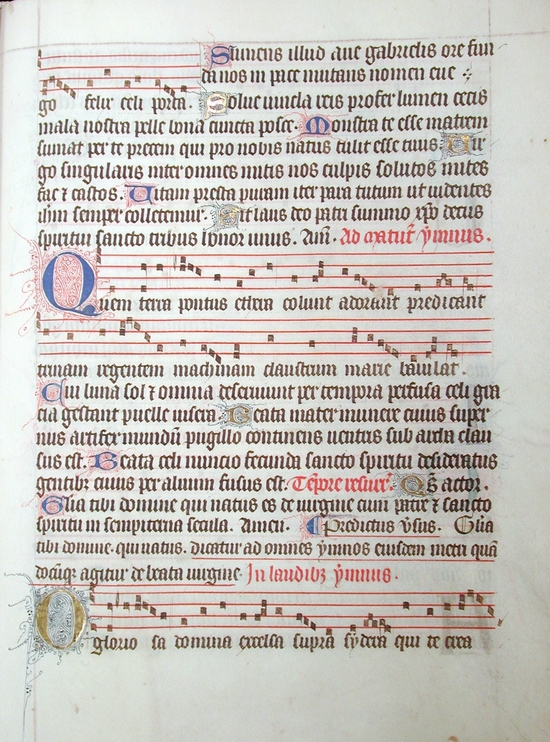
Here's a page from the Poissy Antiphonal that includes both of these hymns - but the melodies seem quite different:


And here again is Letabundus, the Christmas Sequence Hymn, sung today at Second Vespers, as it is on Candlemas also. Here's a lovely version, sung by the Gregorian Singers of the Cremona Church of Sant’Abbondio:


Here's the score, from Hymn Melodies for the whole year from the Sarum service-books:


Here's an image of the score from the same source:


Here's the entry for this feast from the wonderful website Full Homely Divinity:

The Feast of Saint Mary the Virgin - Marymas
August 15th
 O God, who hast taken to thyself the blessed Virgin Mary, mother of thy incarnate Son: Grant that we, who have been redeemed by his blood, may share with her the glory of thine eternal kingdom; through the same thy Son Jesus Christ our Lord, who liveth and reigneth with thee, in the unity of the Holy Spirit, one God, now and for ever. Amen. (Collect for the feast, 1979 BCP)
The feast days of the saints are often referred to as their "heavenly birthdays" since they ordinarily celebrate the day when the saint died and thus passed into the new life of the Kingdom of Heaven.  No one illustrates this better than the Blessed Virgin Mary. Tradition relates that, when the time of her death drew near, all of the apostles gathered in Jerusalem to be with her--all except Thomas, who was preaching the Gospel in India and was unable to return to Jerusalem in time. The apostles gathered around her in a house on Mount Zion, near the Upper Room where they had shared the Last Supper with Jesus and had also received the Holy Spirit with Mary on Pentecost. In the charming medieval carving at the left, John still appears quite youthful, standing on the near side of her bed. Peter is wearing glasses and is reading to her. When she died, the apostles carried her to a tomb in the Garden of Gethsemane, which, tradition says, belonged to Mary's family.

Some time later, the apostles discovered that Mary's tomb was empty. This was not like the Resurrection of Jesus: Mary was not raised from the dead and did not appear to the apostles after her death; nor did an angel announce the news. Rather, her tomb was simply empty and they concluded that she had been taken directly into heaven ("assumed"), in much the same way that scripture and tradition attest that the greatest saints of the Old Testament--Enoch, Moses, and Elijah--were taken up bodily. In time, Thomas returned from India and the apostles told him what had happened, together with their conviction that Mary had been assumed into heaven. According to this tradition, Thomas once again played the role of the doubter and insisted that he would have to see the evidence before he would believe. At this point, we may perhaps be forgiven for thinking that the tradition is a bit unfair to Thomas. It hardly seems possible that this apostle who had traveled far and risked much to share his faith would make the same mistake twice. Nevertheless, the tradition has him going to the tomb of Mary where, instead of her body, he found the tomb full of fragrant flowers--one version of the tradition says the flowers were roses and lilies. And then, looking up, he saw Mary herself, going up to heaven. Looking back, she saw Thomas and dropped the girdle which had tied her robe and an angel delivered it into the hands of Thomas.

It was not until 1950 that the Assumption of Mary was defined as a dogma of the Roman Catholic Church, when Pope Pius XII proclaimed that "the ever-virgin Mary, having completed the course of her earthly life, was assumed body and soul into heaven." In reality, however, this dogma was nothing new. It simply made it a matter of obligation for Roman Catholics to believe what many Christians have always believed, namely, that God had "taken to himself," for eternity, the blessed woman who had borne his incarnate Son in time. All believers look forward to "the resurrection of the body and the life of the world to come." At the Council of Chalcedon in 451, the emperor asked the patriarch of Jerusalem to bring the relics of Mary to Constantinople so that they could be enshrined at what was then the center of the world. The patriarch replied that there were no relics because, as he said, the apostles had found that her tomb was empty and her body had been assumed into heaven: she had already gone where we all hope to go.


Some Christians have difficulty with this idea because it is not in the Bible (though, as we have already noted, the Bible does tell of others who have been assumed, body and soul, into heaven). Nevertheless, Mary's role in our salvation, and her particular relationship with God is a pivotal one on our behalf. Her "yes" to the Archangel Gabriel opened the way for God to take on our humanity, to become fully one with us in the flesh. As an ancient prayer says, God humbled himself to share our humanity in order that we might share in his divinity. In the moment that Mary said "yes" to God's plan, she was already one with God in a unique way, bearing within her body God himself. A connection such as this transcends by far the intimacy of human relationships. Indeed, it reaches beyond death--and so the Church believes.

At the Council of Ephesus in 431, Mary was given the title "Theotokos"--"God-bearer" or "Mother of God." Nestorius taught that the divinity and humanity of Jesus were distinct and never mingled, so that Mary was "Christotokos," the mother of the man Jesus, but not the mother of God incarnate. The teaching of Nestorius was rejected by the Council and Mary has been known ever since as Theotokos, in token of the fact that she carried God himself in her womb, and continued ever after to share a special union with him, both in life and in death. In the West, Mary's feast on August 15th is called the Assumption. In the East it is called Koimesis--"Dormition" or "Falling Asleep." Both titles are somewhat vague about the details. Indeed, in spite of the tradition concerning Thomas's vision of her ascent into heaven, the Church is officially silent on the way in which she got there. What is clear is that, as our Collect says, God took Mary to himself, to be with him and one with him for ever. And that is what we celebrate on this day.

There are two places in Jerusalem associated with the end of Mary's earthly life. One is the basilica in the Garden of Gethsemane (above) which houses her tomb. The other is a monastery on Mount Zion on the traditional site of her falling asleep. Dormition is the name the community of German Benedictines have given to the Abbey that crowns Mount Zion. A life-sized sculpture of the Theotokos in the crypt of the Abbey church shows the influence of traditional Byzantine iconography. In the traditional Orthodox icon, Jesus himself is depicted, standing by his Mother as she falls asleep, and holding her soul, like a child, in his arm.

Taking its cue from the experience of Thomas at the tomb of Mary, the celebration of this feast includes the blessing of fragrant flowers and herbs. Flowers have always been associated with Mary in a particular way. She is the Mystical Rose and many flowers are named for her or have popular names that relate to her. Here is a link describing many of Mary's flowers. And here is another link to a slide show with more information about Mary's flowers and Mary Gardens. A Mary Garden is a place to honor the Mother of God, as well as a place to go for quiet reflection and prayer. It could also provide a setting for your Easter Garden.  Mary Gardens may be found on the grounds of monasteries and churches, and also in the gardens of private homes. They are planted with flowers, herbs, and trees that are named for Mary or associated with her and her Son in scripture and tradition. They may also have statuary, icons, and other art and symbols that provide a focus for prayer and contemplation. Ideally, a Mary Garden is enclosed to provide a place truly set-apart, but even a dish garden can serve the purpose if properly used as a means of focusing prayer.

August is the wrong time to plant any kind of garden, but Marymas would be a good day to begin planning and marking out a Mary Garden. Some plants and seeds and bulbs do best if planted in the fall, and others can be added in the spring. Here is a link that will help you choose appropriate plants for your Mary Garden. In addition to the online resources linked above, Vincenzina Krymow's book Mary's Flowers is a beautifully illustrated text about the flowers associated with Mary and their legends. It includes information about how to create your own Mary Garden. Krymow has also written a companion volume, Healing Plants of the Bible. (Click here to find both of these books in our Bookshop.)
Llandaff Cathedral in Wales has a unique variation on a Mary Garden which we like a lot: each of the niches in the reredos of the Lady Chapel has a sculpture of a flower named in Welsh in honor of Mary.

From ancient times, in every culture, herbs and various flowers have been known to have healing properties. The blessing of herbs and flowers on Marymas is a way of "baptizing" the wisdom of traditional healing and combining it with the Christian wisdom that recognizes that God is the true source of healing and that salvation (wholeness) is ultimately found only in the Son of Mary, Jesus Christ. Thus, it was customary for the faithful to bring bunches of herbs and wild flowers to church on this day. They were blessed at the beginning of the Eucharist and then taken home to be used for healing and protection through the coming year. For the renewal of this tradition, an abbreviated form of the traditional prayers are found on ourMarymas Prayers page (click on the title).

In many parishes and especially at shrines, this is a day for processions and for celebrations that continue after the liturgical observances have been completed. Traditionally, working people had a holiday from work, so that there were also family celebrations. Today, we must be more creative about marking these holidays in our homes, and it may be necessary to transfer some of the celebration to the weekend in order to keep the spirit of a fully homely divinity alive and healthy. If your parish does not have a procession on this day, or if you are unable to attend, why not have a family procession? Hymn singing does not require an organ for accompaniment, and does not need to rival the Kings College Choir in order to praise God in joyful song. (You will find an assortment of good hymns on our Sing of Mary page.) Homemade banners can be as simple as strips of cloth waved by children, or as elaborate as those with greater skills can make them. Our homes can be filled with fragrant flowers and herbs. In the northern hemisphere, this is an outdoor feast. If you do not have a Mary Garden, any garden or park will serve--even the back porch, fitted out with potted plants and cut flowers and herbs, will serve quite well.

An especially good, yet relatively simple way to celebrate this feast is to have a tea party. A festive table can be set in your version of a Mary Garden, which is already full of flowers. Perhaps a few Mary flowers could be put in a small vase on the table. For drinks, we suggest teas that are scented with herbs or made entirely with herbs, as well as a fruit and herb punch from our friends at Catholic Culture that children will enjoy. For those who like old fashioned black teas, there are teas that are flavored with roses--a natural for the feast of the Mystical Rose. Earl Grey tea is another good choice as it is infused with Bergamot, a variety of Monarda, or Bee Balm, which is also known as Sweet Mary. For food, at the tea party, we suggest nasturtium sandwiches and strawberry shortcake. It is a little late in the season for local strawberries but, with modern refrigeration and transportation, it seems that almost any fresh fruit or vegetable can be obtained year-round. The strawberry was known as the "Fruitful Virgin" because it blooms and bears fruit at the same time. Another lovely European tradition says that the strawberry is sacred to Mary who accompanies children to keep them safe when they go strawberry picking on St. John's Day. The nasturtium is known as "St. Joseph's Flower." It is an edible flower and can be combined with cream cheese to make tea sandwiches. Tea should be accompanied by prayers appropriate to the occasion, such as the Collect of the Day which begins this article. Children should be told the story of Mary's heavenly birthday--how else will they learn it? Tomie de Paola's beautifully illustrated book Mary: The Mother of Jesus (available in our Bookshop) tells the story reverently and well. Finally, everyone will enjoy a walk in the garden which could easily be made into a game, with an award, such as a Mary-blue ribbon, for the person who identifies the most flowers and herbs that are named for Mary.
 
For more information about Mary on FHD, click on the links below and also visit our pages on Marymas Prayers and Sing to Mary.


Feasts of Mary
Here is a list of some of the Feast Days which celebrate Mary and her role in our salvation:
December 8th - The Conception of the Blessed Virgin Mary

December 12th - Our Lady of Guadalupe
December 18th - Santa Maria de la O
December 25th - The Nativity of Our Lord Jesus Christ

February 2nd - The Presentation of Our Lord Jesus Christ in the Temple,
also known as the Purification of the Blessed Virgin Mary, and Candlemas

March 19th - Saint Joseph (Spouse of the Blessed Virgin Mary)

March 25th - The Annunciation of Our Lord Jesus Christ to the Blessed Virgin Mary

May 31st - The Visitation of the Blessed Virgin Mary

July 26th - The Parents of the Blessed Virgin Mary, Joachim and Anne

August 15th - Saint Mary the Virgin
(The Assumption, or The Dormition of the Mother of God)

September 8th - The Nativity of the Blessed Virgin Mary
(Our Lady of Glastonbury)
September 24th - Our Lady of Walsingham
October 1st - The Protecting Veil of the Mother of God
November 1st - All Saints' Day (formerly Saint Mary and All Martyrs)

And here's a peek-through to the SSM Breviary; rather than clicking the link above, you can just scroll through the day's offices here, if you'd rather:


LinkWithin

Related Posts Plugin for WordPress, Blogger...