Showing posts with label sarum. Show all posts

Wednesday, August 07, 2013

On the Feast of the Most Sweet Name of Jesus (Aug 7)

Still filling in my Sarum Office hymn listings!  So here are the hymns for this feast day, from Hymn Melodies for the Whole Year from the Sarum service-books:
On the Feast of the most sweet Name of Jesus ( Aug 7) & during the Octave (when the Service is of the Feast ):
EvensongExultet cor precordiis ... ... ... 25 or 41
Mattins: Jesu, dulcis memoria ... ... ... 26
Lauds: Jesu, Auctor clemencie ... ... ... 27 or 39

This feast day, needless to say, isn't on the Calendar anymore.   According to New Advent, it's the same Feast that's now celebrated in most traditions on January 1 - the Feast of the Holy Name - but as you can see (in the citation below) it has been observed at other times in various traditions.

You can get the full office for this day - Psalms, collect, Chapter, antiphons, etc., although no music is provided - at Breviary Offices, from Lauds to Compline Inclusive (Society of St. Margaret, Boston).    (See also the iFrame peek-in at the bottom of this page.Clearly, as late as 1885 - the publish date of that book - at least some Anglican religious orders were still celebrating this August feast.  Here's a link to the SSM website

Here are all five chant scores listed; interestingly, #s 25, 26, and 27 are the same melodies used for the Christmas Office (although some are used at other times as well); melody #41 is used twice at Transfiguration and twice on Ascension Day, as well as for Common of Saints days; and #39 is used during Paschaltide in a variety of ways. 
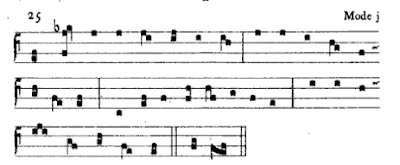


Sing Exultet cor precordiis to melody #25 or #41.    Here's LLPB's recording of melody #25, as used for the familiar Christmas First Vespers hymn Veni, Redemptor Gentium.   On this feast day, you can sing Exultet cor precordiis to this tune, using the following set of English words for this hymn; they come from Breviary Offices, from Lauds to Compline Inclusive (Society of St. Margaret, Boston)
Exultet cor precordiis

O LET the heart exulting beat,
"When Jesus' holy Name resounds;
Above all other it is sweet,
And in all gladness it abounds.

Jesus, Who comforteth in woe,
Jesus, Who heals the wounds of sin,
Jesus, Who curbs the fiends below,
Jesus, Who routs Death's arms within.

Jesus! it soundeth sweetest, best,
In every measure, hymn, and song;
And with its comfort soothes the breast,
And lifts us up, and makes us strong.

Let that great Name of Him the Lord,
Jesus, from tongues of all men peal;
And let the voice and heart accord,
That every ill its sound may heal.

Jesus, Who savest sinners lost,
Be present as we kneel in prayer;
Guide Thou the erring, tempest-tost,
And us, Thy guilty servants, spare.

O let Thy Name be our defence,
In every peril guard and stay,
And purging us from sin's offence.
Perfect us in the better way.

O Christ, all glory be to Thee,
Who shinest with this Name above,
Honour, and worship, majesty,
Be Thine, O Jesu, Lord of love.

O Jesu, from the "Virgin sprung,
All glory be ascribed to Thee,
Like praise be to the Father sung,
And Holy Ghost eternally. Amen. 

Or, use hymn tune #41 as an alternative; here's an an mp3 of that tune from LLPB (with the words for "a Hymn for Morning Prayer of the Feast of the Ascension of our Lord")

LLPB also provides a recording of Hymn tune #26;  the cantor is singing the Christmas Evensong hymn "Jesus, the Father's Only Son."    Here are the Latin words - along with Edward Caswall's 19th Century English translation - for Jesu, dulcis memoria, the Matins hymn for the Feast of the Most Sweet Name of Jesus:
Jesu, dulcis memoria

Jesu, dulcis memoria,
dans vera cordis gaudia:
sed super mel et omnia
ejus dulcis praesentia.

Nil canitur suavius,
nil auditur jucundius,
nil cogitatur dulcius,
quam Jesus Dei Filius.

Jesu, spes paenitentibus,
quam pius es petentibus!
quam bonus te quaerentibus!
sed quid invenientibus?

Nec lingua valet dicere,
nec littera exprimere:
expertus potest credere,
quid sit Jesum diligere.

Sis, Jesu, nostrum gaudium,
qui es futurum praemium:
sit nostra in te gloria,
per cuncta semper saecula.
Amen.


Jesus, the very thought of Thee
With sweetness fills the breast;
But sweeter far Thy face to see,
And in Thy presence rest.

Nor voice can sing, nor heart can frame,
Nor can the memory find
A sweeter sound than Thy blest Name,
O Savior of mankind!

O hope of every contrite heart,
O joy of all the meek,
To those who fall, how kind Thou art!
How good to those who seek!

But what to those who find? Ah, this
Nor tongue nor pen can show;
The love of Jesus, what it is,
None but His loved ones know.

Jesus, our only joy be Thou,
As Thou our prize will be;
Jesus be Thou our glory now,
And through eternity.


(More English verses:

O Jesus, King most wonderful
Thou Conqueror renowned,
Thou sweetness most ineffable
In Whom all joys are found!

When once Thou visitest the heart,
Then truth begins to shine,
Then earthly vanities depart,
Then kindles love divine.

O Jesus, light of all below,
Thou fount of living fire,
Surpassing all the joys we know,
And all we can desire.

Jesus, may all confess Thy Name,
Thy wondrous love adore,
And, seeking Thee, themselves inflame
To seek Thee more and more.

Thee, Jesus, may our voices bless,
Thee may we love alone,
And ever in our lives express
The image of Thine own.

O Jesus, Thou the beauty art
Of angel worlds above;
Thy Name is music to the heart,
Inflaming it with love.

Celestial Sweetness unalloyed,
Who eat Thee hunger still;
Who drink of Thee still feel a void
Which only Thou canst fill.

O most sweet Jesus, hear the sighs
Which unto Thee we send;
To Thee our inmost spirit cries;
To Thee our prayers ascend.

Abide with us, and let Thy light
Shine, Lord, on every heart;
Dispel the darkness of our night;
And joy to all impart.

Jesus, our love and joy to Thee,
The virgin’s holy Son,
All might and praise and glory be,
While endless ages run.)


Here's TPL on the famous Jesu, dulcis memoria:
Iesu, Dulcis Memoria is a celebrated 12th century hymn attributed to St. Bernard of Clairvaux (1090-1153), Doctor Mellifluus. The entire hymn has some 42 to 53 stanzas depending upon the manuscript. Parts of this hymn were used for the Feast of the Holy Name of Jesus, which was formerly celebrated on the Sunday between the Circumcision and Epiphany, or failing such a Sunday, on January 2. The part below was used at Vespers. In the liturgical revisions of Vatican II, the feast was deleted, though a votive Mass to the Holy Name of Jesus had been retained for devotional use. With the release of the revised Roman Missal in March 2002, the feast was restored as an optional memorial on January 3. Similarly the Feast of the Holy Name of Mary was restored as an optional memorial on September 12 in the revised Missal.


The hymn is more often sung to this better-known (and very beautiful) tune:


LLPB has a recording of melody #27here's a recording of it sung as "From East to West, from shore to shore" (A solis ortus cardine), the Lauds and 2nd Vespers hymn for Christmas Day.   You can sing Jesu, Auctor clemencie to this tune today; here's a translation, again from the SSM Breviary:
Jesu, auctor clemencie

Jesu, the Beauty Angels see,
The ears' ecstatic minstrelsy.
The nectar of the Heavenly Home,
The lips' delicious honey comb.

Flower of Virgin Mother blest,
Jesu, true sweetness, purest, best,
Of man the honour and the head.
Thy light of lights upon us shed.

More glorious than the sun to see,
More fragrant than the balsam-tree,
My heart's desire, and boast, and mirth.
Jesu, Salvation of the earth.

Jesu, Who highest bounty art,
And wondrous joyaunce of the heart,
Of goodness the infinity,
Constrain us with Thy charity.

0 King of Virtues. King renowned,
With glory and with victory crowned,
Jesu, by Whom all grace Is given,
Thou honour of the courts of heaven t

Let choirs of Angels singThy Name,
And echo all Thy matchless fame,
Jesus on joyful earth hath smiled,
And us with God hath reconciled.

All honour, laud, and glory be,
0 Jesu, Virgin-born to Thee;
All glory, as is ever meet,
To Father and to Paraclete. Amen. 

Here's an mp3 of an example of alternate melody #39it's the Easter Mattins hymn, Aurora Lucis Rutilat ("The Day Draws on with Golden Light").

It's interesting to me that the Sarum breviary apparently wanted to recall Christmas on this August 7 Feast Day (although it did provide those alternate hymn melodies as well).
Here's the New Advent citation I mentioned above (keep in mind this is from the 1913 Catholic Encyclopedia):
This feast is celebrated on the second Sunday after Epiphany (double of the second class). It is the central feast of all the mysteries of Christ the Redeemer; it unites all the other feasts of the Lord, as a burning glass focuses the rays of the sun in one point, to show what Jesus is to us, what He has done, is doing, and will do for mankind. It originated towards the end of the fifteenth century, and was instituted by the private authority of some bishops in Germany, Scotland, England, Spain, and Belgium. The Office and the Mass composed by Bernardine dei Busti (d. 1500) were approved by Sixtus IV. The feast was officially granted to the Franciscans 25 February, 1530, and spread over a great part of the Church. The Franciscans, Carmelites, and Augustinians kept it on 14 Jan.; the Dominicans 15 Jan. At Salisbury, York, and Durham in England, and at Aberdeen in Scotland it was celebrated 7 Aug., at Liège, 31 Jan., at Compostela and Cambrai, 8 Jan. (Grotefend, "Zeitrechnung", II, 2. 89). The Carthusians obtained it for the second Sunday after Epiphany about 1643; for that Sunday it was also extended to Spain, and later, 20 Dec., 1721, to the Universal Church. The Office used at present is nearly identical with the Office of Bernardine dei Busti. The hymns "Jesu dulcis memoria", "Jesu Rex admirabilis", "Jesu decus angelicum", usually ascribed to St. Bernard, are fragments of a very extensive "jubilus" or "cursus de aeterna sapientia" of some unknown author in the thirteenth century. For the beautiful sequence "Dulcis Jesus Nazarenus" (Morel, "Hymnen des Mittelalters", 67) of Bernardine dei Busti the Franciscans substituted a prose sequence of modern origin: "Lauda Sion Salvatoris"; they still celebrate the feast on 14 January.

In the current Catholic Breviary, the feast is observed (optionally) on January 3, and the hymns - quite obviously deliberately! - all contain the name "Jesus" in the title. They are, per TPL:
This is another set of feast-day hymns formed from a single longer hymn/poem - the one by Bernard of Clairvaux.  More about those hymns at the links.

Here's that iframe look-in to the SSM's Breviary page for this feast:


Tuesday, April 09, 2013

Sarum Compline from Low Sunday to the Vigil of the Ascension

 Sarum-chant.ca has posted English Compline for several seasons:
We are pleased to host on this site beautifully prepared editions of the Sarum Office of Compline in contemporary English.  Thanks go to Emil Salim for assembling these booklets, which cover the following seasons:
   Compline 1: Advent.
   Compline 5: The Octave of Epiphany.
   Compline 6: Ordinary Time.
   Compline 7: The Third Sunday of Lent.
   Compline 9: Ferias in Passion Week.
   Compline 14: From Low Sunday to the Vigil of the Ascension.
Here's a PDF file of "Compline from Low Sunday to the Vigil of the Ascension."   (Linked from the "Annex" page.)  The painting on the cover is Mazzolino's "The Incredulity of St. Thomas," from around 1522.


Monday, November 19, 2012

The Sarum Psalm Tones in Square Notes

I captured these images from "The Canticles at Evensong, Together with the Office Responses and a Table of Psalm-Tones", by Canon Winfred Douglas.  There are some differences between the Sarum tones and the Psalm tones from the Liber Usualis - but I'm not sure what they are yet, exactly.

I wanted to have them posted here, though, and then I can go through them and look.  So, here are those images:


On a related note:  I recently picked up a copy of "The Monastic Diurnal Revised" - the book used currently by the Community of St. Mary, and the original of which Canon Douglas put together for the Community.

Saturday, August 25, 2012

The Sarum Office Hymns "From the Octave of Corpus Christi until Advent"

I have never posted the Sarum hymns for this long period in Ordinary Time!

So I'll do it now; again the listing is from Hymn Melodies for the Whole Year from the Sarum Service Books.
From the Octave of Corpus Christi until Advent :

Mattins:   Nocte surgentes    (Sundays ... ... ... 16;  Ferias ... ... ... 18)
Lauds:  Ecce iam noctis  (Sundays ... ... ... 16;  Ferias ... ... ... 18)
Evensong:  Daily except Sats. - Lucis Creator optime ... 19
                 On Saturdays - O Lux beata, Trinitas ... 22

Tunes 16, 18, and 22 are not used, according to Hymn Melodies, at any other time during the year - but  Lucis Creator optime, sung to tune 19, is also the Sunday Evensong hymn  "From the Оctave of the Epiphany until the 1st Sunday in Lent," the other part of "Ordinary Time" during the year.

As you can see, the formula is to sing two different hymns to the same hymn tunes at Lauds and Mattins depending on whether it's a Sunday or a Feria; here are chant scores 16 and 18:


The LLPB offers this mp3 file as an example of melody #16 above; it's listed on their "Weekday Propers Sung" page as the hymn for Sunday Morning Prayer, and is called "Father We Praise Thee."  The hymns Ecce iam noctis (for Lauds) and Nocte surgentes (for Mattins) seem to be closely related thematically, and the LLPB English version could possibly, I'd say, stand in for either one!  But melody #16 is used at Sundays Lauds during this period, so I'd suggest singing it as Ecce iam noctis.  Or, you could use the English words from TPL below, if you'd prefer.

Here are the English words on the mp3, from Oremus; to reinforce my point above, they write that it's "(Noc­te sur­gen­es vi­gil­e­mus om­nes); trans­lat­ed from La­tin to Eng­lish by in The Eng­lish Hymn­al (Lon­don: Ox­ford Un­i­ver­si­ty Press, 1906), num­ber 165."
Father, we praise Thee, now the night is over;
Active and watchful, stand we all before Thee;
Singing, we offer, prayer and meditation;
Thus we adore Thee.

Monarch of all things, fit us for Thy mansions;
Banish our weakness, health and wholeness sending;
Bring us to Heaven, where Thy saints united
Joy without ending.

All holy Father, Son and equal Spirit,
Trinity blessèd, send us Thy salvation;
Thine is the glory, gleaming and resounding
Through all creation.


Here are the words to Ecce iam noctis in Latin and one English translation (not the same as the words on the recording); as you can see, it's the 11-11-11-5 meter, the Sapphic and Adonic one.
ECCE iam noctis tenuatur umbra
lucis aurora rutilans coruscat;
nisibus totis rogitemus omnes cunctipotentem,1
LO! the dim shadows of the night are waning;
radiantly glowing, dawn of day returneth;
fervent in spirit, to the mighty Father
pray we devoutly.
Ut Deus, nostri miseratus, omnem
pellat angorem, tribuat salutem,
donet et nobis pietate patris regna polorum.2
So shall our Maker, of His great compassion,
banish all sickness, kindly health bestowing;
and may He grant us, of a Father's goodness,
mansions in heaven.
Praestet hoc nobis Deitas beata
Patris ac Nati, pariterque Sancti
Spiritus, cuius resonat per omnem gloria mundum. Amen.
This He vouchsafe us, God for ever blessed,
Father eternal, Son, and Holy Spirit,
Whose is the glory which through all creation
ever resoundeth. Amen.

Latin from the Liturgia Horarum. Tr. by Rev. Maxwell Julius Blacker (1822-1888).

Changes made by Pope Urban VIII in 1632 to the Roman Breviary:
1 ... / lux et aurorae rutilans coruscat:/ supplices rerum Dominum canora voce precemur.
2 Ut reos culpae miseratus omnem/ pellat angorem, tribuat salutem,/ donet et nobis sempiternae munera pacis.

Here's an mp3 of Ecce iam noctis from Liber Hymnarius; the tune used is just about the same as the Sarum chant tune #18 above, except for a few notes in the 3rd and 4th stanzas - so, you can sing this melody, using the English words for Father, We Praise Thee above, at Lauds on feria days other than Sunday.

TPL has this, about Ecce iam noctis:
Attributed to Pope St. Gregory the Great (540-604), but some think it may be a later composition by Alcuin (732-804). In the current Liturgia Horarum it is used for Laudes for the Sundays of the second and fourth weeks of the Psalter during Ordinary Time. In the Roman Breviary it is used for Lauds on the fourth and subsequent Sundays after Pentecost until September 27 inclusive.

Here's something from TPL about Nocte Surgentes, the Mattins hymn, including the words in Latin and English; again, you can see that it's in the Sapphic and Adonic, 11-11-11-5, meter.  Sing it to tune #16 as above on Sundays, or to tune #18 on ferias other than Sunday.  The English words below are metrical, and do fit the melody.
This hymn is usually attributed to Pope St. Gregory the Great (540-604), though some ascribe the hymn to Alcuin. In the Roman Breviary this hymn is used at Sunday Matins on the fourth and subsequent Sundays after Pentecost through September 27. In the Liturgia Horarum it is used for the Office of the Readings on Tuesdays during the second and fourth weeks of the Psalter during Ordinary Time.
NOCTE surgentes vigilemus omnes,
semper in psalmis meditemur atque
viribus totis Domino canamus
dulciter hymnos,
NOW from the slumbers of the night arising,
chant we the holy psalmody of David,
hymns to our Master, with a voice concordant,
sweetly intoning.
Ut, pio regi pariter canentes,
cum suis sanctis mereamur aulam
ingredi caeli, simul et beatam
ducere vitam.
So may out Monarch pitifully hear us,
that we may merit with His Saints to enter
mansions eternal, there withal possessing
joy beatific.
Praestet hoc nobis Deitas beata
Patris ac Nati, pariterque Sancti
Spiritus, cuius resonat per omnem
gloria mundum. Amen.
This be our portion, God forever blessed,
Father eternal, Son, and Holy Spirit,
Whose i s the glory, which through all creation
ever resoundeth. Amen.


Here's an mp3 of Nocte Surgentes, from Liber Hymnarius (see my post here about this new site); and here's their page about the hymn.  This is not the same tune as either #16 or #18 above, though.


And here are the two different Vespers melodies, #19 and 22:


Here again is the mp3 from the LLPB of Lucis Creator optime, sung to tune #19;  it's listed on the LLPB "Weekday Propers Sung" page as the hymn for Sunday Vespers (listed above as "daily except Saturday").  The cantor is using the English translation by J. M. Neale (below). 
TPL says this about the hymn, and includes the words below in Latin and English:
Attributed to Pope St. Gregory the Great (540-604), this hymn is used in the Roman Breviary at Vespers for Sundays after Epiphany and Sundays after Pentecost. In the Liturgia Horarum it is used for Sunday evening Vespers for Ordinary time for the first and third weeks of the Psalter.
LUCIS Creator optime
lucem dierum proferens,
primordiis lucis novae,
mundi parans originem:
O BLEST Creator of the light,
Who mak'st the day with radiance bright,
and o'er the forming world didst call
the light from chaos first of all;
Qui mane iunctum vesperi
diem vocari praecipis:
tetrum chaos illabitur,1
audi preces cum fletibus.
Whose wisdom joined in meet array
the morn and eve, and named them Day:
night comes with all its darkling fears;
regard Thy people's prayers and tears.
Ne mens gravata crimine,
vitae sit exsul munere,
dum nil perenne cogitat,
seseque culpis illigat.
Lest, sunk in sin, and whelmed with strife,
they lose the gift of endless life;
while thinking but the thoughts of time,
they weave new chains of woe and crime.
Caeleste pulset ostium:2
vitale tollat praemium:
vitemus omne noxium:
purgemus omne pessimum.
But grant them grace that they may strain
the heavenly gate and prize to gain:
each harmful lure aside to cast,
and purge away each error past.
Praesta, Pater piissime,
Patrique compar Unice,
cum Spiritu Paraclito
regnans per omne saeculum. Amen.
O Father, that we ask be done,
through Jesus Christ, Thine only Son;
Who, with the Holy Ghost and Thee,
doth live and reign eternally. Amen.

From the Roman Breviary, translation by J. M. Neale (1818-1866).

Changes made by Pope Urban VIII in 1632 to the Roman Breviary:
1 illabitur tetrum chaos,
2 The Liturgia Horarum has: Caelorum pulset intimum.


Here is LLPB 's  mp3 (in English) of O Lux Beata Trinitas ("O Trinity of Blessed Light") sung to melody #22; it's quite beautiful, and uses the J.M. Neale translation below (with a different doxology).

This is a well-known tune any case, for a well-known hym.  TPL offers this about it:
This hymn is ascribed to St. Ambrose (340-397) and is used for Sunday Vespers for the second and fourth weeks of the Psalter in the Liturgy of the Hours. The hymn appears in the Roman Breviary under the title of Iam sol recedit igneus, where it is the Vespers hymn for the ferial office on Saturdays and Trinity Sunday.
O LUX beata Trinitas,
et principalis Unitas,
iam sol recedit igneus,
infunde lumen cordibus.
O TRINITY of blessed Light,
O Unity of sovereign might,
as now the fiery sun departs,
shed Thou Thy beams within our hearts.
Te mane laudum carmine,
te deprecemur vespere:
te nostra supplex gloria
per cuncta laudet saecula.
To Thee our morning song of praise,
to Thee our evening prayer we raise;
Thee may our glory evermore
in lowly reverence adore.
Deo Patri sit gloria,
eiusque soli Filio,
cum Spiritu Paraclito,
et nunc, et in perpetuum.
All laud to God the Father be;
all praise, Eternal Son, to Thee;
all glory, as is ever meet,
to God the Holy Paraclete.

From the Liturgia Horarum. Translation by J. M. Neale (1818-1866).

This is an mp3 of O Lux beata, Trinitas from Liber Hymnarius; again, the tune used is very similar to the Sarum chant tune, #22, above, with some differences in various flourishes. 

Interesting to me that this hymn is sung on Saturdays at Vespers!  Of course, Saturday Vespers is First Vespers of Sunday, so it does make sense.

So, there you have the hymnody for the Hours in the Sarum Use,  for this long stretch between June and November!   I didn't realize I hadn't posted this before - and there are still some missing items in my references.  I'm missing the hymnody for the Little Hours, for instance - and never did get back to that massive 21-count section of hymns for the period between Epiphany and Lent. I'll get there, eventually, though.

I'm excited about the Liber Hymnarius website!   It looks like it aims to be a complete hymn-tune reference for the Hours, which would be fantastic to have at one site.

Monday, August 01, 2011

"The Canticles at Evensong, Together with the Office Responses and a Table of Psalm-Tones"

A nice find at Google Books tonight: "THE CANTICLES AT EVENSONG, TOGETHER WITH THE OFFICE RESPONSES AND A TABLE OF PSALM-TONES: EDITED BY THE REVEREND CHARLES WINFRED DOUGLAS BACHELOR OF MUSIC CANON OF FOND DU LAC." - (The Saint Dunstan Edition)

Here's the link to the book itself, which was published in 1915 (and cost 50 cents).

Below is an iFrame that contains the first page of the Psalm Tone chart; you can scroll through it from this post.


From the Intro:
The following Table of Psalm-tones has been compiled with the purpose of providing greater melodic wealth than is afforded by the Sarum Tonale, while retaining the greater part of the latter in its accustomed order as a basis. To this end, traditional Continental mediations have been added in the forms presented by the Vatican Antiphoner; together with supplementary endings, among which all save the third ending of the fourth Tone are of ancient use, either in England or on the Continent. This exception is a slight modification (made by the Benedictines of Solesmes) of an ancient ending. The additional mediations are distinguished in the Table by the letters B and C; and the solemn mediations for Magnificat by the letter S. Wherever more than a single mediation is given for a Tone, the Sarum form is marked by the letter A. As the numbering of the Sarum endings adopted in recent English Psalters has become widely familiar, it is retained: the additional endings either being substituted for certain of the Sarum set that are practically never used; or else assigned further numbers after the complete enumeration of the Sarum group.

There are more notes at the link. Winfred Douglas is well-known in the Anglican world for his efforts at renewing the chant tradition; here's a bit about him at Cyberhymnal.
While at Syr­a­cuse Un­i­ver­si­ty, Doug­las sang at St. Paul’s Epis­co­pal Ca­thed­ral. He earned his Ba­che­lor of Mu­sic de­gree from Sy­ra­cuse in 1891, then took Ho­ly Or­ders. He moved to Ev­er­green, Col­o­ra­do, for health rea­sons, and be­came an Epis­co­pal priest in 1899. He ed­it­ed the Epis­co­pal New Hymn­al in 1918, and helped de­vel­op the 1940 Epis­co­pal hymn­al as well.

The monastic orders began to revive in England only during the mid-19th Century, fully 300 years after the dissolution of the monasteries by Henry VIII. Winfed Douglas was instrumental in renewing the chant tradition. Here's something about him from the website of the Community of St. Mary East, an Episcopal monastic order from New York:
When the Rev. Canon C. Winfred Douglas became the choirmaster for the Community in 1906, he introduced a new edition of A Manual of Plain Song(4) to the choir, and later his own St. Dunstan Psalter(5). Prior to assuming his new position, he spent time in England, France, and Germany studying early church music. What he always valued most was the course in plainsong given by the Benedictine monks, who, exiled from their home monastery at Solesmes, had taken up residence at Quarr Abbey in the Isle of Wight. In an article for The Catholic Choirmaster published in March 1926, Canon Douglas explained his reasoning for welcoming the opportunity to be choirmaster for the Community of St. Mary.
"Parish Churches are too subject to changing policies with changing rectors for much hope of permanent stability in a musical tradition. It seemed to the writer that seminaries and schools, with their comparatively fixed policies, and above all, religious orders, offered the best field for constructive work... St. Mary's Convent and the group of institutions clustered around it seemed an admirable field for the establishment of a Plainsong tradition."(6)

The transition from modern notation, measured rhythm and polyphonic settings tothe Solesmes method of unison, equi-measured square notation chant presented quite an adjustment for the Sisters. Canon Douglas' patience and skill had them singing

Compline in ten days and the other simple offices over the next weeks. The school girls also learned the chant with the Sisters. Over the years many alumnae returned to Peekskill to sing at major liturgical feasts in St. Mary's Chapel.

The Night Office was first recited in May 1874 from the Neale edition of the Sarum Office(7). On March 12, 1916, a shortened form of the Benedictine Night Hours was introduced(8), and a revision of this came into use Pentecost, June 13, 1943. At Tenebrae and on great feasts such as Christmas, Purification, and Easter, the Night Office was sung in full, adapted from monastic melodies in use in the Latin with local variances since at least the tenth century.

Friday, April 15, 2011

Trinity Wall Street - Webcasts - Videos - Music & Arts - The Trinity Choir - Music from the Sarum Rite 02.03.11

Trinity Wall Street - Webcasts - Videos - Music & Arts - The Trinity Choir - Music from the Sarum Rite 02.03.11

Just found this on the Trinity website! It's one of two videos from a concert performed in February of this year.


Here's the blurb on this concert:
The Trinity Choir, along with Guest Conductor George Steel, General Manager and Artistic Director of New York City Opera, perform Music from the Sarum Rite. These gorgeous compositions – taken from the elaborate and theatrical liturgy of pre-Reformation England – feature soaring soprano lines and rich choral textures by masters such as Robert Wylkinson, William Byrd, Thomas Tallis, and John Sheppard. Although rarely performed today, the Sarum Rite includes some of the most exquisite music of any age. Purchase tickets online here. Tickets can also be purchased at the Trinity Gift Shop, inside Trinity Church. Watch a video of George Steel on the "music that speaks to us with an emotional clarity you wouldn't expect from...such a far away time.


Here's a PDF of the program. And below is the video of the George Steel discussion.

Tuesday, January 25, 2011

Sarum: The Reconciliation of Penitents

Here's a video of a lovely rite, via Derek. I know very little about it at the moment - and still find it extremely affecting. There is a bit of brief explanation in the first few seconds, and then the rite begins.


"Venite, venite, venite, filii; audite me : timorem Domini docebo vos." ("Come, children, hearken to me: I will teach you the fear of the Lord.") The movement and the words are beautiful, I think - as is the chant. Derek also points to a PDF about it; I'll post again as I learn more.

Monday, November 29, 2010

The Advent Sequence: Salus Aeterna

Salus Aeterna is an 11th-Century sequence hymn for Advent, found in the Sarum Gradual.  The video below comes from St. Michael and All Angels Anglican Church in Winnipeg; there is nothing more on the YouTube page than that, but this duo sings the entire sequence, in English.


Here's the score from Hymn Melodies for the Whole Year, from the Sarum Service Books:


Here are the words in Latin from Prosper Gueringer's The Liturgical Year: Advent, and in English from Hymn Melodies:

Salus aeterna, indeficiens mundi vita.
Lux sempiterna, et redemptio vera nostra.
Condolens humana perire saecla per tentantis numina.
Non linquens excelsa, adisti ima propria dementia.
Mox tua spontanea gratia assumens humana,
Quae fuerant perdita omnia, salvasti terrea.
Ferens mundo gaudia.
Tu animas et corpora nostra, Christe, expia,
Ut possideas lucida nosmet liabitacula.
Adventu primo justifica.
In secundo nosque libera;
Ut cum facta luce magna, judicabis omnia,
Compti stola incorrupta, nosmet tua subsequamur mox vestigia quocumque visa. Amen,


Saviour eternal, health and life of the world unfailing,
light everlasting, and in verity our redeemer.
Grieving that the ages of men
must perish through the tempter’s subtlety,
still in heaven abiding,
thou camest earthward of thine own great clemency.
Then freely and graciously deigning to assume humanity,
to lost ones and perishing gavest thou thy free
deliverance, filling all the world with joy.
O Christ, our souls and bodies cleanse
by thy perfect sacrifice, that we as temples
pure and bright fit for thine abode may be.
By thy former advent justify,
by thy second grant us liberty,
that when in the might of glory thou descendest,
judge of all,
we in raiment undefiled bright may shine,
thy footsteps blest,
where’er they lead us.


And here is Gabriel Jackson's (b. 1962) gorgeous polyphonic 20th Century setting, masterfully sung (in Latin) by the BYU Singers:


At one time there was a video on YouTube of a Benjamin Britten composition based on the Gregorian melody, too. It's straightforwardly the Gregorian tune until about 2:04 on the video, at which point a baritone solo begins - and then abruptly ends! The piece uses about half the original Gregorian tune , and was - perhaps?- written as a processional; I had found nothing about it at the time this post was originally written - but see more in the comments below.

Monday, July 19, 2010

Music of the Sarum Office: Downloads

This is the project of The Gregorian Institute of Canada at McMaster University in Canada that I've posted about (somewhere) before - but the site was almost empty in those days. Not anymore; there are dozens of PDF files there now free for the downloading.

Many of these pages seem to be scans. There's a 1531 date on the Kalendar; a note in the Introduction says that:
MUSIC OF THE SARUM OFFICE takes as its basis the text of the Breviarium ad usum Sarum of 1531. Reference is made to the edition of 1879-1886 for clarification and for explanatory notes. The publication of this work commences with the Psalter, the chants of the office for each day of the week followed by the Common of the Saints. This is followed by the Temporale, the chants for the Kalendar of the year and the Sanctorale, or Proper of the Saints. Folio numbers of the original edition appear in the margin. To this text is added the music found in the Antiphonale Sarisburiense (1901-1924), the sources of which stem from the early 13th century. Musical items not available here are made good from other sources such as the Processionale (1502),the Antiphonale (1519-1520) and the Hymnale (1525). The resulting work presented here is thus a Noted Breviary that represents the Use of Sarum in the late 15th and early 16th centuries.

Another note:
At present the rubrics appear only in the original latin. Readers may feel the need for English translations of the rubrics. Readers are encouraged to contact the editor regarding errors or omissions, as well as for clarification of matters of style and performance. The web-based publication of this document is intended to facilitate ongoing attention to these issues.

Hmmmm. Being part of the translation into English would be fun, wouldn't it?

Well, there it is - the beginning, anyway.

Thursday, July 23, 2009

Verbum Supernum Prodiens

There are in existence two different versions of this hymn. About the original Verbum supernum prodiens (Celestial Word, to This Our Earth), TPL has this:
Verbum supernum prodiens dates to somewhere around the 6th or 7th century and can be found in monastic breviaries of the 10th century. The hymn is used for the Office of the Readings as an Advent Hymn.

LLPB calls this Verbum supernum prodiens High Word of God (mp3); this is the Sarum Advent Mattins hymn melody.  Here's the chant score, and below that the Latin words, along with the English translation (Oremus says it's by Charles Bigg, 1906) used on the audio file:


VERBUM supernum prodiens
a Patre lumen exiens,
qui natus orbi subvenis
cursu declivi temporis:

Illumina nunc pectora
tuoque amore concrema;
audita per praeconia
sint pulsa tandem lubrica.

Iudexque cum post aderis
rimari facta pectoris,
reddens vicem pro abditis
iustisque regnum pro bonis,

Non demum artemur malis
pro qualitate criminis,
sed cum beatis compotes
simus perennes caelites.

Sit, Christe, rex piissime,
tibi Patrique gloria
cum Sancto Spiritu Paraclito,
in sempiterna saecula. Amen.


High Word of God, who once didst come,
Leaving Thy Father and Thy home,
To succor by Thy birth our kind,
When, towards Thy advent, time declined,

Pour light upon us from above,
And fire our hearts with Thy strong love,
That, as we hear Thy Gospel read,
All fond desires may flee in dread;

That when Thou comest from the skies,
Great Judge, to open Thine assize,
To give each hidden sin its smart,
And crown as kings the pure in heart,

We be not set at Thy left hand,
Where sentence due would bid us stand,
But with the saints Thy face may see,
Forever wholly loving Thee.

Praise to the Father and the Son,
Through all the ages as they run;
And to the holy Paraclete
Be praise with Them and worship meet. Amen.


Giovanni Viannini sings this to another melody, though:


TPL also has a listing for the later Thomas Aquinas version of Verbum supernum prodiens, about which it says:
Verbum Supernum was written by St. Thomas Aquinas (1225-1274) in honor of Jesus in the Blessed Sacrament at the specific request of Pope Urban IV (1261-1264) when the Pope established the Feast of Corpus Christi in 1264. It is used as a hymn at Lauds on Corpus Christi. The last two stanzas are used for the hymn O Salutaris Hostia (O Saving Victim).

In the Sarum rite, too, this Verbum Supernum Prodiens is used at Lauds on Corpus Christi.   Here's the Sarum melody, as prescribed in Hymn melodies for the whole year, from the Sarum service-books:


Here is an mp3 file of this hymn melody (courtesy of the Lutheran Liturgical Prayer Brotherhood) as used for the Ascension hymn "O Eternal Monarch" (in Latin, Eterne Rex altissime).  Simply use this melody, substituting in the words to Verbum Supernum Prodiens, below.

Again, these are the words of Aquinas' version of the hymn. As you can see, again the last two verses make up the text for one of the very famous hymns sung about the Holy Eucharist; this time it's O Salutaris Hostia ("O Saving Victim"):   
Verbum supernum prodiens,
Nec Patris linquens dexteram,
Ad opus suum exiens,
Venit ad vitæ vesperam.

In mortem a discipulo
Suis tradendus æmulis,
Prius in vitæ ferculo
Se tradidit discipulis.

Quibus sub bina specie
Carnem dedit et sanguinem;
Ut duplicis substantiæ
Totum cibaret hominem.

Se nascens dedit socium,
Convescens in edulium,
Se moriens in pretium,
Se regnans dat in præmium.

O salutaris hostia,
Quæ cæli pandis ostium,
Bella premunt hostilia;
Da robur, fer auxilium.

Uni trinoque Domino
Sit sempiterna gloria:
Qui vitam sine termino
Nobis donet in patria.


The heavenly Word proceeding forth,
Yet leaving not his Father's side,
And going to His work on Earth,
Has reached at length life's eventide.

By false disciple to be given
To foemen for His blood athirst,
Himself, the living bread from heaven,
He gave to his disciples first.

In twofold form of sacrament,
He gave His flesh, He gave His blood,
That man, of soul and body blent,
Might wholly feed on mystic food.

In birth man's fellow-man was He,
His meat while sitting at the board;
He died, our ransomer to be,
He reigns to be our great reward.

O saving Victim, opening wide
The gates of heaven to man below;
Our foes press hard on every side,
Thine aid supply, Thy strength bestow.

All praise and thanks to thee ascend
For evermore, blessed One in Three;
O grant us life that shall not end,
In our true native land with Thee. 

Here's Giovanni Vianini's rendition of an Ambrosian version of this hymn (not the same tune as given above):


Our good friend Derek the Ænglican has explained this in the comments: "This is another one of those where Aquinas has taken an early medieval hymn and tweaked it for different theological purposes. As a result there are two texts with the same incipit. It can be quite confusing and I wish Thomas would just stop it...". I disagree with Derek in this one instance, because I love "O Salutaris Hostia," and am happy that Thomas tweaked it - but I do see his point.

So, there are two hymns with the same name - but for the purposes of this post, I'm really interested in the words to the Aquinas hymn, and the last two verses specifically, which are:
O salutaris hostia,
Quæ cæli pandis ostium,
Bella premunt hostilia;
Da robur, fer auxilium.

Uni trinoque Domino
Sit sempiterna gloria:
Qui vitam sine termino
Nobis donet in patria.


The English words I'm familiar with are these:
O saving victim, opening wide
the gate of heaven to us below,
our foes press on from every side
thine aid supply, thy strength bestow.

All praise and thanks to thee ascend
for evermore, blest One in Three;
O grant us life that shall not end
in our true native land with thee.


The translation above is from Edward Caswall, 1849, and John Mason Neale, 1854, says Oremus Hymnal. And this is the famous hymn that's sung at Benediction of the Blessed Sacrament; at my local convent, it's sung every day immediately following Vespers, to one of eight different tunes.

Here's an mp3 of an Elgar version, a very beautiful motet that I've fallen absolutely in love with, sung by the St. Clement's choir. (I know a different version, which is also very beautiful, but alas cannot find it online.)

Here is the Durham Cathedral Choir singing yet another Elgar version at the Church of Sainte-Jeanne d'Arc de Versailles:


Here's another version:
The procession, exposition, incensing of the altar and singing of "Oh Salutaris Hostia" in preparation for the Litany of the Sacred Heart and the Benediction of the Blessed Sacrament. Filmed at Mother Angelica's Our Lady of the Angels Monastery in Hanceville, Alabama.


I'm not sure what this is, but I do really like it:


Here's Giovanni Vianini's Ambrosian Chant Hymn version of Verbum supernum prodiens:


Lastly, here's a beautiful version of the original Verbum supernum prodiens (the Mattins hymn), composed by Damijan Močnik and sung by the University of Utah Singers (unfortunately, the sound is not very strong):


Saturday, May 30, 2009

The Sarum Pentecost Office

I have previously posted on hymns for Pentecost, but haven't yet listed the entire Office schedule given at Hymn melodies for the whole year, from the Sarum service-books. Which is as follows:
On Whitsun Day & daily until Trinity Sunday
1st Ev.& Matt.:  Jam Christus astra ascenderat ... ... 42
Lauds:   Impleta gaudent viscera ... ... ... 42
2nd Evensong:   Beata nobis gaudia ... ... ... 25

(Follow along with the Offices for Pentecost here, at Breviary Offices, from Lauds to Compline Inclusive (Society of St. Margaret, Boston, 1885); that links to "Whitsun Eve."   I'll link-in via iFrame at the bottom of this post, too.)


This is the chant score for melody #42 Hymn-melodies for the whole year from the Sarum service-books:


And here's an audio file of  When Christ Our Lord Had Passed Once More (mp3), the Lutheran Liturgical Prayer Brotherhood's version in English of the Latin hymn. Jam Christus astra ascenderat.  (They presecribe this hymn for Lauds rather than for 1st Vespers and Mattins, though.) 

Here's one version of the full Latin text, and the English words used on the mp3; this is Percy Dearmer's translation from the English hymnal of 1906:

Jam Christus astra ascenderat,
Reversus unde venerat,
Patris fruendum munere
Sanctum daturus Spiritum.

Solemnis urgebat dies,
Quo mystico septemplici
Orbis volutus septies
Signat beata tempora.

Cum lucis hora tertia
Repente mundus intonat,
Apostolis orantibus
Deumvenire nuntiat.

De patris ergo lumine
Decorus ignis almus est,
Qui fida Christi pectore
Calore Verbi compleat.

Impleta gaudent viscera,
Afflata Sancto Spiritu,
Vocesque diversas sonant,
Fantur Dei magnalia.

Notique cunctis gentibus,
Græcis, Latinis, Barbaris,
Simulque demirantibus,
Linguis loquuntur omnium.

Judæa tunc incredula,
Vesana torvo spiritu,
Madere musto sobrios
Christi fideles increpat.

Sed editis miraculis
Occurrit et docet Petrus,
Falsum profari perfidos,
Joele teste comprobans.

Deo Patri sit gloria,
Et Filio, qui a mortuis
Surrexit, ac Paraclito.
In sæculorum sæcula.


When Christ our Lord had passed once more
Into the heaven He left before,
He sent a Comforter below
The Father’s promise to bestow.

The solemn time was soon to fall
Which told the number mystical
For since the resurrection day
A week of weeks had passed away.

At the third hour a rushing noise
Came like the tempest’s sudden voice,
And mingled with the apostles’ prayer,
Proclaiming loud that God was there.

From out the Father’s light it came,
That beautiful and kindly flame,
To kindle every Christian heart,
And fervor of the Word impart.

As then, O Lord, Thou didst fulfill,
Each holy heart to do Thy will,
So now do Thou our sins forgive
And make the world in peace to live.

To God the Father, God the Son,
And God the Spirit, praise be done;
May Christ the Lord upon us pour
The Spirit’s gift forevermore.


As you can see, the Sarum Lauds hymn, Impleta gaudent viscera, is found within the text of Jam Christus astra ascenderat itself; this is a very familiar formula.  It very often happens that the hymn texts for the various Offices on a particular feast are actually split-up pieces of one longer text.

It's probably the case that the set of words above made up the long text, and Jam Christus astra ascenderat only uses the first four verses above, plus a doxology.   Then Impleta gaudent viscera uses the rest of the words at Lauds; I do not, at the moment, have an English translation to that hymn (but will keep looking).  In any case, both hymns are sung to the same hymn tune in the Sarum system.

There's quite a bit about the hymn from the cathcorn.org page above; I believe it originally comes from Britt's Hymns of the Breviary and MissalReferences to the English translation don't apply to the translation I've posted here.
Author:  Ambrosian, 4th cent. Meter: Iambic dimeter. Translation: First four stanzas by J. M. Neale; remainder by G. H. Palmer and J. W. Doran. There are about fifteen translations; three of which are in the Annus Sanctus. Liturgical Use: Hymn for Matins on Whitsunday and throughout the octave. The hymn is a metrical setting of Acts 2,
1-16.
  1. “Christ had already ascended on high, returning whence He came, that He might send the Holy Spirit, who was to be received as the gift of the Father.” Fruendum: fut. part. of fruor, signifying one who or that which is to be enjoyed; here rather in the sense of “to be imparted.” Munere, by the liberality, generosity, etc. The Holy Ghost
    proceeds from the Father and the Son, and was sent by the Father and the Son.
  2. “The solemn day drew nigh, on which the earth, having revolved seven times in the mystical sevenfold, announces the blessed time.” Dies, Pentecost. Septemplici = hebdomas, a period of seven days. It is styled mystical because of the well known mysterious significance of the number seven. The meaning of the stanza is that seven times seven revolutions of the earth take place between Easter and Pentecost. The Pentecost of the Jews was celebrated on the fiftieth day after the Passover or Jewish Easter. The Easter and Pentecost of the Jews were figures of the Christian festivals. The Pentecost of the Old Law was the festival on which was celebrated the “ingathering”
    of, and also the thanksgiving for the harvest (cf. Ex. 34, 22; Deut.
    16, 9-10). See also the article on Whitsunday, in the Cath.
    Encycl.

    Behold the appointed morn appear
    In solemn mystery sublime!
    Seven times sevenfold this earthly sphere
    Revolving, marked the blessed time.

    J. D. Chambers.
  3. “When at the third hour of day the whole world suddenly resounds, and announces to the praying Apostles that God is come.” Deum = Spiritum Sanctum.
  4. “Of the Father’s light, therefore, is that beauteous, kindly flame, which fills with the fervor of the Word the hearts of those believing in Christ.” Fidus is generally followed by the dative, but in poetry also  by the genitive. Or, fida pectora, Christ’s faithful
    souls. Calore verbi: This may be interpreted as in Neale’s
    version, viz. “To fill with fervor of His word.” It would
    then refer to the gift of fervid eloquence with which the Apostles
    were endowed. Or Verbum might preferably be rendered: the
    Word, the eternal Son of God. Note the following:
    To warm each faithful breast below
    With Christ, the Lord’s all-quickening glow.
    Father Aylward.
  5. “Filled therewith (sc. calore verbi), their hearts, inspired by the Holy Ghost, rejoice, and speaking divers tongues, they proclaim the wondrous works of God.”
  6. “At one and the same time, they (each one) spoke to the astonished people in the tongues of all, and they were understood by all, Greeks, Romans, and Barbarians.” Noti (sunt). Cunctis, etc., are in the dative
    with the passive, not the ablative. Read the article on Tongues,
    Gift of
    , in the Cath. Encycl.
  7. “Then faithless Judea, rendered insane by its savage spirit, accuses the sober, faithful followers of Christ of being drunk with new wine.” Judæa, i.e., the Jews.
  8. “But by the miracles wrought, Peter opposes them, and shows that the perfidious Jews speak falsely, proving it by the testimony of Joel.” (cf. Joel 2, 28).


Here's a PDF of Jam Christus astra ascenderat, including chant score and words, published by Giovanni Vianni.


Here's the Pentecost Vespers hymn, Rejoice, the Year Upon Its Way (mp3), again courtesy of the LLPB.  It's Beata nobis gaudia in Latin, and #25 in the Hymn-melodies for the whole year from the Sarum service-books; here's that score:


This page has the words in Latin; this one has the English words used on the audio file; the translation here is by Richard Ellis Roberts, 1906:

Beata nobis gaudia
Anni reduxit orbita,
Cum Spiritus paraclitus
Illapsus est Apostolis.

Ignis vibrante lumine
Linguæ figuram detulit,
Verbis ut essent proflui,
Et caritate fervidi.

Linguis loquuntur omnium,
Turbæ pavent Gentilium:
Musto madere deputant,
Quos spiritus repleverat.

Parata sunt hæc mystice,
Paschæ peracto tempore,
Sacro dierum circulo,
Quo lege fit remissio.

Te nunc Deus piissime
Vultu precamur cernuo,
Illapsa nobis cœlitus
Largire dona Spiritus.

Dudum sacrata pectora
Tua replesti gratia:
Dimitte nostra crimina,
Et da quieta tempora.

Deo Patri sit gloria,
Et Filio, qui a mortuis
Surrexit, ac Paraclito.
In sæculorum sæcula.


Rejoice! the year upon its way
has brought again that blessed day,
when on the chosen of the Lord
the Holy Spirit was outpoured.

On each the fire, descending, stood,
in quivering tongues' similitude,
tongues, that their words might ready prove,
and fire, to make them flame with love.

To all in every tongue they spoke;
amazement in the crowd awoke,
who mocked, as overcome with wine,
those who were filled with power divine.

These things were done in type that day,
when Eastertide had passed away,
the number told which once set free
the captive at the jubilee.

And now, O holy God, this day
regard us as we humbly pray,
and send us, from thy heavenly seat,
the blessings of the Paraclete.

To God the Father, God the Son,
and God the Spirit, praise be done;
may Christ the Lord upon us pour
the Spirit's gift for evermore.


Here is the Britt entry for this hymn (linked above); the references to the English translation don't apply to the translation I've posted here:
Author: Ascribed to St. Hilary, Bishop of Poitiers (d. 368), but on insufficient evidence. Meter: Iambic dimeter. Translation by W. J. Blew.
There are about twenty translations. The Annus Sanctus contains three translations, and a fragment of a fourth. Liturgical Use: Hymn for Lauds on Whitsunday and throughout the octave.
  1. “The circle of the year has again brought back to us blessed joys, when the Spirit, the Comforter, came down upon the Apostles.”
  2. “The fire with tremulous flame assumed the shape of a tongue, that they might be eloquent in speech and fervent in charity.” Et apparuerunt illis dispertitæ linguæ tamquam ignis, seditque supra singulos eorum (Acts 2, 3).
  3. “Speaking in the tongues of all, the multitudes of the Gentiles are amazed: they deemed as drunk with new wine, those whom the Holy Ghost had filled.”
  4. “These things were wrought mystically, when the Paschal time was completed, in the sacred circle of days in which by law remission occurred.” Circulo = numero, as in the Original Text. Remissio: The allusion is to the annus remissionis (Ezech. 46, 17), or Year of Jubilee, which in the Old Law occurred every fifty years (cf. Lev. 25). During the Year of Jubilee, debts were remitted, slaves liberated, etc. Read the article on Jubilee, in the Cath. Encycl. Read also the article on Sabbatical Year, as both are referred to in Lev. 25.
  5. “With bowed heads, we now beseech Thee, O most loving God, to bestow upon us the gifts of the Holy Ghost, which were sent down from heaven.” Largire, imper. of largior.
  6. “Formerly Thou didst fill with Thy grace sacred breasts; pardon now our sins and grant us peaceful days.” The first two lines of this stanza may refer either to our own breasts sanctified in Baptism, or to the breasts of the Apostles which were sanctified in so wondrous a manner on the day of Pentecost. Note the elaborate English doxology.


The LLPB also offer us three additional mp3s for Pentecost:  "a Versicle [mp3] for the Feast of Pentecost";  for Compline:  Veni Creator Spiritus (mp3); and a great bonus file: A Solemn Nunc Dimittis, with a Pentecost antiphon (mp3).  So we are really in luck today.

Here's that peek-in to the SSM Breviary:


Here's some of my favorite (Western) Pentecost art.   First, from Pierre Reymond, from 1550:


Here's an El Greco, from around 1610:


A Giotto, from around 1305:


A Duccio di Buoninsegna, from around 1310:


My favorite of all, though, is this one, from "the end of the 15th Century," and attributed to "Meister des Salemer Heiligenaltars" (in English: "Master of the Salem Heiligenaltar"), which, as far as I can see, is an anonymous credit (see this page in German, too). This is something I've never seen before, but how gorgeous:

And here are Chantblog posts on the Pentecost propers:

LinkWithin

Related Posts Plugin for WordPress, Blogger...