Spurred on by Derek's incessant nagging, I've finally gotten around to posting the Psalm Tones!
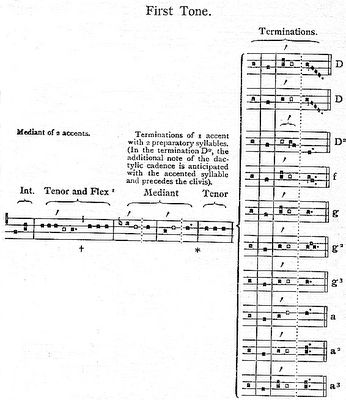
Below is an image of Tone 1 in the old square-note notation; the first musical line (labeled "I") is the melody, and the smaller chunks of score, labeled with letters beginning with "D," are the various possible endings that can be used. Tone 1 has the most possible endings of any of the Psalm Tones - 10 in all, in this chart. (Keep in mind that chant notation can be difficult to read if you're not used to it - but picking up the Psalm Tone melodies by ear is actually quite easy. That's the way I learned, and I recommend it highly. You'll find an audio file (mp3) of the chant further down the page - and there are links to all the Tones at the bottom of this post.)

Here's an image of Tone 1 in modern notation and without endings, from the Lutheran Liturgical Prayer Brotherhood Psalmody Page. The stuff in the parenthesis is the "flex," sung in the first half of the Psalm for a particularly long verse; it's rarely used, so you can safely ignore it for now. Remember, too, that the "incipit" - the notes in the very first measure - are only used once, when singing the first verse; for all subsequent verses, skip directly to the "reciting tone," which is the first note of the second measure, used until you get to the end of the line. (The "reciting tone" is the repetitive note in the chant; it's indicated on the score by the dark, heavy doubled note.) Don't worry too much about endings now, either; you can easily pick that stuff up as you go.

(The notes of the chant melody pictured here - it's Lutheran-style - are slightly different from what's on the audio file linked below. There are regional and other variations in Psalm-singing.)
Follow along with either notation, while listening to an mp3 of Psalm 41 sung to Tone 1 (they are using ending "g" above here) by the St. David's Episcopal Church, Austin, Compline Choir. The mp3 includes an antiphon (text: "Heal me O Lord, for I have sinned against you") sung before and after the Psalm; don't be confused by the antiphon's melody, which is completely different from that of the Psalm Tone. Remember: it's quite easy to pick up these melodies by ear, so don't be discouraged! Just keep listening and singing.
The translation is from the 1979 U.S. Book of Common Prayer:
(Here's an even older look at the square-note notation for Tone 1, courtesy of the Order of St. Benedict; you can see its ten possible endings here, too. These charts are quite a bit more confusing, though, I think - so look at it later, after you've gotten more of the hang of the thing by singing:
)
Here is a good, one-page tutorial on chant notation. On the left is the old Gregorian style; on the right is modern musical notation.
In my opinion, one of the most important things to know - and one of the only things you can't figure out on your own without hearing the music - is the "podatus." Here it is, first in Gregorian notation:

As the tutorial says: "When one note is written above another note like this, the bottom note is sung first, and then the note above it." Here's the modern notation:

That one is used over and over again, and many other neume-types are created from it.
Here are Chantblog pages for all the Psalm Tones, with sound files included at each entry:
Below is an image of Tone 1 in the old square-note notation; the first musical line (labeled "I") is the melody, and the smaller chunks of score, labeled with letters beginning with "D," are the various possible endings that can be used. Tone 1 has the most possible endings of any of the Psalm Tones - 10 in all, in this chart. (Keep in mind that chant notation can be difficult to read if you're not used to it - but picking up the Psalm Tone melodies by ear is actually quite easy. That's the way I learned, and I recommend it highly. You'll find an audio file (mp3) of the chant further down the page - and there are links to all the Tones at the bottom of this post.)
Here's an image of Tone 1 in modern notation and without endings, from the Lutheran Liturgical Prayer Brotherhood Psalmody Page. The stuff in the parenthesis is the "flex," sung in the first half of the Psalm for a particularly long verse; it's rarely used, so you can safely ignore it for now. Remember, too, that the "incipit" - the notes in the very first measure - are only used once, when singing the first verse; for all subsequent verses, skip directly to the "reciting tone," which is the first note of the second measure, used until you get to the end of the line. (The "reciting tone" is the repetitive note in the chant; it's indicated on the score by the dark, heavy doubled note.) Don't worry too much about endings now, either; you can easily pick that stuff up as you go.
(The notes of the chant melody pictured here - it's Lutheran-style - are slightly different from what's on the audio file linked below. There are regional and other variations in Psalm-singing.)
Follow along with either notation, while listening to an mp3 of Psalm 41 sung to Tone 1 (they are using ending "g" above here) by the St. David's Episcopal Church, Austin, Compline Choir. The mp3 includes an antiphon (text: "Heal me O Lord, for I have sinned against you") sung before and after the Psalm; don't be confused by the antiphon's melody, which is completely different from that of the Psalm Tone. Remember: it's quite easy to pick up these melodies by ear, so don't be discouraged! Just keep listening and singing.
The translation is from the 1979 U.S. Book of Common Prayer:
Antiphon: Heal me O Lord, for I have sinned against you
1 Happy are they who consider the poor and needy! *
the LORD will deliver them in the time of trouble.
2 The LORD preserves them and keeps them alive,
so that they may be happy in the land; *
he does not hand them over to the will of their enemies.
3 The LORD sustains them on their sickbed *
and ministers to them in their illness.
4 I said, "LORD, be merciful to me; *
heal me, for I have sinned against you."
5 My enemies are saying wicked things about me: *
"When will he die, and his name perish?"
6 Even if they come to see me, they speak empty words; *
their heart collects false rumors;
they go outside and spread them.
7 All my enemies whisper together about me *
and devise evil against me.
8 "A deadly thing," they say, "has fastened on him; *
he has taken to his bed and will never get up again."
9 Even my best friend, whom I trusted,
who broke bread with me, *
has lifted up his heel and turned against me.
10 But you, O LORD, be merciful to me and raise me up, *
and I shall repay them.
11 By this I know you are pleased with me, *
that my enemy does not triumph over me.
12 In my integrity you hold me fast, *
and shall set me before your face for ever.
13 Blessed be the LORD God of Israel, *
from age to age. Amen. Amen.
Antiphon: Heal me O Lord, for I have sinned against you
(Here's an even older look at the square-note notation for Tone 1, courtesy of the Order of St. Benedict; you can see its ten possible endings here, too. These charts are quite a bit more confusing, though, I think - so look at it later, after you've gotten more of the hang of the thing by singing:

)
Here is a good, one-page tutorial on chant notation. On the left is the old Gregorian style; on the right is modern musical notation.
In my opinion, one of the most important things to know - and one of the only things you can't figure out on your own without hearing the music - is the "podatus." Here it is, first in Gregorian notation:
As the tutorial says: "When one note is written above another note like this, the bottom note is sung first, and then the note above it." Here's the modern notation:
That one is used over and over again, and many other neume-types are created from it.
Here are Chantblog pages for all the Psalm Tones, with sound files included at each entry:


2 comments:
bls, are there rules (or customs) about when to use which tones?
Not for most of us. In convents and monasteries, the tone used to sing the Psalms is dependent upon the Antiphon for the day or for the season; whatever tone that Antiphon is written in, the Psalms take on, too.
And how the Antiphon gets written is an opaque question to me; I'm not sure where most of them have come from, or why certain tones are chosen for them. Some famous ones - like the Great "O" Antiphons - are traditionally sung to a certain tone (2, in that case). But most tones, I think, in most cases, are particular to the monastic house, and so it's unpredictable in that way.
I just sing in whatever tone happens to emerge from my mouth that day (although I sing in Tone 2 during Lent quite frequently; that's just personal falderol and foolishness, though).
Anyway, that's my story, and I'm sticking to it....;-)
Post a Comment