Showing posts with label ascension. Show all posts

Saturday, May 16, 2015

The Ascension Antiphon on the Magnificat: O Rex Gloriae

While working on my last post, "Vespers for the Feast of the Ascension: Hymnus: Salutis humanae Sator," I noticed something really fascinating.

Listen to this recording of the Ascension Antiphon on the Magnificat, O Rex Gloriae, and see what you notice:


Here's the chant score, from the Liber Usualis:


Does this remind you of anything?   It should.

Now listen to this recording of O Rex Gentium, the Great O Antiphon (that is, the Antiphon on the Magnificat) for December 22 (December 21 in Anglican reckoning):


Here's the chant score for that one:


There's no doubt about it; O Rex Gloriae is a deliberate echo - it even starts with a "Great O"!  - of the Great O Antiphons sung at Advent in the days leading up to Christmas.

Put another way:  the Great O's are sung at Christ's coming;and O Rex Gloriae is sung at Christ's going. 

I truly love discovering this kind of thing....

Wednesday, May 13, 2015

"Vespers for the Feast of the Ascension: Hymnus: Salutis humanae Sator"

Claudio Monteverdi evidently wrote a setting of the service of Vespers for the Feast of the Ascension; this is the hymn from that service. As you can see, it's written in alternatim style, the chant alternating with the composed polyphony.


CPDL offers these Latin words and this English translation for this "Hymn for 2nd Vespers of the Ascension."   (Sarum, BTW, used a different hymn for Ascension Vespers:  Eterne Rex atissime.)

1. Salutis humanae Sator,
Jesu, voluptas cordium,
Orbis redempti Conditor,
Et casta lux amantium:

2. Que victus es clementia,
Ut nostra ferres crimina?
Mortem subires innocens,
A morte nos ut tolleres?

3. Perrumpis infernum chaos;
Vinctis catenas detrahis;
Victor triumpho nobili
Ad dexteram Patris sedes.

4. Te cogat indulgentia,
Ut damna nostra sarcias
Tuique vultus compotes
Dites beato lumine.

5. Tu dux ad astra, et semita,
Sis meta nostris cordibus,
Sis lacrymarum gaudium,
Sis dulce vitae praemium.


1. Hail, Thou who man's Redeemer art,
Jesu, the joy of every heart;
Great Maker of the world's wide frame,
And purest love's delight and flame:

2. What nameless mercy Thee o'ercame,
To bear out load of sin and shame?
For guiltless, Thou Thy life didst give,
That sinful erring man might live.

3. The realms of woe are forced by Thee,
Its captives from their chains set free;
And Thou, amid Thy ransomed train,
At God's right hand dost victor reign.

4. Let mercy sweet with Thee prevail,
To cure the wounds we now bewail;
Oh, bless us with Thy holy sight,
And fill us with eternal light.

5. Our guide, our way to heavenly rest,
Be Thou the aim of every breast;
Be Thou the soother of our tears,
Our sweet reward above the spheres.


Somebody has uploaded a video for every movement of this piece to YouTube; here, for instance, is "Viri Galilaei," the first Psalm antiphon (which begins with the same musical motif used for the Introit of the same name at the Ascension mass):


Here's the entire playlist, which runs the service in order:


You can follow along with the service in Latin and in English at Divinum Officium; enter 5-14-2015 for the date, and click Vesperae.


Here, from ChristusRex.org, are all the Mass Propers for Ascension, sung by the Sao Paulo Benedictines:

In Ascensione Domini
Dominica
Introitus: Act. 1, 11; Ps. 46 Viri Galilæi (2m48.4s - 2635 kb) score here
Alleluia: Ps. 46, 6 Ascendit Deus (1m50.2s - 1725 kb) score here
Alleluia: Ps. 67, 18.19 Dominus in Sina (2m33.9s - 2409 kb) score here
Offertorium: Ps. 46, 6 Ascendit Deus (1m33.8s - 1469 kb MONO due to problems with my recording setscore here
Communio:
(anno A)Mt. 28, 18.19 Data est mihi (1m21.9s - 1283 kb) score here
(anno B)Mc. 16, 17.18 Signa (1m05.5s - 1027 kb)
(anno C)  Ps. 67, 33.34 Psallite Domino (59.0s - 925 kb MONO due to problems with my recording setscore here

You can read other posts about the day's propers on Chantblog as well:

And don't forget to read Full Homely Divinity's article on Ascension.

The art used on the videos is not, actually, related to the Ascension;  it's a Resurrection image, from Grunewald's Isenheim Altarpiece.  

Here's an Ascension image, though; it's "a decorated initial 'C'" that "contains the Ascension of Christ," from the Drogo Sacramentary, c. 850:


Blessed Ascension!

Tuesday, May 27, 2014

The Communion Song(s) for the Feast of the Ascension

There are three different Communion chants for the Feast of the Ascension - one for each year.  I'll post all of them here.

Year A's chant is Data est mihi ("All power is given to me"):


The text is this familiar one, from Matthew 28, containing the very last words of Matthew's Gospel:
18  [And Jesus coming, spoke to them, saying:] All power is given to me in heaven and in earth.
19 Going therefore, teach ye all nations; baptizing them in the name of the Father, and of the Son, and of the Holy Ghost.


Here's James MacMillan's Data est mihi, sung by the Westminster Choir conducted by Joe Miller; this piece comes from a collection called "The Strathclyde Motets."   This video was recorded "at the Choir's Homecoming Concert in Princeton, N.J. in January 2011":


The Communio for Year B is Signa autem eos ("These signs will accompany them"):


Signa autem eos, qui in me credunt, hæc sequéntur: dæmónia ejícient: super ægros manus impónent, et bene habébunt. from Corpus Christi Watershed on Vimeo.

The text is taken from Mark 16:17-18, the last part of Mark's Gospel:
17 And these signs will accompany those who believe: in my name they will cast out demons; they will speak in new tongues; 18 they will pick up serpents with their hands; and if they drink any deadly poison, it will not hurt them; they will lay their hands on the sick, and they will recover.”
(There are only two more verses after this, these:
19 So then the Lord Jesus, after he had spoken to them, was taken up into heaven and sat down at the right hand of God. 20 And they went out and preached everywhere, while the Lord worked with them and confirmed the message by accompanying signs.

But of course, there's that footnote, too: "Some of the earliest manuscripts do not include 16:9–20.")


Psallite Domino ("Sing to the Lord") is the Communion song for Year C; here it's sung by the Congregation of St. Lazarus Autun:


This text comes, while taking some liberties, from Psalm (67/)68:
33 to him who rides in the heavens, the ancient heavens;
    behold, he sends out his voice, his mighty voice.
34 Ascribe power to God,
    whose majesty is over Israel,
    and whose power is in the skies.


Here's a very nice polyphonic Psallite Domino:  this piece was composed by Sebastiaan Van Steenberge, performed by Koristen van Keizersberg (Director: Peter Maus), and recorded at Keizersberg Abbey in Leuven, Belgium in May 2008:


Here, from ChristusRex.org, are all the Mass Propers for Ascension, sung by the Sao Paulo Benedictines:

In Ascensione Domini
Dominica
Introitus: Act. 1, 11; Ps. 46 Viri Galilæi (2m48.4s - 2635 kb) score here
Alleluia: Ps. 46, 6 Ascendit Deus (1m50.2s - 1725 kb) score here
Alleluia: Ps. 67, 18.19 Dominus in Sina (2m33.9s - 2409 kb) score here
Offertorium: Ps. 46, 6 Ascendit Deus (1m33.8s - 1469 kb MONO due to problems with my recording setscore here
Communio:
(anno A)Mt. 28, 18.19 Data est mihi (1m21.9s - 1283 kb) score here
(anno B)Mc. 16, 17.18 Signa (1m05.5s - 1027 kb)
(anno C)  Ps. 67, 33.34 Psallite Domino (59.0s - 925 kb MONO due to problems with my recording setscore here

You can read other posts about the day's propers on Chantblog as well:


Don't forget to read Full Homely Divinity's article on Ascension.


And here's a wonderful thing - a glorious piece I didn't know existed until just now!  It's Bach's Ascension Oratorio (AKA the Cantata for Ascension Day, Lobet Gott in seinen Reichen - "Praise God in His Kingdoms"), first performed on May 19, 1735 in Leipzig.    Listen especially for Ach, bleibe doch, mein liebstes Leben here - which ultimately became the Agnus Dei in the B Minor Mass: 


The German and English words are here (and also here).

This is the list of movements and musicians from the YouTube page:
Johann Sebastian Bach
Ascension Oratorio, BWV 11
(Cantata, Lobet Gott in seinen Reichen, BWV 11)

Part I
1 Chorus. Lobet Gott in seinen Reichen
2 Evangelista. Der Herr Jesus hub seine Hände auf
3 Recitativo. Ach, Jesu, ist dein Abschied
4 Aria. Ach, bleibe doch, mein liebstes Leben
5 Evangelista. Und ward aufgehoben zusehends
6 Chorale. Nun lieget alles unter dir

Part II
7 Evangelista. Und da sie ihm nachsahen
8 Recitativo. Ach ja! so komme bald zurück
9 Evangelista. Sie aber beteten ihn an
10 Aria. Jesu, deine Gnadenblicke
11 Chorale. Wenn soll es doch geschehen

Hannah Morrison, soprano
Meg Bragle, mezzo-soprano
Nicholas Mulroy, tenor
Peter Harvey, bass

Monteverdi Choir
English Baroque Soloists
John Eliot Gardiner, conductor


This depiction of the Ascension comes from Folio 13v of the Rabula Gospels (Mesopotamia, 6th century AD):


Thursday, May 09, 2013

The 2nd Alleluia for Ascension Day: Dominus in Sina ("The Lord is in Sinai")

Here's a video of this chant, sung by the Congregation of St. Lazarus Autun:


The text comes from Psalm (67/)68, vv (18-19/)17-18; here's CCWatershed's translation of the proper itself:
The Lord is in Sinai, in the holy place; ascending on high, he has led captivity captive.
Here's the full chant score:


Psalm 68 is a long - and obscure! - Psalm; here are the first 19 verses, for a little bit of context:
To the choirmaster. A Psalm of David. A Song.

1 God shall arise, his enemies shall be scattered;
and those who hate him shall flee before him!
2 As smoke is driven away, so you shall drive them away;
as wax melts before fire,
so the wicked shall perish before God!
3 But the righteous shall be glad;
they shall exult before God;
they shall be jubilant with joy!

4 Sing to God, sing praises to his name;
lift up a song to him who rides through the deserts;
his name is the Lord;
exult before him!
5 Father of the fatherless and protector of widows
is God in his holy habitation.
6 God settles the solitary in a home;
he leads out the prisoners to prosperity,
but the rebellious dwell in a parched land.

7 O God, when you went out before your people,
when you marched through the wilderness, Selah
8 the earth quaked, the heavens poured down rain,
before God, the One of Sinai,
before God, the God of Israel.
9 Rain in abundance, O God, you shed abroad;
you restored your inheritance as it languished;
10 your flock found a dwelling in it;
in your goodness, O God, you provided for the needy.

11 The Lord gives the word;
the women who announce the news are a great host:
12 “The kings of the armies—they flee, they flee!”
The women at home divide the spoil—
13 though you men lie among the sheepfolds—
the wings of a dove covered with silver,
its pinions with shimmering gold.
14 When the Almighty scatters kings there,
let snow fall on Zalmon.

15 O mountain of God, mountain of Bashan;
O many-peaked mountain, mountain of Bashan!
16 Why do you look with hatred, O many-peaked mountain,
at the mount that God desired for his abode,
yes, where the Lord will dwell forever?
17 The chariots of God are twice ten thousand,
thousands upon thousands;
the Lord is among them; Sinai is now in the sanctuary.
18 You ascended on high,
leading a host of captives in your train
and receiving gifts among men,
even among the rebellious, that the Lord God may dwell there.

Paul cites these verses Psalm in Ephesians 4:8, in what to my eyes appears to be a very complex - and again, obscure! - rabbinic argument.   Here are the first 16 verses of that chapter:
I therefore, a prisoner for the Lord, urge you to walk in a manner worthy of the calling to which you have been called, with all humility and gentleness, with patience, bearing with one another in love, eager to maintain the unity of the Spirit in the bond of peace.  There is one body and one Spirit—just as you were called to the one hope that belongs to your call— one Lord, one faith, one baptism,  one God and Father of all, who is over all and through all and in all.  But grace was given to each one of us according to the measure of Christ's gift.  Therefore it says,

“When he ascended on high he led a host of captives,
    and he gave gifts to men.”

(In saying, “He ascended,” what does it mean but that he had also descended into the lower regions, the earth?  He who descended is the one who also ascended far above all the heavens, that he might fill all things.)  And he gave the apostles, the prophets, the evangelists, the shepherds and teachers, to equip the saints for the work of ministry, for building up the body of Christ,  until we all attain to the unity of the faith and of the knowledge of the Son of God, to mature manhood, to the measure of the stature of the fullness of Christ,  so that we may no longer be children, tossed to and fro by the waves and carried about by every wind of doctrine, by human cunning, by craftiness in deceitful schemes.  Rather, speaking the truth in love, we are to grow up in every way into him who is the head, into Christ, from whom the whole body, joined and held together by every joint with which it is equipped, when each part is working properly, makes the body grow so that it builds itself up in love.


Here, from ChristusRex.org, are all the Mass Propers for Ascension, sung by the Sao Paulo Benedictines:
In Ascensione Domini
Dominica
Introitus: Act. 1, 11; Ps. 46 Viri Galilæi (2m48.4s - 2635 kb) score here
Alleluia: Ps. 46, 6 Ascendit Deus (1m50.2s - 1725 kb) score here
Alleluia: Ps. 67, 18.19 Dominus in Sina (2m33.9s - 2409 kb) score here
Offertorium: Ps. 46, 6 Ascendit Deus (1m33.8s - 1469 kb MONO due to problems with my recording setscore here
Communio:
(anno A)Mt. 28, 18.19 Data est mihi (1m21.9s - 1283 kb) score here
(anno B)Mc. 16, 17.18 Signa (1m05.5s - 1027 kb)
(anno C)  Ps. 67, 33.34 Psallite Domino (59.0s - 925 kb MONO due to problems with my recording setscore here

You can read other posts about the day's propers on Chantblog as well:


And don't forget to read Full Homely Divinity's article on Ascension.

This is Andrei Rublev's lovely Ascension, from around 1408; it's now in the Tretyakov Gallery, Moscow.


The Gallery's website has some interesting things to say
about this icon:
From the Prazdnichny Chin (row) which was located above the Deisus and which illustrated events from the Gospel, only five icons have been preserved. Three of them are in the collection of the Tretyakov Gallery and two icons from this row – the “Baptism” and the “Feast of the Purification” – are in the collection of the State Russian Museum in St Petersburg. Most researchers are inclined to view these icons as works coming from the atelier of Andrei Rublev and Daniil. The best done is thought to be the icon of the “Ascension” and many researchers attribute it to Andrei Rublev himself. The icon of the «Ascension» differs from all the other multi-figure icons in the Prazdnichny Chin in the way it possesses a special rhythmic organisation of the composition. Here there appeared the feeling of harmony and plastic balance characteristic of Andrei Rublev. The iconography of the «Ascension» was formed in Byzantine art on the basis of texts from the Gospel According to Mark (XVI, 15–20) and the Gospel According to Luke (XXIV, 42–52), as well as on the Acts of the Apostles (1, 4–12), which tell of the ascension of Christ to heaven after his resurrection from the dead on the fortieth day. This miracle occurred on the Eleon Hill before the disciples when they saw the ascending Christ. Before the apostles there were «two men in white garments» –angels who spoke of the second coming of the Teacher to Earth. The icons come from the Prazdnichny Chin of the iconostasis of the Church of the Assumption in the city of Vladimir. During the period 1768–1775, the dilapidated iconostasis dating from 1408 no longer corresponded to the tastes of the age of Catherine the Great and was taken out of the church and sold to the village of Vasilievskoye, near Shui (present-day Ivanovskaya Oblast). During 1918–1920s, the icons were removed by an expedition of the Central State Restoration Workshops.

    Wednesday, May 16, 2012

    The 1st Alleluia and Offertory for Ascension: Ascendit Deus ("God has gone up")

    Ascendit Deus ("God has gone up") is the text for both the first Alleluia and the Offertory for Ascension Day.

    Here's the Alleluia, sung by St. Stephen's House, Oxford:


    Here's the chant score:


    And here's the Offertory, sung by the Schola Cantorum Of Amsterdam Students:


    Here's the chant score:


    The text for both propers comes from Psalm 47; here's the JoguesChant translation (and here's an mp3 of the Offertory from their site):
    God has gone up amidst shouts of joy, the Lord to the sound of the trumpet, alleluia

    The Feast of the Ascension is forty days after Easter; it commemorates Christ's ascension to heaven post-Resurrection. The story is hinted at in Luke 24:31 and told fully in Acts 1:1-11; it's mentioned in Mark 16:19, too (although it's one of the disputed verses (9-20) in Mark 16). New Advent says of the Feast of the Ascension that:
    The observance of this feast is of great antiquity. Although no documentary evidence of it exists prior to the beginning of the fifth century, St. Augustine says that it is of Apostolic origin, and he speaks of it in a way that shows it was the universal observance of the Church long before his time. Frequent mention of it is made in the writings of St. John Chrysostom, St. Gregory of Nyssa, and in the Constitution of the Apostles. The Pilgrimage of Sylvia (Peregrinatio Etheriae) speaks of the vigil of this feast and of the feast itself, as they were kept in the church built over the grotto in Bethlehem in which Christ was born (Duchesne, Christian Worship, 491-515). It may be that prior to the fifth century the fact narrated in the Gospels was commemorated in conjunction with the feast of Easter or Pentecost. Some believe that the much-disputed forty-third decree of the Council of Elvira (c. 300) condemning the practice of observing a feast on the fortieth day after Easter and neglecting to keep Pentecost on the fiftieth day, implies that the proper usage of the time was to commemorate the Ascension along with Pentecost. Representations of the mystery are found in diptychs and frescoes dating as early as the fifth century.

    Further:
    Certain customs were connected with the liturgy of this feast, such as the blessing of beans and grapes after the Commemoration of the Dead in the Canon of the Mass, the blessing of first fruits, afterwards done on Rogation Days, the blessing of a candle, the wearing of mitres by deacon and subdeacon, the extinction of the paschal candle, and triumphal processions with torches and banners outside the churches to commemorate the entry of Christ into heaven. Rock records the English custom of carrying at the head of the procession the banner bearing the device of the lion and at the foot the banner of the dragon, to symbolize the triumph of Christ in His ascension over the evil one. In some churches the scene of the Ascension was vividly reproduced by elevating the figure of Christ above the altar through an opening in the roof of the church. In others, whilst the figure of Christ was made to ascend, that of the devil was made to descend.

    In the liturgies generally the day is meant to celebrate the completion of the work of our salvation, the pledge of our glorification with Christ, and His entry into heaven with our human nature glorified.

    Here, from ChristusRex.org, are all the Mass Propers for Ascension, sung by the Sao Paulo Benedictines:
    In Ascensione Domini
    Dominica
    Introitus: Act. 1, 11; Ps. 46 Viri Galilæi (2m48.4s - 2635 kb) score here
    Alleluia: Ps. 46, 6 Ascendit Deus (1m50.2s - 1725 kb) score here
    Alleluia: Ps. 67, 18.19 Dominus in Sina (2m33.9s - 2409 kb) score here
    Offertorium: Ps. 46, 6 Ascendit Deus (1m33.8s - 1469 kb MONO due to problems with my recording setscore here
    Communio:
    (anno A)Mt. 28, 18.19 Data est mihi (1m21.9s - 1283 kb) score here
    (anno B)Mc. 16, 17.18 Signa (1m05.5s - 1027 kb)
    (anno C)  Ps. 67, 33.34 Psallite Domino (59.0s - 925 kb MONO due to problems with my recording setscore here

    You can read other posts about the day's propers on Chantblog as well:

    And don't forget to read Full Homely Divinity's article on Ascension.

    Several composers have set this text to music, including Jacobus Gallus (sung here by The Summer Singers of Minneapolis, Minnesota):


    Here, The Brethren sing Jackson Berkey's setting:


    And who could resist the Giuseppe Giordani version?:


    Gerald Finzi's (epic!) English setting, "God is gone up," is perhaps the best known of all; it starts at about 3:20 on the video below (brought to you by the Choir of St John's College). But first, you get Stanford's Justorum Animae (from Three Latin Motets), as a bonus!


    Friday, June 03, 2011

    "Medieval Chant and Polyphony for the Ascension: 1000: A Mass for the End of Time Program Notes"

    Following up on the last post about the Ascension Sequence, Rex Omnipotens die hodierna, here are program notes written by Susan Hellauer of Anonymous 4; the notes accompany their CD "1000: A Mass for the End of Time" - and are relevant to Ascension Day:
    After this I looked, and, behold, a door was opened in heaven; and the first voice which I heard was as it were of a trumpet talking with me; which said, Come up hither, and I will show thee things which must be hereafter. . . . And I beheld when he had opened the sixth seal, and lo, there was a great earthquake; and the sun became black as sackcloth of hair, and the moon became as blood. And the stars of heaven fell unto the earth, even as a fig tree casteth her untimely figs, when she is shaken of a mighty wind. And the heaven departed as a scroll when it is rolled together; and every mountain and island were moved out of their places. . . . And when he had opened the seventh seal, there was silence in heaven about the space of half an hour.

    –The Apocalypse of John the Divine

    It was a time of dread and hope, collapse and renewal, of violent anarchy and the elusive promise of worldwide peace. As the first millennium approached, the alliances of Charlemagne’s ninth-century empire broke apart at the seams, and Europe was plunged into a nightmarish cycle of deadly feuds, invasion and war.

    Slowly, painfully, a new European order began to emerge from the rubble. Once-pagan warrior kings looked upon Christianity as a politically unifying and civilizing force. The Church, under the brilliant leadership of Pope Sylvester II (formerly the scholar-monk Gerbert of Aurillac) began to turn this spiritual authority into political power. Great cathedrals, the first monumental architecture in the west since the collapse of the Roman Empire five hundred years before, began to appear. There occurred as well a burst of intense creative activity in European Christian liturgy and its music. The traditional Roman plainchant repertory was vigorously renewed and greatly enlarged; new developments in the science of music, including staff line notation and solfeggio, allowed the new creations to be quickly learned, written down and disseminated throughout Europe.

    Much as the fear of nuclear annihilation was an ever-present theme in the second half of the twentieth century, so too did fear and anticipation of the Last Judgment and end of the world influence the late-tenth-century Christian world view. Although many simple folk were unaware of the exact year and its significance, laymen and clerics alike (themselves unaware that the “official” calendar was a few years off in dating Jesus’s birth) debated the exact hour and day of “the end.” Would it be on New Year’s Eve 999 or New Year’s Day 1000, or Easter, or Ascension Day, or Christmas; or would the end actually come in 1033 – a thousand years after the death and resurrection of Jesus? In his Apocalypse, John the Divine had seen the devil being chained and sealed for a thousand years, then let loose for “a little season.” Was the terror and uncertainty of the tenth century a sign of Satan’s return? Would an antichrist rise up, to be defeated in anticipation of the Last Judgment? Who would be saved, who damned, and what horrors awaited the earth?

    In the Christian liturgy, the Last Judgment is most strongly conjured up in the liturgies of the Advent season, the Requiem mass, and the feast of Jesus’s Ascension, celebrated forty days after Easter. His imminent return, in the glorious manner in which he departed (Acts 1:9–11), had been expected by the earliest Christians; as centuries passed this expectation was transferred to the first millennium. Our program is based on the Ordinary and Proper chants of the Ascension mass, most with added tropes — newly written text and music added to make them more solemn or festive — drawing on related Ascension themes, including the Last Judgment. Most of these works are found in manuscripts of c. 1000 originating in Aquitaine, in southwestern France (many of them associated with the Abbey of St. Martial in Limoges). Two of them, the Gloria: Prudentia prudentium and the Alleluia: Ascendens cristus, are from the Winchester Troper, an important source from Britain, c. 1000, containing some of the very earliest written polyphony for liturgical use. The troped portions of the Aquitanian chants would almost certainly have been adorned with polyphony, created by the singers according to certain rules of improvisation that are preserved for us in theoretical treatises of the time. We have constructed polyphonic lines, based on examples from the Winchester Troper and on contemporary theoretical writings, with an occasional drone or ison to enhance the texture.

    The Propers of the mass (Introit, Alleluia, Prose with Sequence, Offertory and Communion) are those items specific to the feast at hand. With the exception of the Alleluias, all here are enlarged with Ascension tropes. Most notable of these is the extensive introductory dialog to the Introit: Viri galilei, Quem creditis super astra ascendisse. It is a rich, self-contained work in itself, modeled on the widely popular Easter Introit trope Quem queritis, which is generally seen as the precursor of liturgical drama. Like the Quem queritis, Quem creditis exists in more than one version; we have chosen the melody associated with the Aquitanian abbey of St. Martial in Limoges. In this work one can easily hear how the Aquitanian plainchant style differs from the earlier, more subtly refined Gregorian style, most recognizably in its vigorous, outgoing melody, with gesture and emphasis enhancing a strong tonal center. The second of the two Alleluias, Ascendens cristus, is set with an organal line in the Winchester Troper. The prose, or prose with sequence, its origins related to the practice of troping, was a relatively new addition to the medieval mass, with Frankish composers of the ninth and tenth centuries adding great numbers of them for specific saints and feasts, large and small, to the liturgical stock. The Ascension Prose and sequence: Rex omnipotens, with its introductory trope Salvator mundi te ascendente, is one of the finest of these. After each double versicle of the prose, an untexted “sequence” of pitches follows, to which would most probably have been added an improvised polyphonic or organal line. We also sing the extensive trope, Elevatus est rex fortis, to the Offertory: Viri galilei, with an added organal line.

    The items of the Ordinary of the mass are those that (usually) remain the same regardless of the occasion. But in the age of troping, they could be made “proper” to the day with added texts. The Gloria is expanded with the Ascension trope Prudentia prudentium, and the Kyrie: Celestis terrestrisque, although its text is not specific to the Ascension, is designated for that feast in its manuscript source, written in the little town of Apt, where a fine, anonymous musician in an artistic backwater created new liturgical works of his (or her) own inspiration. The brief but artful Sanctus: Ante seculum and Agnus: Omnipotens eterne are intended for general use on high feast days, and we have added organal lines to their tropes.

    The processional hymn Judicii signum enjoyed a long life in medieval liturgy, and is based on the prophecies of one of the early medieval Christian Sibyls. After the mass chants, we sing a Lection from the Apocalypse of Saint John, which, along with the sibyllic oracles, was the Middle Ages’ primary source for information about the coming Armageddon. Regnantem sempiterna is a perfect, gem-like prosa of the ninth-century West-Frankish school, and the hymn Cives celestis patrie, with which we end the program, describes the foundation jewels (and their mystical meanings) of the new Jerusalem — the perfect city that will replace the earth at the end of time.

    And he carried me away in the spirit to a great and high mountain, and showed me that great city, the holy Jerusalem. . . . And the foundations of the wall of that city were garnished with all manner of precious stones. . . . And the twelve gates were twelve pearls; every several gate was of one pearl; and the street of the city was pure gold, as it were transparent glass. . . . And the gates of it shall not be shut at all by day: for there shall be no night there.

    - Apocalypse, chapter 21

    Thursday, June 02, 2011

    Rex Omnipotens die hodierna ("The King Eternal as upon this Holy Day"): The Ascension Sequence

    The Sequence Hymn for Ascension Day - today - is, according to Hymn Melodies for the Whole Year from the Sarum Service-books, "Rex Omnipotens die hodierna" ("The King Eternal as upon this Holy Day"). Here's the chant score itself:


    Unfortunately - and as is pretty usual, for the lesser-known Sequence hymns - it's difficult to find recordings of this music online. Anonymous 4 did an 8-minute version called "Sequence with Prose: Salvator mundi/Rex omnipotens die hodierna," of which you can find short clips here and there. There's one on their website, from the CD "1000: A Mass for the End of Time," that gives a bit of the flavor of the piece (and includes some of the other mass chants for Ascension). Amazon offers this similar 30-second cut.

    The Latin words are, I think, these - taken from a book called (yes!) Archaeologia, Or, Miscellaneous Tracts Relating to Antiquity, Volume 46, Part 2 (which seems to have words to many of the Sequences):
    Prosa adseguentia Cithara, de Ascensione Domini. Alleluia.

    Rex omnipotens, die hodierna,
    Mundo triumphali redempto potentia,
    Victor ascendit caelos unde descenderat
    Nam quadraginta postquam surrexerat
    Diebus sacris confirmans pectore
    Apostoloru[m] pacis clara reliquens oscula
    Quibus et dedit potestatem laxandi crimina,
    Et misit eos in mundum baptizare cunctas animas,
    In patris et filii et sancti spiritus dementia
    Et conuescens precepit eis ab ierosolomis
    Ne abirent sed expectarent promissa munera. [f. 1456.]
    Non post multos enim dies mittam uobis spiritum paraclitum in terra
    Et eritis mihi testes in ierusalem iudea siue samaria.
    Et, cum hoc dixisset, uidentibus illis elevatus est, et nubes clam
    Suscepit eum ab eorum oculis intuentibus illis aera.
    Ecce stetere amicti duo uiri in ueste clara
    Juxta, dicentes quid admiramini caelorum alta?
    Jesus enim, hie qui assumptus est a uobis ad patris dextera[m]
    Vt ascendit ita ueniet querens talenti commissi lucra,
    0 deus maris poli arcei. hominem quern creasti fraude subdola
    Hostis expulit paradiso et captiuatum secum traxit ad tartara.
    Sanguine proprio quem redemisti deo [f. 146]
    Illuc et rediens unde prius corruit paradisi gaudia,
    Iudex, cum ueneris iudicare secula,
    Da nobis petimus sempiterna gaudia in sanctorum patria
    In qua tibi cantemus omnes alleluia.
    [Bodl. MS. 775, f. 145. Cott. Cal. A, xiv. f. 61. MS. Beg. 2, B. iv. f. 97 vo. Sarnm Gradual, f. 143 vo.]

    Here's an English translation, from The Latin hymns in the Wesleyan hymn book : studies in hymnology, by Frederic W. MacDonald (1899) (here's a PDF of this book):
    This day the King omnipotent,
    Having redeemed the world by His triumphant might,
    Ascends a Conqueror to heaven, whence He had come.
    Through forty holy days after He rose He tarried.
    Confirming the souls of the Apostles ;
    To whom, bequeathing the sweet kiss of peace,
    He gave the power to bind and loose,
    And sent them to baptize all men
    In the mercy of Father, Son, and Holy Spirit.
    And, eating with them, bade them not depart
    From Jerusalem, but wait for the promised gifts.
    Not many days hence will I send to you the Spirit, the
    Comforter,
    And ye shall be My witnesses in Jerusalem, Judea, and
    Samaria.
    And when He had this said, while they beheld He rose,
    and a bright cloud
    Received Him from their sight, they gazing upward.
    Behold, two men, in white robes clad, stood by, and said :
    Why look ye to high heaven ?
    For this Jesus, who is taken from you to the right hand of
    the Father,
    As He ascended so shall come, seeking His gain of the
    entrusted talent.
    O God of ocean, air, and field, man whom Thou didst
    create, and whom by guile
    The foe drove out of paradise, and led a captive with him
    to the abyss,
    Whom by Thine own blood Thou hast redeemed, O God,
    Bring back again thither whence first he fell.
    To joys of paradise.
    When Thou the judge, to judge the world shalt come,
    Grant us, we pray Thee, everlasting joy
    In the homeland of saints.
    Where we all shall sing to Thee, Alleluia."

    I do wish these Sequences were more readily available! Maybe I'll get some singers together and record them all myself, in fact; to me, they are some of the most beautiful music in all the chant repertoire. It really is worth clicking to the Anonymous 4 site to listen to their clips, though. Always worth listening to them sing, no matter how short or long the clips; they always produce such beautiful stuff.


    In the Google book, A Dictionary of Hymnology, there is this note about this Sequence:
    Rex omnipotens die hodierna. Hermannus Contractus (?). [Ascension.] This is found in a MS. in the Bodleian (Bodl. 775 f. 145), written c. 1000, as a Sequence "on the Ascension of the Lord," and in another Ms., in the same Library, of circa 1070 (Douce, 222, f. 101); in a Winchester book of the 11th cent, now in Corpus Christi College, Cambridge (No. 473); in a Ms. of the 11th cent. (Harl. 2961 f. 254), and another of the 11th or 12th cent. (Reg. 8 C. xiii. f. 22). both in the British Museum, &c. Among Missals it is found in an early 14th cent. Paris and a 14th cent. Sens in the British Museum; in a Sarum, c. 1370, a Hereford, c. 1370, and a York, c. 1390, all now in the Bodleian: in the St. Andrew's, and various French Missals, its use being uniformly for the Ascension. The printed text is also in Neale's Sequentiae, 1852, p. 58; Daniel, v. p. 66, and Kehrein, No. 116 (see also p. 967, ii.). Tr. as:—

    1. Lord of all power and might, Mankind redeemed, Ac. By C. S. Calverley, In the 1871 ed. of the Hymnary, No. 305, and in his Literary Remains, 1886.

    2. To the throne He left, victorious. By E. H. Plomptre, made for and pub. in the Hymnary, 1872, No. 305. in the place of the above No. 1.

    3. The almighty King, victorious, on this day. By C. B. Pearson, In the Sarum Missal in English, 1868, and his Sequences from the Sarum Missal, 1871.

    So you can see why Anonymous 4 included on their CD "1000: A Mass for the End of Time" - it was written, it seems, about the year 1000.

    Here's a post on the Ascension Office (and actually, here's another!), and here's one on the mass chants for the day.

    Here's one video that's appropriate for the day, even though it's not of the Sequence: Finzi's "God Is Gone Up With a Shout," sung by the Christ Church Cathedral Ottawa Choir of Men and Boys. The text is from Psalm 47, from what I can recall:


    This is an icon of the "The Anastasis and the Ascension" at St. Catherine's Monastery in Egypt, from, apparently, the 13th Century:

    Monday, May 25, 2009

    An Ascension anthem, and other music for Ascension Day

    Here's a video of Patrick Gowers' Viri Galilaei; it's sung by the St. Paul's Cathedral Choir.


    Viri Galilaei is the incipit of the Introit for the Feast of the Ascension; you can listen to all the mass propers for Ascension Day here.

    Here are the words to this anthem; I found them in an old service bulletin from St. Thomas Church:
    Alleluia. And while they looked steadfastly toward heaven
    as he went up, behold, two men stood by them in white apparel;
    Which said unto them, Ye men of Galilee, why stand ye gazing up to heaven?
    In like manner as ye have seen him going up into heaven, so shall he come again.
    God is gone up with a merry noise, and the Lord with the sound of the trumpet.
    Christ to highest heaven ascending, led captivity captive.
    Sing ye to the Lord who ascended to the heaven of heavens to the sun rising.

    See the conqueror mounts in triumph, Ssee the King in royal state,
    Riding on the clouds his chariot to his heavenly palace gate.
    Hark! the choirs of angel voices Joyful Alleluias sing.
    And the portals high are lifted to receive their heavenly King. Alleluia.

    Proper of the Mass, Ascension; Bishop Christopher Wordsworth

    I think the citation in italics at the end means that the text here was taken from two sources; the first section comes from the mass propers for Ascension Day, and there is a hymn called "See the conqueror mounts in triumph," text by one Christopher Wordsworth (I think that's him, in the photo on left at the link - whew!).

    In the St. Thomas service for that day, the Mass Ordinary was a very beautiful one, too: Zoltán Kodály's Missa Brevis. The "Music Notes" from St. Thomas tell its story:
    The Missa Brevis of Zoltán Kodály (1882-1967) was originally written as an organ mass during a holiday that the composer took in Galyateto in the Summer of 1943. The composer had been asked to play the harmonium at a low mass in the church at Galyateto and, feeling that the music that he played ought to reflect the text, he made a number of sketches before the service, later converting these into the Missa Brevis for organ and choir. The subtitle of the setting, Tempore belli (Time of war), adopted from Haydn’s Mass in C major of 1796, gives a clue to the unfortunate and unusual circumstances surrounding the piece’s first performance. During the siege of Budapest, Kodály and his wife took shelter in the cellars of the Opera House and it was on 11th February 1945 in one of the cloakrooms that the first performance of this version of the Mass was given by a group of the House’s principal soloists accompanied by harmonium. In 1948 Kodály orchestrated the piece and it was premiered at the Three Choirs Festival in Worcester. The work shows many influences including Gregorian chant and the works of Handel, Bach, Palestrina and an organ mass by Franz Liszt dating from 1879.


    And there were two selections - the Prelude and Postude from the service - from Messiaen's L'Ascension, if you like that sort of thing.

    Here's the original Gregorian chant Viri Galilaei:


    The text comes from Acts 1:11 and Psalm 47:1, and these are the Latin words, followed by the English:
    Viri Galilaei, quid admiramini aspicientes in caelum?
    Alleluia: quemadmodum vidistis eum ascendentem in caelum,
    ita veniet, alleluia, alleluia, alleluia.

    Omnes gentes plaudite manibus:
    iubilate Deo in voce exsultationis.


    Ye men of Galilee, why wonder you, looking up to heaven? alleluia. He shall so come as you have seen Him going up into heaven, alleluia, alleluia, alleluia.

    O clap your hands, all ye nations; shout unto God, with the voice of exultation.

    There are two collects available for Ascension Day - I'm interested in why two, and where they came from, and will try to find out - one of which is one of my favorites for the year:
    Almighty God, whos blessed Son our Savior Jesus Christ ascended far above all heavens that he might fill all things: Mercifully give us faith to perceive that, according to his promise, he abides with his Church on earth, even to the end of the ages; through Jesus Christ our Lord, who lives and reigns with you and the Holy Spirit, one God, in glory everlasting. Amen.

    Friday, May 22, 2009

    Full Homely Divinity's Pentecost Novena

    New this year, I believe, from this page:
    The nine days from Ascension Day to the Eve of Pentecost are the original novena--nine days of prayer. Before he ascended, Jesus ordered the disciples not to leave Jerusalem, but to wait there to be baptized by the Holy Spirit. After his Ascension, they returned to the upper room in Jerusalem where they devoted themselves to prayer. These last days of the Great Fifty Days of Easter can be a time for us to prepare for the celebration of Pentecost. As we anticipate the coming of the Holy Spirit, this can be a time to pray for renewal in the Spirit and a time to reflect on the gifts which the Spirit bestows on the Church. The prayer for the newly baptized, p. 308, in the 1979 Book of Common Prayer is the traditional prayer for the seven gifts of the Spirit, based on the prophecy of Isaiah 11:2-3. This prayer could be the basis for daily reflection on the gifts of the Spirit in the days between the Ascension and Pentecost and the following adaptation of it could be used daily as a simplified novena.

    Heavenly Father, we thank you that by water and the Holy Spirit you have bestowed upon us the forgiveness of sin, and have raised us to the new life of grace in your Son Jesus Christ. Sustain us, O Lord, in the gifts of your Spirit: an inquiring and discerning heart, the courage to will and to persevere, a spirit to know and to love you, and the gift of joy and wonder in all your works. Amen.

    Or, here is a fuller novena, based on the sevenfold gifts of the Spirit. It may be used at the conclusion of the Daily Office or as a separate act of devotion.

    A Novena for the Gifts of the Spirit

    Come, Holy Ghost, our souls inspire,
    and lighten with celestial fire.
    Thou the anointing Spirit art,
    who dost thy sevenfold gifts impart.
    Thy blessed unction from above
    is comfort, life, and fire of love.
    Enable with perpetual light
    the dullness of our blinded sight.
    Anoint and cheer our soiled face
    with the abundance of thy grace.
    Keep far our foes, give peace at home:
    where thou art guide, no ill can come.
    Teach us to know the Father, Son,
    and thee with both to be but One,
    that through the ages all along,
    this may be our endless song:
    praise to thy eternal merit,
    Father, Son, and Holy Spirit. Amen.

    Come, great Paraclete, Father of the poor, Comforter of the blest, fulfill the promise of our Savior who would not leave us as orphans. Enter our minds and hearts as you descended on the day of Pentecost upon the Mother of Jesus and upon his Apostles. Grant that every member of the Church may have a part in those gifts which were bestowed that day. O Holy Spirit, giver of every good and perfect gift, may the Father's will be done in us and through us, and may you, O mighty Spirit, equal to the Father and the Son in Being and majesty, be praised and glorifed for ever and ever. Amen.

    Here may be added any of the following prayers: Our Father, Hail Mary, Trisagion, Kyrie eleison, Gloria Patri, concluding with the prayer appropriate to the day of the novena.

    First Day
    Come, O Holy Spirit, the Lord and Lifegiver: Take up your dwelling within my soul and make of it your sacred temple. Make me live by grace as an adopted child of God. Pervade all the energies of my soul, and create in me a fountain of living water springing up into life everlasting; through Jesus Christ our Lord, who lives and reigns with you and the Father, one God, in Trinity of Persons, now and forever. Amen.

    Second Day - Wisdom

    Come, O Spirit of Wisdom, and reveal to me the mysteries of divine things, their greatness, and power, and beauty. Teach me to love them above and beyond all the transient joys and satisfactions of the mortal world. Show me the way by which I may be able to attain to them and participate in them forever; through Jesus Christ our Lord, who lives and reigns with you and the Father, one God, in Trinity of Persons, now and forever. Amen.

    Third Day - Understanding
    Come, O Spirit of Understanding, and enlighten my mind, that I may know and believe all of the mysteries of salvation and discern your hand at work in the world. Teach me to see with your eyes that I may apply my heart unto wisdom in this life and be made worthy to attain to the vision glorious in the life to come; through Jesus Christ our Lord, who lives and reigns with you and the Father, one God, in Trinity of Persons, now and forever. Amen.

    Fourth Day - Counsel
    Come, O Spirit of Counsel, help and guide me in all my ways, that I may always do your holy will. Incline my heart to that which is good, turn it away from all that is evil, and direct me by the path of him who is the Way, the Truth, and the Life to the goal of eternal life; through Jesus Christ our Lord, who lives and reigns with you and the Father, one God, in Trinity of Persons, now and forever. Amen.

    Fifth Day - Fortitude
    Come, O Spirit of Fortitude, and give courage to my soul. Make my heart strong in all trials and in all distress, generously pouring strength into it that I may be able to resist the allurements of the world, the flesh, and the devil; through Jesus Christ our Lord, who lives and reigns with you and the Father, one God, in Trinity of Persons, now and forever. Amen.

    Sixth Day - Knowledge

    Come, O Spirit of Knowledge, and make me understand the emptiness and chaos of life without you. Give me grace to recognize the goodness of the whole creation and to honor the Creator by using the world only for your glory and for the benefit and the salvation of all whom you have made; through Jesus Christ our Lord, who lives and reigns with you and the Father, one God, in Trinity of Persons, now and forever. Amen.

    Seventh Day - Piety

    Come, O Spirit of Piety, possess my heart; incline it to a true faith in you, to a holy love of you, my God, that with my whole being I may seek you, and find you to be my best, my truest joy;through Jesus Christ our Lord, who lives and reigns with you and the Father, one God, in Trinity of Persons, now and forever. Amen.

    Eighth Day - Holy Awe [Fear]
    Come, O Spirit of Holy Awe, penetrate my inmost heart, that I may set you, my Lord and God, before my face forever. In joy and wonder may I be made worthy to appear before the pure eyes of your divine Majesty and behold your glory face to face in the heaven of heavens, where you live and reign in the unity of the Ever-blessed Trinity, now and forever. Amen.

    Ninth Day

    Come, O Holy Comforter, come in all your fullness and power. Enrich us in our poverty, inflame us in our feebleness, melt our hearts with your love. Make us wholly yours, until your gifts are ours and we are lost in you; through Jesus Christ our Lord, who lives and reigns with you and the Father, one God, in Trinity of Persons, now and forever. Amen.


    A video of the Pentecost hymn Veni, Creator Spiritus (the English words of which are above, just under the title "A Novena for the Gifts of the Spirit"), sung by the Schola Cantorum of Amsterdam Students:

    Wednesday, May 20, 2009

    The Sarum Ascension Office

    I have previously posted about the Ascension Day Music for the Mass and also put up an Office Hymns for Ascension post.

    But I haven't actually posted the listing from Hymn Melodies for the whole year from the Sarum service books before - so I will now:
    On Ascension Day, & daily until Whitsun Day :
    Ev. & Matt.:  Eterne Rex altissime ... ... ... 41
    [Matt. (York):   Hymnum canamus glorie ... ... ... 42]
    Lauds:   Tu, Christe, nostrum gaudium ... ... 41

    (Follow along with the Ascension Offices here, at Breviary Offices, from Lauds to Compline Inclusive (Society of St. Margaret, Boston, 1885); that links to the Vigil of Ascension.   I'll link-in via iFrame at the bottom of this post, too.)

    Here's the chant score for the melody #41, used at Sarum at Vespers, Mattins, and Lauds:


    Here is an mp3 file of "a Hymn for First Vespers of the Feast of the Ascension of our Lord", from the Lutheran Liturgical Prayer Brotherhood.   The tune is #41 above.

    This hymn in English is "O Eternal Monarch"; in Latin, it's Eterne Rex altissime.  You can find the Latin words to this hymn, and more about it, on page 157 of Britt's Hymns of the Breviary and Missal (a large PDF file), and the English ones on page 43 of The Hymner: Containing Translations of the Hymns from the Sarum Breviary, at Google Books. 

    Here are the words to Eterne Rex altissime from the source mentioned above; this is J.M. Neale's translation.  The words don't match exactly with what's on the LLPB sound file, though:
    Eternal Monarch, King most high,
    Whose Blood hath brought redemption nigh,
    By whom the death of Death was wrought
    And conquering Grace's battle fought:

    Ascending to the throne of might,
    And seated at the Father's right,
    All power in heav'n is Jesu's own,
    That here his Manhood had not known.

    That so, in Nature's triple frame,
    Each heav'nly and each earthly name,
    And things in hell's abyss abhorr'd,
    May bend the knee and own him Lord.

    Yea, Angels tremble when they see
    How changed is our humanity;
    That Flesh hath purged what flesh had stain'd,
    And God, the Flesh of God, hath reign'd.

    Be thou our Joy, and thou our Guard,
    Who art to be our great Reward:
    Our glory and our boast in thee
    For ever and for ever be.

    All glory, Lord, to thee we pay,
    Ascending o'er the stars to-day:
    All glory, as is ever meet,
    To Father and to Paraclete. Amen.


    Here is an mp3 file of "a Hymn for Morning Prayer of the Feast of the Ascension of our Lord", also from the LLPB.  This one is also sung to melody #41.

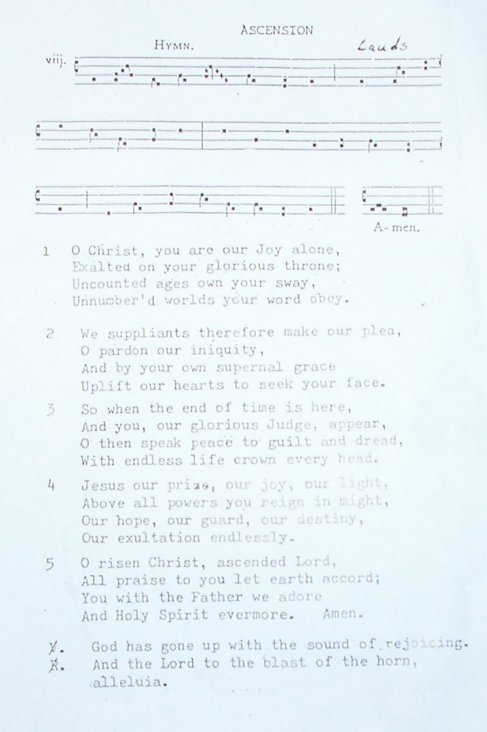
    This hymn in English is "O Christ Thou Art Our Joy Alone"; in Latin: Tu, Christe, Nostrum Gaudium. Here's a page from a site called "A MIDI Collection of Traditional Catholic Hymns" that includes the words in Latin and English (a J.M Neale translation), and gives the source of this hymn as "Anon. 5th Cent." (The tune there is listed as "a Grenoble church melody"; it's the same tune as the one in #448 in the 1982 Hymnal, "O Love, How Deep, How Broad, How High." listed there as "Deus tuorum militum, from Antiphoner, 1753.")

    The words in English can be found on on page 43 of The Hymner: Containing Translations of the Hymns from the Sarum Breviary, at Google Books; I do not know who did this translation.

    And here are the words to Tu, Christe, Nostrum Gaudium, from the same source:
    O Christ ! thou art our Joy alone,
    Exalted on thy glorious throne ;
    Who o'er earth's fabrick bearest sway,
    Transcending earthly joys for aye.

    We suppliants, therefore, ask of thee
    To pardon our iniquity;
    And of thine own supernal grace
    Uplift our hearts to seek thy face.

    When, cloud-throned 'mid the reddening sky,
    In glory thou, our Judge, art nigh ;
    O then, remitting guilt and pain,
    Restore our long-lost crowns again.

    Be thou our Joy, and thou our Guard,
    Who art to be our great Reward :
    Our glory and our boast in thee
    For ever and for ever be.

    All glory, Lord, to thee we pay,
    Ascending o'er the stars to-day:
    All glory, as is ever meet,
    To Father and to Paraclete. Amen.


    Here's a chant score of this hymn from my sources, one that uses a different set of words but the same tune:


    Here is an mp3 file of "a Hymn for Second Vespers of the Feast of the Ascension of our Lord," also from LLPB.   This tune is not either of those listed above - but it's very pretty!

    This hymn in English is "A Hymn of Glory"; in Latin, it's Hymnum canamus glorie; here's a page at CCEL with the words from the Lutheran hymnal, which are used on the mp3. The author is given as "The Venerable Bede, 735" on that page; here are the English words:
    1. A Hymn of glory let us sing:
    New songs throughout the world shall ring:
    Alleluia! Alleluia!
    Chirst, by a road before untrod,
    Ascendeth to the throne of God.
    Alleluia! Alleluia! Alleluia! Alleluia! Alleluia!

    2. The holy apostolic band
    Upon the Mount of Olives stand;
    Alleluia! Alleluia!
    And with His followers they see
    Jesus' resplendent majesty.
    Alleluia! Alleluia! Alleluia! Alleluia! Alleluia!

    3. To whom the angels, drawing nigh,
    "Why stand and gaze upon the sky?
    Alleluia! Alleluia!
    This is the Savior!" thus they say;
    "This is His noble triumph-day."
    Alleluia! Alleluia! Alleluia! Alleluia! Alleluia!

    4. "Again shall ye behold Him so
    As ye today have seen Him go,
    Alleluia! Alleluia!
    In glorious pomp ascending high,
    Up to the portals of the sky."
    Alleluia! Alleluia! Alleluia! Alleluia! Alleluia!

    5. Oh, grant us thitherward to tend
    And with unwearied hearts ascend
    Alleluia! Alleluia!
    Unto Thy kingdom's throne, where Thou,
    As is our faith, art seated now.
    Alleluia! Alleluia! Alleluia! Alleluia! Alleluia!

    6. Be Thou our Joy and strong Defense
    Who art our future Recompense:
    Alleluia! Alleluia!
    So shall the light that springs from Thee
    Be ours through all eternity.
    Alleluia! Alleluia! Alleluia! Alleluia! Alleluia!

    7. O risen Christ, ascended Lord,
    All praise to Thee let earth accord,
    Alleluia! Alleluia!
    Who art, while endless ages run,
    With Father and with Spirit One.
    Alleluia! Alleluia! Alleluia! Alleluia! Alleluia!


    The LLPB also includes "a Versicle [mp3] for Exaudi, the Sunday after Ascension": the text, from Psalm 47, is: "God is gone up with a shout, alleluia. The Lord with the sound of the trumpet, alleluia."


    Apparently York did it differently than Salisbury - see the note in the listing above - but as the Lutherans did! It's always interesting to see these regional variations.  (Here's the chant score for melody #42, listed above, for which I have no audio file):


    Here's that peek-in to the SSM Breviary:


    You can read more about the propers for Ascension Day on Chantblog as well:


    Here's a terrific Giotto Ascension:


    And this Tintoretto - completely different - is pretty great, too:

    Monday, April 28, 2008

    The Introit for the Feast of the Ascension: Viri Galilaei ("O men of Galilee")

    In tending to concentrate on the music for the Divine Office on this blog - largely  because there didn't seem to be much of anything on the web on the topic, but also because I love the Office - I've tended to neglect the music for the celebration of the Eucharist.

    Below, as also discussed in my "Office Hymns for Ascension" post, is an audio file of the Introit for this mass, Viri Galilaei ("O men of Galilee"), sung by the "Schola of the Vienna Hofburgkapelle."


    The text comes from Acts 1:11 and Psalm 47:1, and these are the Latin words, followed by the English:
    Viri Galilaei, quid admiramini aspicientes in caelum?
    Alleluia: quemadmodum vidistis eum ascendentem in caelum,
    ita veniet, alleluia, alleluia, alleluia.

    Omnes gentes plaudite manibus:
    iubilate Deo in voce exsultationis.


    Ye men of Galilee, why wonder you, looking up to heaven? alleluia. He shall so come as you have seen Him going up into heaven, alleluia, alleluia, alleluia.

    O clap your hands, all ye nations; shout unto God, with the voice of exultation.

    Here's the full chant score:


    EDIT:
    In the comments, an anonymous poster has left two links to videos of two of the mass chants for Ascension: one to the Introit and the other to the Alleluia I.


    Here, from ChristusRex.org, are all the Mass Propers for Ascension, sung by the Sao Paulo Benedictines:
    In Ascensione Domini
    Dominica
    Introitus: Act. 1, 11; Ps. 46 Viri Galilæi (2m48.4s - 2635 kb) score here
    Alleluia: Ps. 46, 6 Ascendit Deus (1m50.2s - 1725 kb) score here
    Alleluia: Ps. 67, 18.19 Dominus in Sina (2m33.9s - 2409 kb) score here
    Offertorium: Ps. 46, 6 Ascendit Deus (1m33.8s - 1469 kb MONO due to problems with my recording setscore here
    Communio:
    (anno A)Mt. 28, 18.19 Data est mihi (1m21.9s - 1283 kb) score here
    (anno B)Mc. 16, 17.18 Signa (1m05.5s - 1027 kb)
    (anno C)  Ps. 67, 33.34 Psallite Domino (59.0s - 925 kb MONO due to problems with my recording setscore here

    You can read other posts about the day's propers on Chantblog as well:


    And don't forget to read Full Homely Divinity's article on Ascension.


    LinkWithin

    Related Posts Plugin for WordPress, Blogger...