Showing posts with label illuminated manuscripts. Show all posts

Friday, November 25, 2011

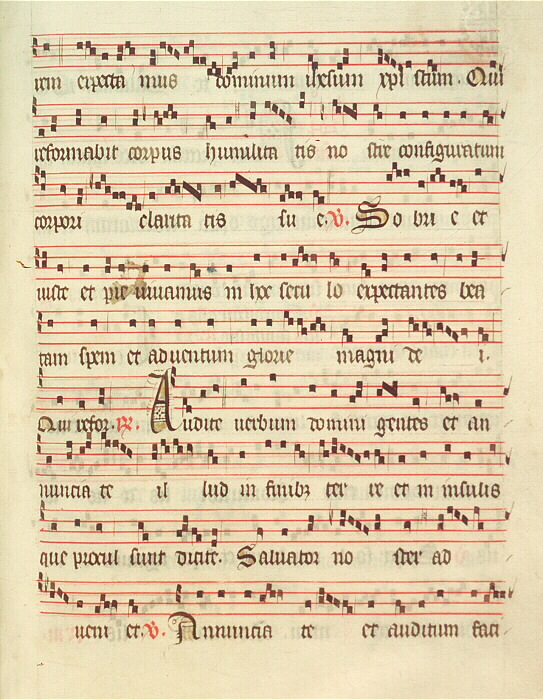
Audite Verbum: An Advent Matins Responsory

Canto ambrosiano, Avvento, Responsorio AUDITE VERBUM, Schola Gregoriana Mediolanensis, Giovanni Vianini, Milano, Italia - YouTube

That's an Ambrosian Chant version of the Advent Responsory, Audite verbum.

Here's something about this Responsory from the 1918 book, Liturgica historica: papers on the liturgy and religious life of the Western church, available in full at the Google Books link. (Psst, Derek: It looks like quite a good resource!)
At the end of each lesson for matins, i. e. the night office, is a long responsory which, in its simplest form, is thus made up: first, a biblical text (or an adaptation of one), which is the 'responsory' in a strict sense; on which follows a 'verse', also from Scripture; and after that the second half (or part) of the preceding 'responsory'.

For instance, .... the responsory at the end of the eighth lesson at matins of the first Sunday of Advent:—Responsory: 'Audite verbum Domini gentes, et annuntiate illud in finibus terrae *. Et insulis quae procul sunt dicite: Salvator noster adveniet.' Verse: 'Annuntiate, et auditum facite: loquimini et clamate.' And then comes a repetition of the second half of the 'responsory' proper: * Et insulis quae procul sunt dicite: Salvator noster adveniet.' It is obvious that, with an arrangement of this kind, to be tolerable at all the ' verse' must be such that its last words, when followed by the second half of the 'responsory', will make sense and form a continuous phrase. But the authentic and native Roman method of singing these responsories knew no need for such clever dovetailings; for according to that Roman method the ' responsory' was simply repeated in its entirety after the 'verse'.


The translation found at Divinum Offocium for this Responsory (along with the entire service of Matins - another good resource) is:
R. Hear the word of the Lord, O ye nations, and declare it in the ends of the earth * And in the isles afar off, and say Our Saviour shall come.
V. Declare it and make it known, lift up your voice and cry aloud.
R. And in the isles afar off, and say Our Saviour shall come.

The Medieval Music Database has a page on this responsory, as well, along with a page from The Poissy Antiphonal. This is a different tune, though:
Sunday, July 10, 2011

BBC News - Codex Calixtinus book 'disappears' from Spain cathedral

BBC News - Codex Calixtinus book 'disappears' from Spain cathedral
The Codex Calixtinus dates from the 12th Century and was compiled as a guidebook for medieval pilgrims following the Way of Saint James.

This is the oldest copy of the manuscript and is unsaleable on the open market.

Only a handful of people had access to the room in which it was kept.

This edition of the Codex Calixtinus is thought to date from around 1150.

Its purpose was largely practical - to collect advice of use to pilgrims heading to the shrine there. It also included sermons and homilies to St James.

On Wednesday afternoon, the book was reported missing from the room where it is kept.

"We are investigating its disappearance," a police spokeswoman said, according to AFP news agency.

"It is usually kept in a room to which only half a dozen people have access," she said.

The Codex is only brought out on special occasions, such as last year's visit of Pope Benedict, when it is closely guarded.

If the work has been stolen, it will be impossible to sell it on the open market, says the BBC's arts reporter Vincent Dowd.

Saturday, October 09, 2010

Si Iniquitates

Si Iniquitates is the Introit for this Sunday, October 10th, "the 28th Sunday of Ordinary Time." (Called The 20th Sunday after Pentecost, too, or Proper 23. It gets confusing sometimes.)

Here is the mp3 from JoguesChant, and here is the score from the Brazilian Benedictines:


The text is a famous one, from Psalm 130; in the Introit, verse 2 and the first half of verse 3 of the Psalm comes first, and verse 1 follows:
De profundis

1
Out of the depths have I called to you, O LORD;
LORD, hear my voice; *
let your ears consider well the voice of my supplication.

2
If you, LORD, were to note what is done amiss, *
O Lord, who could stand?

3
For there is forgiveness with you; *
therefore you shall be feared.

4
I wait for the LORD; my soul waits for him; *
in his word is my hope.

5
My soul waits for the LORD,
more than watchmen for the morning, *
more than watchmen for the morning.

6
O Israel, wait for the LORD, *
for with the LORD there is mercy;

7
With him there is plenteous redemption, *
and he shall redeem Israel from all their sins.

Here's a polyphonic version written by Samuel Wesley, and sung by the Scuola Corale della Cattedrale in Lugano:


This Psalm has been an option in the Burial Rite since the 1928 Book of Common Prayer in the U.S.; here's a gorgeous version of the haunting De Profundis ("Out of the Deep") from John Rutter's Requiem, sung by Monteverdi Choir Würzburg:


That piece uses the Coverdale translation of the Psalm, of course:
1 Out of the deep have I called unto thee, O Lord *
Lord, hear my voice.
2 O let thine ears consider well *
the voice of my complaint.
3 If thou, Lord, wilt be extreme to mark what is done amiss *
O Lord, who may abide it?
4 For there is mercy with thee *
therefore shalt thou be feared.
5 I look for the Lord; my soul doth wait for him *
in his word is my trust.
6 My soul fleeth unto the Lord *
before the morning watch, I say, before the morning watch.
7 O Israel, trust in the Lord, for with the Lord there is mercy *
and with him is plenteous redemption.
8 And he shall redeem Israel *
from all his sins.

And here's Arvo Pärt's De Profundis, evidently sung by the Hilliard Ensemble:


I'm quite a huge fan of Arvo Pärt, I always note with surprise.

In any case, this is another of the very powerful "Crying Psalms," used by composers to express deep mourning or anguish of the soul. I am interested in its use here in October as the Introit, and made a little Google search on the topic. In doing this, I came across a book titled "The Advent project: the later-seventh-century creation of the Roman Mass proper‎," which I had in my Google library, but hadn't looked at yet. While I'm not sure why "Si Iniquitates" is here, I did learn that the post-Pentecost Introits start out with 16 Psalm texts - and these particular Psalms are all in numerical order. Then follow texts from a variety of sources, one of which is this Psalm. I also learned that "the most noteworthy feature of the sequence as a whole is that it comprises a set of twenty-two uniquely assigned chants (indeed twenty-five including those of the Ember Days), a further testimony to the extraordinary completeness of the introit's annual cycle."

While this isn't an answer to my particular question, it's pretty fascinating, and here's the section I'm talking about, embedded:


The Collect of the Day is this one:
Lord, we pray that your grace may always precede and follow us, that we may continually be given to good works; through Jesus Christ our Lord, who lives and reigns with you and the Holy Spirit, one God, now and for ever. Amen.

Quite lovely, and much shorter than many. Again I wish I had the Hatchett commentary at hand to see where this one came from; perhaps Caelius will help us out. (EDIT: Yes, indeed he did. Here's the good stuff, from his comments:
Hackett on the Collect for Proper 23,

"This appears in the Gregorian sacramentary among a group of prayers for morning and evening (no. 966) ad in the supplement (no. 1177) as the collect for the seventeenth Sunday after (the) Pentecost (octave). It is used for the seventeenth Sunday after Trinity in the Sarum missal and earlier Prayer Books. "All" is not in the Latin. Earlier editions had "prevent" in [one of] its archaic meaning[s] "go before" (rather than its modern meaning "hinder"). The prayer is for grace which anticipates us as well as grace which accompanies us that we may be continually dedicated to good works--"prevenient" [usually attributed to John Wesley] and "cooperating" grace.

Along with a note that "The comments in brackets are mine. I just find it funny that Wesley had to remind people of concepts already apparent in shorthand in the ancient Collects." Thanks again, Caelius.)

Here is De Profundis from the  Très Riches Heures du Duc de Berry:

Sunday, May 09, 2010

"Preserving Words and Worlds"

This program was on NPR's "Speaking of Faith" this morning, and I listened for awhile as I was headed out to early service.

It's about preservation of manuscripts - ancient and current - and was pretty fascinating. Here's the intro blurb on that page:
Saint John's University and Abbey in rural Minnesota houses a monastic library that rescues writings from across the centuries and across the world. There are worlds in this place on palm leaf and papyrus, in microfilm and pixels. And the relevance of the past to the present is itself revealed in a new light.

Here's a video/slideshow of some parts of the interview. And you can listen to the whole thing at the link above.

Wednesday, June 03, 2009

More Digitized Manuscripts

And some quite beautiful ones, from the German site Manuscripta Mediaevalia (that link will take you to a translation of the original page).

Here's the first page of the Book of Exodus, from this MS of the Pentateuch, Joshua, and Judges.


And here's Matthew, from the New Testament MS.


There don't seem to be any chant books in this group, but still: the pages are beautiful and worth posting, I thought.

LinkWithin

Related Posts Plugin for WordPress, Blogger...