Showing posts with label psalm tones. Show all posts

Monday, November 19, 2012

The Sarum Psalm Tones in Square Notes

I captured these images from "The Canticles at Evensong, Together with the Office Responses and a Table of Psalm-Tones", by Canon Winfred Douglas.  There are some differences between the Sarum tones and the Psalm tones from the Liber Usualis - but I'm not sure what they are yet, exactly.

I wanted to have them posted here, though, and then I can go through them and look.  So, here are those images:


On a related note:  I recently picked up a copy of "The Monastic Diurnal Revised" - the book used currently by the Community of St. Mary, and the original of which Canon Douglas put together for the Community.

Monday, August 01, 2011

"The Canticles at Evensong, Together with the Office Responses and a Table of Psalm-Tones"

A nice find at Google Books tonight: "THE CANTICLES AT EVENSONG, TOGETHER WITH THE OFFICE RESPONSES AND A TABLE OF PSALM-TONES: EDITED BY THE REVEREND CHARLES WINFRED DOUGLAS BACHELOR OF MUSIC CANON OF FOND DU LAC." - (The Saint Dunstan Edition)

Here's the link to the book itself, which was published in 1915 (and cost 50 cents).

Below is an iFrame that contains the first page of the Psalm Tone chart; you can scroll through it from this post.


From the Intro:
The following Table of Psalm-tones has been compiled with the purpose of providing greater melodic wealth than is afforded by the Sarum Tonale, while retaining the greater part of the latter in its accustomed order as a basis. To this end, traditional Continental mediations have been added in the forms presented by the Vatican Antiphoner; together with supplementary endings, among which all save the third ending of the fourth Tone are of ancient use, either in England or on the Continent. This exception is a slight modification (made by the Benedictines of Solesmes) of an ancient ending. The additional mediations are distinguished in the Table by the letters B and C; and the solemn mediations for Magnificat by the letter S. Wherever more than a single mediation is given for a Tone, the Sarum form is marked by the letter A. As the numbering of the Sarum endings adopted in recent English Psalters has become widely familiar, it is retained: the additional endings either being substituted for certain of the Sarum set that are practically never used; or else assigned further numbers after the complete enumeration of the Sarum group.

There are more notes at the link. Winfred Douglas is well-known in the Anglican world for his efforts at renewing the chant tradition; here's a bit about him at Cyberhymnal.
While at Syr­a­cuse Un­i­ver­si­ty, Doug­las sang at St. Paul’s Epis­co­pal Ca­thed­ral. He earned his Ba­che­lor of Mu­sic de­gree from Sy­ra­cuse in 1891, then took Ho­ly Or­ders. He moved to Ev­er­green, Col­o­ra­do, for health rea­sons, and be­came an Epis­co­pal priest in 1899. He ed­it­ed the Epis­co­pal New Hymn­al in 1918, and helped de­vel­op the 1940 Epis­co­pal hymn­al as well.

The monastic orders began to revive in England only during the mid-19th Century, fully 300 years after the dissolution of the monasteries by Henry VIII. Winfed Douglas was instrumental in renewing the chant tradition. Here's something about him from the website of the Community of St. Mary East, an Episcopal monastic order from New York:
When the Rev. Canon C. Winfred Douglas became the choirmaster for the Community in 1906, he introduced a new edition of A Manual of Plain Song(4) to the choir, and later his own St. Dunstan Psalter(5). Prior to assuming his new position, he spent time in England, France, and Germany studying early church music. What he always valued most was the course in plainsong given by the Benedictine monks, who, exiled from their home monastery at Solesmes, had taken up residence at Quarr Abbey in the Isle of Wight. In an article for The Catholic Choirmaster published in March 1926, Canon Douglas explained his reasoning for welcoming the opportunity to be choirmaster for the Community of St. Mary.
"Parish Churches are too subject to changing policies with changing rectors for much hope of permanent stability in a musical tradition. It seemed to the writer that seminaries and schools, with their comparatively fixed policies, and above all, religious orders, offered the best field for constructive work... St. Mary's Convent and the group of institutions clustered around it seemed an admirable field for the establishment of a Plainsong tradition."(6)

The transition from modern notation, measured rhythm and polyphonic settings tothe Solesmes method of unison, equi-measured square notation chant presented quite an adjustment for the Sisters. Canon Douglas' patience and skill had them singing

Compline in ten days and the other simple offices over the next weeks. The school girls also learned the chant with the Sisters. Over the years many alumnae returned to Peekskill to sing at major liturgical feasts in St. Mary's Chapel.

The Night Office was first recited in May 1874 from the Neale edition of the Sarum Office(7). On March 12, 1916, a shortened form of the Benedictine Night Hours was introduced(8), and a revision of this came into use Pentecost, June 13, 1943. At Tenebrae and on great feasts such as Christmas, Purification, and Easter, the Night Office was sung in full, adapted from monastic melodies in use in the Latin with local variances since at least the tenth century.

Sunday, August 17, 2008

Psalm Tones with Their Endings

Here's a one-page chart that gives the Psalm tones and their various endings; it originally comes from the Liber Usualis. Musica Sacra has the PDF file, if you'd rather have that. (Click the image below for the full-size chart.)


I need to compare and contrast in detail, but I do believe the Sarum Psalm tones are slightly different in some of their endings.

Thursday, August 24, 2006

Psalm Tones: Tonus Peregrinus

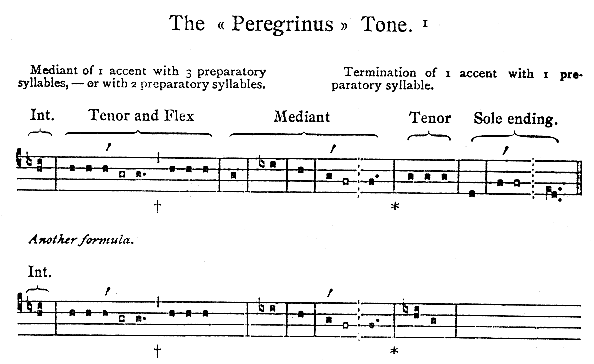
Below is an image of the Tonus Peregrinus in the old square-note notation.     (Keep in mind that chant notation can be difficult to read if you're not used to it - but picking up the Psalm Tone melodies by ear is actually quite easy.  That's the way I learned, and I recommend it highly.  You'll find an audio file (mp3) of the chant further down the page - and there are links to all the Tones at the bottom of this post.)  

Here's an image of the Tonus Peregrinus in modern notation from the Lutheran Liturgical Prayer Brotherhood Psalmody Page (they call it "Tone 9," actually).  The stuff in the parenthesis is the "flex," used for the first half of the Psalm for a particularly long verse; it's rarely used, so you can safely ignore it for now.  Remember, too, that the "incipit" - the notes in the very first measure - are only used once, when singing the first verse; for all subsequent verses, skip directly to the "reciting tone," which is the first note of the second measure, used until you get to the end of the line.  (The "reciting tone" is the repetitive note in the chant; it's indicated on the score by the dark, heavy doubled note.)   


Follow along with either notation, while listening to an mp3 of Psalm 114 sung to the Tonus Peregrinus, again taken from the LLBP Psalmody page.    The mp3 includes an antiphon (text:  "Tremble thou earth at the presence of the Lord, the God of Jacob") sung before and after the Psalm; don't be confused by the antiphon's melody, which is completely different from that of the Psalm Tone.   Remember:  it's quite easy to pick up these melodies by ear, so don't be discouraged!  Just keep listening and singing.

The translation on the mp3 is the King James Version:
Antiphon:  Tremble thou earth at the presence of the Lord, the God of Jacob

1 When Israel went out of Egypt,
the house of Jacob from a people of strange language;

2 Judah was his sanctuary,
and Israel his dominion.

3 The sea saw it, and fled:
Jordan was driven back.

4 The mountains skipped like rams,
and the little hills like lambs.

5 What ailed thee, O thou sea, that thou fleddest?
thou Jordan, that thou wast driven back?

6 ye mountains, that ye skipped like rams;
and ye little hills, like lambs?

7 Tremble, thou earth, at the presence of the Lord,
at the presence of the God of Jacob;

8 which turned the rock into a standing water,
the flint into a fountain of waters.

Antiphon:  Tremble thou earth at the presence of the Lord, the God of Jacob


Since the above links no longer work, here's a video of Psalm 114 sung, in Latin, to the Tonus Peregrinus.  (I will figure out how to deal with my previous entries at a later date.)


(Here's an even older look at the square-note notation for the TP, courtesy of the Order of St. Benedict.    These charts are quite a bit more confusing, though, I think - so look at it later, after you've gotten more of the hang of the thing by singing:


)


Here is a good, one-page tutorial on chant notation. On the left is the old Gregorian style; on the right is modern musical notation.

In my opinion, one of the most important things to know - and one of the only things you can't figure out on your own without hearing the music - is the "podatus." Here it is, first in Gregorian notation:


As the tutorial says: "When one note is written above another note like this, the bottom note is sung first, and then the note above it." Here's the modern notation:


That one is used over and over again, and many other neume-types are created from it.


At Sunday Vespers, Psalm 114 is sung using this tone; it's the only time I've ever heard it used in the Divine Office. The name, of course, means "Wandering Tone" (literally, "Pilgrim Tone"), and it's fitting to use it to sing Psalm 114, since it describes Israel's flight from Egypt. (At the Vespers I attend, Psalm 115 - "Non nobis, Domine" - is tacked on to 114.) This is also the only tone in which the intonation is sung at every Psalm verse. The tune is very old, according to this page that seems to have something to do with Boston Camerata:
The synagogue gave to the Early Christian church some of its ancient melodies; the recitation formula of the psalm B'tset Yisrael ("When Israel went forth out of Egypt"), for example, survives in the Gregorian chant repertoire as the tonus peregrinus. It is thanks to a Christian that we have the oldest surviving example of written-down Jewish music, the beautiful Eulogy of Moses.


Here are Chantblog pages for all the Psalm Tones, with sound files included at each entry:

Psalm Tones: Tone 8

Below is an image of Tone 8 in the old square-note notation; the main melody is labeled "VIII"), and it's followed by three different possible endings, labeled "G," G*," and "c."      (Keep in mind that chant notation can be difficult to read if you're not used to it - but picking up the Psalm Tone melodies by ear is actually quite easy.  That's the way I learned, and I recommend it highly.  You'll find an audio file (mp3) of the chant further down the page - and there are links to all the Tones at the bottom of this post.)


Here's an image of Tone 8 in modern notation, with only one ending, from the Lutheran Liturgical Prayer Brotherhood Psalmody Page.   The stuff in the parenthesis is the "flex," sung in the first half of the Psalm for a particularly long verse; it's rarely used, so you can safely ignore it for now.  Remember, too, that the "incipit" - the notes in the very first measure - are only used once, when singing the first verse; for all subsequent verses, skip directly to the "reciting tone," which is the first note of the second measure, used until you get to the end of the line.  (The "reciting tone" is the repetitive note in the chant; it's indicated on the score by the dark, heavy doubled note.)  Don't worry too much about endings now, either; you can easily pick that stuff up as you go.  (The singers in the mp3 below are using ending G shown above, which is the same as the one ending shown below in the modern notation.)


(The notes of the chant melody pictured here - it's Lutheran-style - are slightly different, in a couple of places, from what's on the audio file linked below.  There are regional and other variations in Psalm-singing.)

Follow along with either notation, while listening to an mp3 of Psalm 93 sung to Tone 8 by the St. David's Episcopal Church, Austin, Compline Choir.       The mp3 includes an antiphon (text:  "Mighty is the Lord who dwells on high") sung before and after the Psalm; don't be confused by the antiphon's melody, which is completely different from that of the Psalm Tone.   Remember:  it's quite easy to pick up these melodies by ear, so don't be discouraged!  Just keep listening and singing.

The translation on the audio file is from the 1979 U.S. Book of Common Prayer:
Antiphon:  Mighty is the Lord who dwells on high

1 The LORD is King;
he has put on splendid apparel; *
the LORD has put on his apparel
and girded himself with strength.

2 He has made the whole world so sure *
that it cannot be moved;

3 Ever since the world began, your throne has been established; *
you are from everlasting.

4 The waters have lifted up, O LORD,
the waters have lifted up their voice; *
the waters have lifted up their pounding waves.

5 Mightier than the sound of many waters,
mightier than the breakers of the sea, *
mightier is the LORD who dwells on high.

6 Your testimonies are very sure, *
and holiness adorns your house, O LORD,
for ever and for evermore.

Antiphon:  Mighty is the Lord who dwells on high


(Here's an even older look at the square-note notation for Tone 8, courtesy of the Order of St. Benedict;  you can see its three endings here, too - along with an alternate for the chant itself.  These charts are quite a bit more confusing, though, I think - so look at it later, after you've gotten more of the hang of the thing by singing:

)


Here is a good, one-page tutorial on chant notation. On the left is the old Gregorian style; on the right is modern musical notation.

In my opinion, one of the most important things to know - and one of the only things you can't figure out on your own without hearing the music - is the "podatus." Here it is, first in Gregorian notation:


As the tutorial says: "When one note is written above another note like this, the bottom note is sung first, and then the note above it." Here's the modern notation:


That one is used over and over again, and many other neume-types are created from it.


Here are Chantblog pages for all the Psalm Tones, with sound files included at each entry:

Tuesday, August 01, 2006

Psalm Tones: Tone 7

Below is an image of Tone 7 in the old square-note notation; the main melody is labeled "VII," and there are five different possible endings that can be used (labeled "a," "b," "c," "c2," and "d").      (Keep in mind that chant notation can be difficult to read if you're not used to it - but picking up the Psalm Tone melodies by ear is actually quite easy.  That's the way I learned, and I recommend it highly.  You'll find an audio file (mp3) of the chant further down the page - and there are links to all the Tones at the bottom of this post.)


Here's an image of Tone 7 in modern notation, without endings, from the Lutheran Liturgical Prayer Brotherhood Psalmody Page.   The stuff in the parenthesis is the "flex," sung in the first half of the Psalm for a particularly long verse; it's rarely used, so you can safely ignore it for now.  Remember, too, that the "incipit" - the notes in the very first measure - are only used once, when singing the first verse; for all subsequent verses, skip directly to the "reciting tone," which is the first note of the second measure, used until you get to the end of the line.  (The "reciting tone" is the repetitive note in the chant; it's indicated on the score by the dark, heavy doubled note.)  Don't worry too much about endings now, either; you can easily pick that stuff up as you go.


The incipit is not used in the mp3 sample below; that's because the first line of the Psalm is very short, and the incipit is not needed.  So the singing begins with the large note at the start of the second measure.


Follow along with either notation, while listening to an mp3 of Psalm 8 sung to Tone 7 (they're using ending "b" above) by the St. David's Episcopal Church, Austin, Compline Choir.      The mp3 includes an antiphon (text:  "How exalted is your name O Lord in all the world") sung before and after the Psalm; don't be confused by the antiphon's melody, which is completely different from that of the Psalm Tone.   Remember:  it's quite easy to pick up these melodies by ear, so don't be discouraged!  Just keep listening and singing.

The translation on the audio file is from the 1979 U.S. Book of Common Prayer:

Antiphon:  How exalted is your name O Lord in all the world

1 O LORD our Governor, *
how exalted is your Name in all the world!

2 Out of the mouths of infants and children *
your majesty is praised above the heavens.

3 You have set up a stronghold against your adversaries, *
to quell the enemy and the avenger.

4 When I consider your heavens, the work of your fingers, *
the moon and the stars you have set in their courses,

5 What is man that you should be mindful of him? *
the son of man that you should seek him out?

6 You have made him but little lower than the angels; *
you adorn him with glory and honor;

7 You give him mastery over the works of your hands; *
you put all things under his feet:

8 All sheep and oxen, *
even the wild beasts of the field,

9 The birds of the air, the fish of the sea, *
and whatsoever walks in the paths of the sea.

10 O LORD our Governor, *
how exalted is you Name in all the world!

Antiphon:  How exalted is your name O Lord in all the world


(Here's an even older look at the square-note notation for Tone 7, courtesy of the Order of St. Benedict;  you can see its five endings here, too.  These charts are quite a bit more confusing, though, I think - so look at it later, after you've gotten more of the hang of the thing by singing:

)

Here is a good, one-page tutorial on chant notation. On the left is the old Gregorian style; on the right is modern musical notation.

In my opinion, one of the most important things to know - and one of the only things you can't figure out on your own without hearing the music - is the "podatus." Here it is, first in Gregorian notation:


As the tutorial says: "When one note is written above another note like this, the bottom note is sung first, and then the note above it." Here's the modern notation:


That one is used over and over again, and many other neume-types are created from it.


Here are some links that might be interesting to you:
  • Many topics of interest here, at the Lutheran Liturgical Prayer Brotherhood website: PDFs on "Psalm Tone Distribution Table—Only know one or two Psalm tones? Find the Psalms that use the tones you know by using this index"; "Seasonal Psalm Tones—These tones may be used when the Brotherhood Prayer Book does not specify any tone, such as for responsories and canticles in the Seasonal Propers, Saint’s Day Propers, and Common of Saints."; etc. And there's an interesting page full of "questions and comments" here.
  • Liturgica.com (where on this page you'll hear "The Kontakion of the Annunciation from Cycles of Grace," and of course don't forget to click around to listen to the many chant clips all over the site), a "new content" article titled The Return of Chant: Rediscovering the Church’s Musical Tradition. That one's about the Catholic Church, and the writers have also put up
  • Another page titled Sacred Music and Its Time: Articles on Liturgy, Chant, and polyphony. Lots of PDFs and text files there, too, again from the Catholic perspective.


Here are Chantblog pages for all the Psalm Tones, with sound files included at each entry:

Thursday, July 27, 2006

Psalm Tones: Tone 6

Below is an image of Tone 6 in the old square-note notation; there's an alternate melody shown here as well.      (Keep in mind that chant notation can be difficult to read if you're not used to it - but picking up the Psalm Tone melodies by ear is actually quite easy.  That's the way I learned, and I recommend it highly.  You'll find an audio file (mp3) of the chant further down the page - and there are links to all the Tones at the bottom of this post.)


Here's an image of Tone 6 - just the first melody above - in modern notation, from the Lutheran Liturgical Prayer Brotherhood Psalmody Page.   The stuff in the parenthesis is the "flex," sung in the first half of the Psalm for a particularly long verse; it's rarely used, so you can safely ignore it for now.  Remember, too, that the "incipit" - the notes in the very first measure - are only used once, when singing the first verse; for all subsequent verses, skip directly to the "reciting tone," which is the first note of the second measure, used until you get to the end of the line.  (The "reciting tone" is the repetitive note in the chant; it's indicated on the score by the dark, heavy doubled note.) 


(Notice that the melody in this score - it's Lutheran-style  - is just slightly different than what's pictured in the images above.   There are regional and other variations in Psalm-singing.)

Follow along with either notation, while listening to an mp3 of Psalm 112 sung to Tone 6 from the Lutheran Liturgical Prayer Brotherhood Psalmody page.      The mp3 includes an antiphon (text:  "The generation of the upright shall be blessed") sung before and after the Psalm; don't be confused by the antiphon's melody, which is completely different from that of the Psalm Tone.   Remember:  it's quite easy to pick up these melodies by ear, so don't be discouraged!  Just keep listening and singing.

The translation is the King James Version:
Antiphon:  The generation of the upright shall be blessed

1 Praise ye the LORD.
Blessed is the man that feareth the LORD,
that delighteth greatly in his commandments.

2 His seed shall be mighty upon earth:
the generation of the upright shall be blessed.

3 Wealth and riches shall be in his house:
and his righteousness endureth for ever.

4 Unto the upright there ariseth light in the darkness:
he is gracious, and full of compassion, and righteous.

5 A good man showeth favor, and lendeth:
he will guide his affairs with discretion.

6 Surely he shall not be moved for ever:
the righteous shall be in everlasting remembrance.

7 He shall not be afraid of evil tidings:
his heart is fixed, trusting in the LORD.

8 His heart is established, he shall not be afraid,
until he see his desire upon his enemies.

9 He hath dispersed,
he hath given to the poor;
his righteousness endureth for ever;
his horn shall be exalted with honor.

10 The wicked shall see it, and be grieved;
he shall gnash with his teeth, and melt away:
the desire of the wicked shall perish.

Antiphon:  The generation of the upright shall be blessed

(Here's an even older look at the square-note notation for Tone 6, courtesy of the Order of St. Benedict;  you can the alternate melody here, too.  These charts are quite a bit more confusing, though, I think - so look at it later, after you've gotten more of the hang of the thing by singing:


)


Here is a good, one-page tutorial on chant notation. On the left is the old Gregorian style; on the right is modern musical notation.
In my opinion, one of the most important things to know - and one of the only things you can't figure out on your own without hearing the music - is the "podatus." Here it is, first in Gregorian notation:


As the tutorial says: "When one note is written above another note like this, the bottom note is sung first, and then the note above it." Here's the modern notation:


That one is used over and over again, and many other neume-types are created from it.


Here are Chantblog pages for all the Psalm Tones, with sound files included at each entry:

Psalm Tones: Tone 5

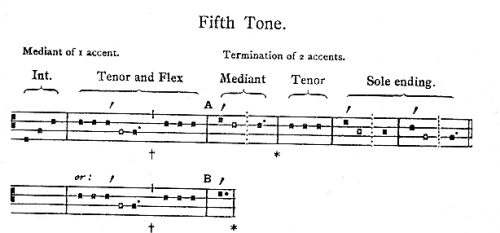
Below is an image of Tone 5 in the old square-note notation   (Keep in mind that chant notation can be difficult to read if you're not used to it - but picking up the Psalm Tone melodies by ear is actually quite easy.  That's the way I learned, and I recommend it highly.  You'll find an audio file (mp3) of the chant further down the page - and there are links to all the Tones at the bottom of this post.) . 


Here's an image of Tone 5 in modern notation, from the Lutheran Liturgical Prayer Brotherhood Psalmody Page.     The stuff in the parenthesis is the "flex," sung in the first half of the Psalm for a particularly long verse; it's rarely used, so you can safely ignore it for now.  Remember, too, that the "incipit" - the notes in the very first measure - are only used once, when singing the first verse; for all subsequent verses, skip directly to the "reciting tone," which is the first note of the second measure, used until you get to the end of the line.   (The "reciting tone" is the repetitive note in the chant; it's indicated on the score by the dark, heavy doubled note.) 

(The notes of the chant melody pictured here - it's Lutheran-style - are slightly different from what's on the audio file linked below.  There are regional and other variations in Psalm-singing.)

Follow along with either notation, while listening to an mp3 of Psalm 142 sung to Tone 5 by the St. David's Episcopal Church, Austin, Compline Choir.      The mp3 includes an antiphon (text:  "You are my refuge O Lord, my portion in the land of the living") sung before and after the Psalm; don't be confused by the antiphon's melody, which is completely different from that of the Psalm Tone.   Remember:  it's quite easy to pick up these melodies by ear, so don't be discouraged!  Just keep listening and singing.

The translation is from the 1979 U.S. Book of Common Prayer:
Antiphon:  You are my refuge O Lord, my portion in the land of the living

1 I cry to the LORD with my voice; *
to the LORD I make loud supplication.

2 I pour out my complaint before him *
and tell him all my trouble.

3 When my spirit languishes within me, you know my path; *
in the way wherein I walk they have hidden a trap for me.

4 I look to my right hand and find no one who knows me; *
I have no place to flee to, and no one cares for me.

5 I cry out to you, O LORD; *
I say, "You are my refuge,
my portion in the land of the living."

6 Listen to my cry for help, for I have been brought very low; *
save me from those who pursue me,
for they are too strong for me.

7 Bring me out of prison, that I may give thanks to your Name; *
when you have dealt bountifully with me,
the righteous will gather around me.

Antiphon:  You are my refuge O Lord, my portion in the land of the living

(Here's an even older look at the square-note notation for Tone 5, courtesy of the Order of St. Benedict.  These charts are quite a bit more confusing, though, I think - so look at it later, after you've gotten more of the hang of the thing by singing:

)


Here is a good, one-page tutorial on chant notation. On the left is the old Gregorian style; on the right is modern musical notation.

In my opinion, one of the most important things to know - and one of the only things you can't figure out on your own without hearing the music - is the "podatus." Here it is, first in Gregorian notation:


As the tutorial says: "When one note is written above another note like this, the bottom note is sung first, and then the note above it." Here's the modern notation:


That one is used over and over again, and many other neume-types are created from it.


Here are Chantblog pages for all the Psalm Tones, with sound files included at each entry:

Psalm Tones: Tone 4

Below are images of Tone 4 in the old square-note notation; notice that there is a main melody (labeled "IV"), with two possible endings (labeled "g" and "E"), and also an alternate melody (labeled "IV alt" - although as far as I can see it's actually just the same melody as "IV", displayed on a different line of the score), with four possible endings (labeled "c," "A," "A*," and "d").    (Keep in mind that chant notation can be difficult to read if you're not used to it - but picking up the Psalm Tone melodies by ear is actually quite easy.  That's the way I learned, and I recommend it highly.  You'll find an audio file (mp3) of the chant further down the page - and there are links to all the Tones at the bottom of this post.)

Here's an image of Tone 4, without endings and in modern notation, from the Lutheran Liturgical Prayer Brotherhood Psalmody Page.      The stuff in the parenthesis is the "flex," sung in the first half of the Psalm for a particularly long verse; it's rarely used, so you can safely ignore it for now.  Remember, too, that the "incipit" - the notes in the very first measure - are only used once, when singing the first verse; for all subsequent verses, skip directly to the "reciting tone," which is the first note of the second measure, used until you get to the end of the line.  (The "reciting tone" is the repetitive note in the chant; it's indicated on the score by the dark, heavy doubled note.)  Don't worry too much about endings now, either; you can easily pick that stuff up as you go.


(Keep in mind that this is Lutheran style Psalm-singing; the melodies are slightly different from those pictured in the images above.)

Follow along with either notation, while listening to an mp3 of Psalm 113 sung to Tone 4 (he's using ending "A" above) from the Lutheran Liturgical Prayer Brotherhood Psalmody page.   The mp3 includes an antiphon (text:  "Blessed be the name of the Lord from this time forth and forevermore") sung before and after the Psalm; don't be confused by the antiphon's melody, which is completely different from that of the Psalm Tone.   Remember:  it's quite easy to pick up these melodies by ear, so don't be discouraged!  Just keep listening and singing.

The translation is the King James Version:
Antiphon:  Blessed be the name of the Lord from this time forth and forevermore

1 Praise ye the LORD.
Praise, O ye servants of the LORD,
praise the name of the LORD.

2 Blessed be the name of the LORD
from this time forth and for evermore.

3 From the rising of the sun
unto the going down of the same
the LORD's name is to be praised.

4 The LORD is high above all nations,
and his glory above the heavens.

5 Who is like unto the LORD our God,
who dwelleth on high,

6 who humbleth himself to behold
the things that are in heaven, and in the earth!

7 He raiseth up the poor out of the dust,
and lifteth the needy out of the dunghill;

8 that he may set him with princes,
even with the princes of his people.

9 He maketh the barren woman to keep house,
and to be a joyful mother of children.
Praise ye the LORD.

Antiphon:  Blessed be the name of the Lord from this time forth and forevermore

(Here's an even older look at the square-note notation for Tone 4, courtesy of the Order of St. Benedict;  you can see its two possible melodic interpretations, and its total of five possible endings, here as well.  These charts are quite a bit more confusing, though, I think - so look at it later, after you've gotten more of the hang of the thing by singing:


)


Here is a good, one-page tutorial on chant notation. On the left is the old Gregorian style; on the right is modern musical notation.

In my opinion, one of the most important things to know - and one of the only things you can't figure out on your own without hearing the music - is the "podatus." Here it is, first in Gregorian notation:


As the tutorial says: "When one note is written above another note like this, the bottom note is sung first, and then the note above it." Here's the modern notation:


That one is used over and over again, and many other neume-types are created from it.

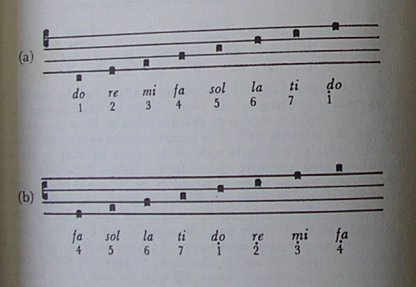
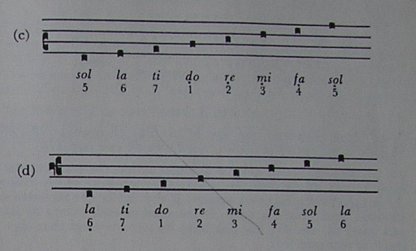
Gregorian melodies are written on a staff of four lines and three spaces (as opposed to modern music, which is written on a staff of five lines and four spaces). The notes indicated on the lines or in the spaces of the staff represent those of the sol-fa system (the usual do re mi deal). The sol-fa scale consists of eight notes comprising an octave; each of the eight notes is one whole tone from the one before it, except for fa and do, which are only a half-tone higher than mi and ti respectively. This is the regular major "doe-a-deer" scale; nothing complicated about it, really.

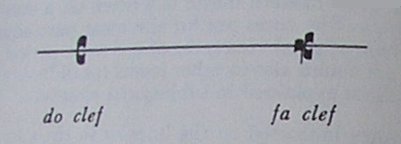
The notation uses one of two clefs to designate either do or fa on the staff. These are moveable and not fixed as they are in modern notation: the do clef may appear on the second, third, or fourth line from the bottom (but is usually found on the third or fourth); the fa clef may appear on the third or fourth line (but most often on the third):


The choice and position of clef are determined by the range of the melody. A particular clef is chosen and located so that the melody will fit conveniently within the lines of the staff. It all sounds very complicated, but really it's done simply for convenience. One more interesting point: there are no sharps in Gregorian Chant, and only one note - ti - may be flatted. When it is, it's called te instead.

Below are some staffs that show the various positions of the clefs and their influence on the notes:


Here are Chantblog pages for all the Psalm Tones, with sound files included at each entry:


Psalm Tones: Tone 3

Below is an image of Tone 3 in the old square-note notation; the main melody is labeled "III," and there are five possible endings (labeled "b," "a," "a2," "g," and "g2") to the main melody of the chant.     (Keep in mind that chant notation can be difficult to read if you're not used to it - but picking up the Psalm Tone melodies by ear is actually quite easy.  That's the way I learned, and I recommend it highly.  You'll find an audio file (mp3) of the chant further down the page - and there are links to all the Tones at the bottom of this post.) 


Here's an image of Tone 3, without endings and in modern notation, from the Lutheran Liturgical Prayer Brotherhood Psalmody Page.    The stuff in the parenthesis is the "flex," sung in the first half of the Psalm for a particularly long verse; it's rarely used, so you can safely ignore it for now.  Remember, too, that the "incipit" - the notes in the very first measure - are only used once, when singing the first verse; for all subsequent verses, skip directly to the "reciting tone," which is the first note of the second measure, used until you get to the end of the line.  (The "reciting tone" is the repetitive note in the chant; it's indicated on the score by the dark, heavy doubled note.)  Don't worry too much about endings now, either; you can easily pick that stuff up as you go.


(The notes of the chant melody pictured here - it's Lutheran-style - are slightly different from what's on the audio file linked below.  There are regional and other variations in Psalm-singing.)


Follow along with either notation, while listening to an mp3 of the first 17 verses of Psalm 139 sung to Tone 3 (they are using ending "a" here) by the St. David's Episcopal Church, Austin, Compline Choir.    The mp3 includes an antiphon (text:  "The night shall be as clear as the day; Alleluia") sung before and after the Psalm; don't be confused by the antiphon's melody, which is completely different from that of the Psalm Tone.   Remember:  it's quite easy to pick up these melodies by ear, so don't be discouraged!  Just keep listening and singing.

The translation is from the 1979 U.S. Book of Common Prayer:
Antiphon:  The night shall be as clear as the day; Alleluia

1 LORD, you have searched me out and known me; *
you know my sitting down and my rising up;
you discern my thoughts from afar.

2 You trace my journeys and my resting-places *
and are acquainted with all my ways.

3 Indeed, there is not a word on my lips, *
but you, O LORD, know it altogether.

4 You press upon me behind and before *
and lay your hand upon me.

5 Such knowledge is too wonderful for me; *
it is so high that I cannot attain to it.

6 Where can I go then from your Spirit? *
where can I flee from your presence?

7 If I climb up to heaven, you are there; *
if I make the grave my bed, you are there also.

8 If I take the wings of the morning *
and dwell in the uttermost parts of the sea,

9 Even there your hand will lead me *
and your right hand hold me fast.

10 If I say, "Surely the darkness will cover me, *
and the light around me turn to night,"

11 Darkness is not dark to you;
the night is as bright as the day; *
darkness and light to you are both alike.

12 For you yourself created my inmost parts; *
you knit me together in my mother's womb.

13 I will thank you because I am marvelously made; *
your works are wonderful, and I know it well.

14 My body was not hidden from you, *
while I was being made in secret
and woven in the depths of the earth.

15 Your eyes beheld my limbs, yet unfinished in the womb;
all of them were written in your book; *
they were fashioned day by day,
when as yet there was none of them.

16 How deep I find your thoughts, O God! *
how great is the sum of them!

17 If I were to count them, they would be more in number than the sand; *
to count them all, my life span would need to be like yours.

Antiphon:  The night shall be as clear as the day; Alleluia


(Here's an even older look at the square-note notation for Tone 3, courtesy of the Order of St. Benedict;  you can see its five possible endings here, too.  These charts are quite a bit more confusing, though, I think - so look at it later, after you've gotten more of the hang of the thing by singing:


Here is a good, one-page tutorial on chant notation. On the left is the old Gregorian style; on the right is modern musical notation.

In my opinion, one of the most important things to know - and one of the only things you can't figure out on your own without hearing the music - is the "podatus." Here it is, first in Gregorian notation:


As the tutorial says: "When one note is written above another note like this, the bottom note is sung first, and then the note above it." Here's the modern notation:


That one is used over and over again, and many other neume-types are created from it.


I learned to Psalm-sing at a local convent - and I was actually learning chant the way people did, probably, in the monastic communities of the Middle Ages.  That is, by listening to it and then simply beginning to sing.   I can easily now pick up one of these tones and sing the various endings; it's all much easier than you'd think when you're starting out!  Again:  it's much easier to simply start singing than it is to read drawn-out descriptions of how to sing!  Sing along with the mp3, and you'll start getting it very quickly.


Here are Chantblog pages for all the Psalm Tones, with sound files included at each entry:

LinkWithin

Related Posts Plugin for WordPress, Blogger...