Showing posts with label ambrosian chant. Show all posts

Friday, November 25, 2011

Audite Verbum: An Advent Matins Responsory

Canto ambrosiano, Avvento, Responsorio AUDITE VERBUM, Schola Gregoriana Mediolanensis, Giovanni Vianini, Milano, Italia - YouTube

That's an Ambrosian Chant version of the Advent Responsory, Audite verbum.

Here's something about this Responsory from the 1918 book, Liturgica historica: papers on the liturgy and religious life of the Western church, available in full at the Google Books link. (Psst, Derek: It looks like quite a good resource!)
At the end of each lesson for matins, i. e. the night office, is a long responsory which, in its simplest form, is thus made up: first, a biblical text (or an adaptation of one), which is the 'responsory' in a strict sense; on which follows a 'verse', also from Scripture; and after that the second half (or part) of the preceding 'responsory'.

For instance, .... the responsory at the end of the eighth lesson at matins of the first Sunday of Advent:—Responsory: 'Audite verbum Domini gentes, et annuntiate illud in finibus terrae *. Et insulis quae procul sunt dicite: Salvator noster adveniet.' Verse: 'Annuntiate, et auditum facite: loquimini et clamate.' And then comes a repetition of the second half of the 'responsory' proper: * Et insulis quae procul sunt dicite: Salvator noster adveniet.' It is obvious that, with an arrangement of this kind, to be tolerable at all the ' verse' must be such that its last words, when followed by the second half of the 'responsory', will make sense and form a continuous phrase. But the authentic and native Roman method of singing these responsories knew no need for such clever dovetailings; for according to that Roman method the ' responsory' was simply repeated in its entirety after the 'verse'.


The translation found at Divinum Offocium for this Responsory (along with the entire service of Matins - another good resource) is:
R. Hear the word of the Lord, O ye nations, and declare it in the ends of the earth * And in the isles afar off, and say Our Saviour shall come.
V. Declare it and make it known, lift up your voice and cry aloud.
R. And in the isles afar off, and say Our Saviour shall come.

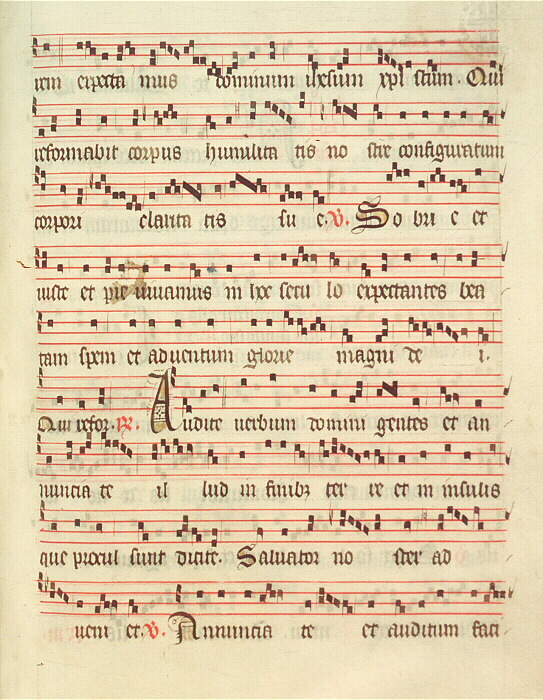
The Medieval Music Database has a page on this responsory, as well, along with a page from The Poissy Antiphonal. This is a different tune, though:
Friday, May 13, 2011

Misericordia Domini ("The Mercy of the Lord"): the Introit for the Fourth Sunday of Easter


Here's an mp3 of this Introit, from JoguesChant; their translation of this text from Psalm 33:5-6, then 1:
The earth is full of the mercy of the Lord, alleluia; by the word of the Lord, the heavens were established, alleluia, alleluia. Rejoice in the Lord, O you righteous! Praising befits those who are upright.
The chant propers for today were once used on the previous Sunday; I'm not sure why everything got moved back one week, but will try to find out.

These days, this is "Good Shepherd Sunday," reflected both in the reading from John and the Alleluia and Communion Song which both use the text Ego sum Pastor bonus - "I am the Good Shepherd."

Here's the chant score for the Alleluia:


Here's a video labeled "Domenica IV di Pasqua - Alleluja" - but it's definitely not the chant in the score above! As far as I can tell - by going to the YouTube uploader's page - it's an Ambrosian chant version of the Alleluia. And it is beautiful!


That was recorded in 2008; here's the same chant from 2009:


I must get to know more about Ambrosian chant! I'll be checking out that YouTube account to get the skinny, I promise.

Here's the (Gregorian) Communio, with the score embedded in the video:


(I must add that, strangely enough, our reading from John leaves "I am the Good Shepherd" out entirely!  We read only John:1-10, but the Good Shepherd parts of the text are in verses 14 (the Communion Song) and 11 (the Alleluia above) (see all of John 10 here).   Very odd!   But, we do get these verses (11-16) in Year B, so we'll hear them eventually.)

And how about this, for Good Shepherd Sunday? Wikipedia says it's from around 300 CE; that it's marble, 92cm high, and that the legs have been restored. The sculpture resides in the Vatican Museum in Rome.

Wednesday, January 14, 2009

A wonderful YouTube chant resource

Is here: at "vianinigiovanni"'s page. The credit on many of the video reads, "Giovanni Vianini, Cantore e direttore Schola Gregoriana Mediolanensis, Milano, Italia."

Giovanni Vianini is obviously the cantor and director of the Schola Gregoriana Mediolanensis, in Milan; I'm not sure if that's his page (I think it is), or if it's a fan's page dedicated to him. The Canto Ambrosiano website says this about Vianini:
Giovanni Vianini, 62, of Cremona descents, begins his musical activity at 8 years old as cantor, contralto, in the Musical chapel of Milan's Chatedral managed by the Master Pietro Dentella.

Actually, he works in Milan in the liturgical sacred music field, vocal and instrumental. Organist and studious of organistic, he has built 30 organs with mechanical transmission, diversifing with the passing of time the own musical skill.

He devoted himself to the medieval music ( studying with the psaltery and the provenzal harp), to the Renaissance music, with the studying of the wind instruments ( chalmey, dulciana, cromorni and straight flutes).

His musical engagement is principally turned to the studying, divulgation and practice in liturgy of Ambrosian and Gregorian singing. He is Director of the Schola Gregoriana Mediolanensis chor, school instituited on 1981 and composed of 50 choristers. Every year he keeps a starting course to the Ambrosian and Gregorian singing ( with 100 members ).

For 10 years he has been Director of S. Marco Basilica Musical Chapel in Milan with the presence in several liturgical exhibithion and concerts of sacred music: besides he has organizes the " Gregorian Chant" and sacred polyphony review " Musical Spring" in S. Marco Basilica.

49 years of liturgical exhibithion as choir chorister, organist and choir director. Every second sunday of the month , the Schola Gregoriana Mediolanensis sings during the evening Mass at 6.00 p.m. in Chiaravalle Abbey in Milan with a Gregorian chant program.

Every fourth sunday of the month , the Schola Gregoriana Mediolanensis sings during the evening Mass at 6.30 p.m. in S. Marco Basilica in Milan with an Ambrosian chant program.


Anyway, there are dozens of videos there, and most are chant-oriented. Here's one labeled "TENEBRAE FACTAE SUNT, Responsorio ambrosiano" (an Ambrosian responsory, that is, I believe for Good Friday, but will look more at this):


[EDIT: I notice the video itself says this "Responsoria Settimana Santa," which I'm told means "Responsory for Holy Week." There's something there about "Feria VI. in Parasceve," too, and I'm not sure what that means. The chant score itself says that this is sung "After the Second Reading."]

[EDIT II: But then the note on the web page says this:
Responsorio ambrosiano per il Venerdi Santo, si trova a pagina 180 dell'Antifonale Ambrosiano edito da Desclee' e Socii (Roma?) Tournai, Belgium 1935. Schola Gregoriana Mediolanensis, solista e direttore Giovanni Vianini, Milano, Italia, www.cantogregoriano.it, studio del canto gregoriano ed ambrosiano, Polifonia medievale


And that says "Holy Friday," for sure. This was found in an Ambrosian Antiphonal, apparently.]

Anyway, the whole score is there, which is great.

HT to massinformation (I think that's where I saw it first, anyway).

Saturday, July 30, 2005

Ambrosian Chant

From The Catholic Encyclopedia:
The question as to what constitutes Ambrosian chant in the sense of chant composed by St. Ambrose has been for a long time, and still is, a subject for research and discussion among historians and archæologists. When the saint became Bishop of Milan, in 374, he found a liturgy in use which tradition associates with St. Barnabas. It is presumed that this liturgy, which was brought from Greece and Syria, included singing by the celebrant as well as the spoken word and liturgical action. On the other hand, it is certain that the greater part of the chants now used in connection with the Ambrosian, or Milanese, rite, which are frequently designated in the wider sense as Ambrosian chant, originated in subsequent centuries as the liturgy was developed and completed. So far no documents have been brought to light which would prove that the saint composed anything except the melodies to most of his hymns. Of a large number of hymns attributed to him, only fourteen are pronounced with certainty to be his, while four more may be assigned to him with more or less probability. Like any other great man who dominates his time, St. Ambrose had many imitators, and it so happened that hymns written by his contemporaries or those who came after him, in the form which he used, that is, the Iambic dimeter, were called "Hymni Ambrosiani". The confusion brought about in the course of time by the indiscriminate use of this designation has necessitated endless study and research before it was decided with any degree of certainty which hymns were by St. Ambrose and which by his imitators. As regards the melodies, it has been equally difficult for archæologists to distinguish them and restore them to what was probably their original form.


Ambrose is traditionally regarded as the "father of Christian hymnody." A musical analysis from the same source:
The literature at the time of St. Ambrose shows that the Greek music was the only kind known to the saint and his contemporaries. St. Augustine, who wrote his unfinished work "De Musicâ" at about the time that St. Ambrose wrote his hymns, gives us an idea as to the form which the melodies must have had originally. He defines music as "the science of moving well" (scientia bene movendi) and the Iambic foot as consisting "of a short and a long, of three beats". As in the case of St. Ambrose we have poet and composer in one person, it is but natural to suppose that his melodies took the form and rhythm of his verses. The fact that these hymns were intended to be sung by the whole congregation, over which, according to the Arians, the saint cast a magic spell by means of his music, also speaks in favour of their having been syllabic in character and simple in rhythm. For several centuries it has been held that St. Ambrose composed what are now termed antiphons and responsories. There is no satisfactory proof that such is the case. The fact that he introduced the antiphonal (alternate) mode of singing the psalms and his own hymns (each of the latter had eight stanzas), by dividing the congregation into two choirs, probably gave rise to this opinion. The responsory as practised by direction of St. Ambrose consisted in intoning the verse of a psalm by one or more chanters and the repetition of the same by the congregation.


Ambrosian chant is also known as Milanese Chant:
Milanese chant is commonly known as Ambrosian chant, since it is attributed to St. Ambrose, bishop of Milan from 374 to 397, a time when the Western Roman emperor made it his capital. Hence it is sometimes called the oldest Western chant. This is ingenuous, for this makes a comparison of Ambrosian history with the oldest surviving manuscripts of other types of chant. Comprehensive Milanese chant manuscripts are no older than the twelfth century (some partial sources date from the preceding century). Mass and office chants occur continuously in the manuscripts, with separate books for winter and summer.

Yet St. Ambrose is credited with composing hymns, presumably texts and chants, for his people to sing while Arians were besieging them in their cathedral in 386. St. Augustine names four of these hymns that are still extant: Aeterne rerum conditor, Deus creator omnium, Jam surgit hora tertia, and Veni redemptor gentium. These all use the same meter, and later hymns of the same meter are called Ambrosian, and are sometimes attributed to St. Ambrose. Many of these have long been used in Gregorian as well as Milanese liturgical books.

Despite these early origins, Milanese chant is generally identified with the Lombard kingdom, founded in 569. Charlemagne became king of Lombardy by conquest in 774, and Carolingian kings of Italy ruled until 962. But the Carolingian insistence on Roman (that is, Gregorian) chant was ineffective in Lombardy. At the Council of Trent in the sixteenth century, the many local variants of the Roman rite were standardized, but Milan (and the part of northern Italy that formed its archdiocese) was allowed to retain its rite because of its antiquity. Modern editions of Mass chants in 1935 and Vespers in 1939 (no morning office was published) vary from the medieval sources.

The sung proper parts of the mass (with corresponding Gregorian terms noted) are ingressa (introit), psalmellus (gradual), alleluia, a chant after the gospel, offertorium (offertory), confractorium (in place of the ordinary Agnus Dei) and transitorium (communion).


Some Links:


LinkWithin

Related Posts Plugin for WordPress, Blogger...