Below is an image of Tone 2 in the old square-note notation. (Keep in mind that chant notation can be difficult to
read if you're not used to it - but picking up the Psalm Tone melodies
by ear is actually quite easy.
That's the way I learned, and I recommend it highly. You'll find an
audio file (mp3) of the chant further down the page - and there are
links to
all the Tones at the bottom of this post.)

Here's an image of Tone 2 in modern notation, from the Lutheran Liturgical Prayer Brotherhood Psalmody Page. The stuff in the parenthesis is the "flex," sung in the first half of the Psalm for a particularly long verse; it's rarely used, so you can safely ignore it for now. Remember, too, that the "incipit" - the notes in the very first measure - are only used once, when singing the first verse; for all subsequent verses, skip directly to the "reciting tone," which is the first note of the second measure, used until you get to the end of the line.

(The notes of the chant melody pictured here - it's Lutheran-style - are slightly different from what's on the audio file below. There are regional and other variations in Psalm-singing.)
Follow along with either notation, while listening to an mp3 of Psalm 129 sung to Tone 2 by the St. David's Episcopal Church, Austin, Compline Choir. The mp3 includes an antiphon (text: "My oppressor shall not prevail against me") sung before and after the Psalm; don't be confused by the antiphon's melody, which is completely different from that of the Psalm Tone. Remember: it's quite easy to pick up these melodies by ear, so don't be discouraged! Just keep listening and singing.
The translation is from the 1979 U.S. Book of Common Prayer:
(Here's an even older look at the square-note notation for Tone 2, courtesy of the Order of St. Benedict. These charts are quite a bit more confusing, though, I think - so look at it later, after you've gotten more of the hang of the thing by singing:
 )
)
Here is a good, one-page tutorial on chant notation. On the left is the old Gregorian style; on the right is modern musical notation.
In my opinion, one of the most important things to know - and one of the only things you can't figure out on your own without hearing the music - is the "podatus." Here it is, first in Gregorian notation:

As the tutorial says: "When one note is written above another note like this, the bottom note is sung first, and then the note above it." Here's the modern notation:

That one is used over and over again, and many other neume-types are created from it.
Tone 2 is quite well-known, as it's often used for Psalm 22 on Maundy Thursday. I'd thought for awhile that certain Psalms were "joined" to certain tones, but that isn't (necessarily) true. I don't think Psalm 22 is in the Lectionary except on Maundy Thursday, though; of course, if you sing the Monthly cycle from the BCP, you do get it at other times.
Interesting that for this tone, there is only one termination; I wonder why. My guess is that they knew a good thing when they heard it, and decided not to mess.
Here are Chantblog pages for all the Psalm Tones, with sound files included at each entry:
Here's an image of Tone 2 in modern notation, from the Lutheran Liturgical Prayer Brotherhood Psalmody Page. The stuff in the parenthesis is the "flex," sung in the first half of the Psalm for a particularly long verse; it's rarely used, so you can safely ignore it for now. Remember, too, that the "incipit" - the notes in the very first measure - are only used once, when singing the first verse; for all subsequent verses, skip directly to the "reciting tone," which is the first note of the second measure, used until you get to the end of the line.
(The notes of the chant melody pictured here - it's Lutheran-style - are slightly different from what's on the audio file below. There are regional and other variations in Psalm-singing.)
Follow along with either notation, while listening to an mp3 of Psalm 129 sung to Tone 2 by the St. David's Episcopal Church, Austin, Compline Choir. The mp3 includes an antiphon (text: "My oppressor shall not prevail against me") sung before and after the Psalm; don't be confused by the antiphon's melody, which is completely different from that of the Psalm Tone. Remember: it's quite easy to pick up these melodies by ear, so don't be discouraged! Just keep listening and singing.
The translation is from the 1979 U.S. Book of Common Prayer:
Antiphon: My oppressor shall not prevail against me
1 "Greatly have they oppressed me since my youth," *
let Israel now say;
2 "Greatly have they oppressed me since my youth, *
but they have not prevailed against me."
3 The plowmen plowed upon my back *
and made their furrows long.
4 The LORD, the Righteous One, *
has cut the cords of the wicked.
5 Let them be put to shame and thrown back, *
all those who are enemies of Zion.
6 Let them be like grass upon the housetops, *
which withers before it can be plucked;
7 Which does not fill the hand of the reaper, *
nor the bosom of him who binds the sheaves;
8 So that those who go by say not so much as,
"The LORD prosper you. *
We wish you well in the Name of the LORD."
Antiphon: My oppressor shall not prevail against me
(Here's an even older look at the square-note notation for Tone 2, courtesy of the Order of St. Benedict. These charts are quite a bit more confusing, though, I think - so look at it later, after you've gotten more of the hang of the thing by singing:
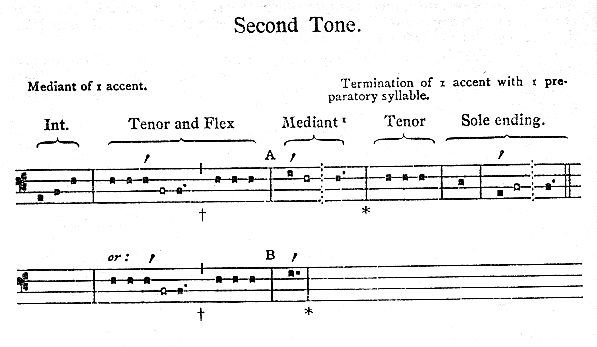
Here is a good, one-page tutorial on chant notation. On the left is the old Gregorian style; on the right is modern musical notation.
In my opinion, one of the most important things to know - and one of the only things you can't figure out on your own without hearing the music - is the "podatus." Here it is, first in Gregorian notation:
As the tutorial says: "When one note is written above another note like this, the bottom note is sung first, and then the note above it." Here's the modern notation:
That one is used over and over again, and many other neume-types are created from it.
Tone 2 is quite well-known, as it's often used for Psalm 22 on Maundy Thursday. I'd thought for awhile that certain Psalms were "joined" to certain tones, but that isn't (necessarily) true. I don't think Psalm 22 is in the Lectionary except on Maundy Thursday, though; of course, if you sing the Monthly cycle from the BCP, you do get it at other times.
Interesting that for this tone, there is only one termination; I wonder why. My guess is that they knew a good thing when they heard it, and decided not to mess.
Here are Chantblog pages for all the Psalm Tones, with sound files included at each entry:
- Tone 1 (with mp3)
- Tone 2 (with mp3)
- Tone 3 (with mp3)
- Tone 4 (with mp3)
- Tone 5 (with mp3)
- Tone 6 (with mp3)
- Tone 7 (with mp3)
- Tone 8 (with mp3)
- Tonus Peregrinus (with mp3)


