I realized recently that I've never completed the seasonal schedule of Daily Office Hymns! I went from Advent through the octave of Pentecost (skipping a few things that don't match up with modern practice, and more on those later) - but neglected Trinity Sunday, Corpus Christi, and the "Ordinary Time" hymns. "Ordinary Time" is a new designation, of course; what I mean is, the hymns used daily in the long non-festal periods (except for saints' days and All Saints/All Souls).
So I'll fix that now. According to Hymn melodies for the whole year, from the Sarum service-books, the hymns are:
(Follow along with the Offices for Trinity here, at Breviary Offices, from Lauds to Compline Inclusive (Society of St. Margaret, Boston, 1885). I'll link-in via iFrame at the bottom of this post, too.)
The above list would be this group of melodies - which, interestingly, are rarely or never used for any other day of the year:


Here's an mp3 of the St. David's Compline choir (of Austin, TX) singing Adesto, sancta Trinitas; they are using melody #43 above (but not the Neale translation below). The Lutheran Liturgical Prayer Brotherhood also offers an mp3, using the same melody.
Nethymnal has what they call the "Chartres melody" for Adesto, sancta Trinitas; below is the Latin text along with the John Mason Neale English translation:
This early polyphony piece by Philippe de Vitry (1291 - 1361) includes Adesto, sancta Trinitas as one of several texts - as far as I can tell so far - used in a kind of swirl of melody and verse:
So I'll fix that now. According to Hymn melodies for the whole year, from the Sarum service-books, the hymns are:
On Trinity Sunday & daily until Corpus Christi :
Evensong & Mattins: Adesto, sancta Trinitas ... ... ... 43 or 75
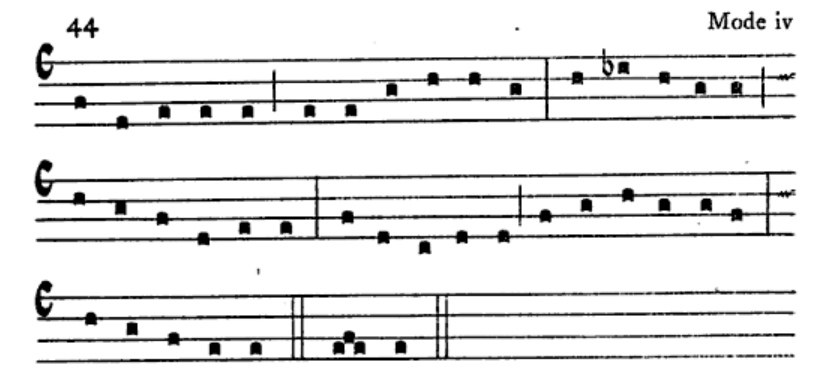
Lauds: O Pater sancte ... ... ... ... 44
(Follow along with the Offices for Trinity here, at Breviary Offices, from Lauds to Compline Inclusive (Society of St. Margaret, Boston, 1885). I'll link-in via iFrame at the bottom of this post, too.)
The above list would be this group of melodies - which, interestingly, are rarely or never used for any other day of the year:


Here's an mp3 of the St. David's Compline choir (of Austin, TX) singing Adesto, sancta Trinitas; they are using melody #43 above (but not the Neale translation below). The Lutheran Liturgical Prayer Brotherhood also offers an mp3, using the same melody.
Nethymnal has what they call the "Chartres melody" for Adesto, sancta Trinitas; below is the Latin text along with the John Mason Neale English translation:
Adesto Sancta Trinitas
Par splendor una Deitas
Qui extas rerum omnium
Sine fine principum.
Te celorum militia
Laudat adorat predicat
Triplexque mundi machina
Benedicit per saecula.
Assumus et nos cernui
Te adorantes famuli
Vota precesque supplicum
Ymnis junge caelestium.
Unum te lumen credimus
Quod et ter idem colimus
Alpha et O quem dicimus
Te laudet omnis spiritus.
Laus Patri sit ingenito
Laus Ejus Unigenito
Laus sit Sancto Spiritui
Trino Deo et simplici.
Amen.
Be present, holy Trinity,
like splendor, and one Deity;
of things above, and things below,
beginning, that no end shall know.
Thee all the armies of the sky
adore, and laud, and magnify;
and nature, in her triple frame,
for ever sanctifies thy Name.
And we, too, thanks and homage pay,
thine own adoring flock today;
O join to that celestial song
the praises of our suppliant throng!
Light, sole and one, we thee confess,
with triple praise we rightly bless;
Alpha and Omega we own,
with every spirit round thy throne.
To thee, O unbegotten One,
and thee, O sole-begotten Son,
and thee, O Holy Ghost, we raise
our equal and eternal praise.
This early polyphony piece by Philippe de Vitry (1291 - 1361) includes Adesto, sancta Trinitas as one of several texts - as far as I can tell so far - used in a kind of swirl of melody and verse:
de Vitry was, apparently, an innovative and influential composer of the period, and is thought to have written the Ars nova notandi (A New Technique of Writing [Music]) in around 1322.
I'm not sure about chant melody #75 above; will post audio for it if I find it.
Here's an mp3 of O Pater sancte, using melody #44 above, from LLPB. They use it for Lauds - and also offer a couple of versicles for the day: one for Lauds and one for Vespers.
Here's Cyberhymnal's version of "Father, Most Holy"; the Latin words (from Gutenberg.org) are below, with the Percy Dearmer translation following:
O Pater sancte mitis atque pie,
O Jesu Christe Fili venerande,
Paracliteque Spiritus O alme,
Deus aeterne,
Trinitas sancta Unitasque firma,
Deitas vera, Bonitas immensa,
Lux angelorum, salus orphanorum,
Spesque cunctorum,
Serviunt tibi cuncta quae creasti,
Te tuae cunctae laudant creaturae,
Nos quoque tibi psallimus devote,
Tu nos exaudi.
Gloria tibi omnipotens Deus,
Trinus et unus, magnus et excelsus,
Te decet hymnus, honor, laus et decus,
Nunc, et in aevum.
Father most holy, merciful and tender;
Jesus our Savior, with the Father reigning;
Spirit all kindly, Advocate, Defender,
Light never waning;
Trinity sacred, Unity unshaken;
Deity perfect, giving and forgiving,
Light of the angels, Life of the forsaken,
Hope of the living;
Maker of all things, all Thy creatures praise Thee;
Lo, all things serve Thee through Thy whole creation:
Hear us, Almighty, hear us as we raise Thee
Heart’s adoration.
To the all ruling triune God be glory:
Highest and greatest, help Thou our endeavor;
We, too, would praise Thee, giving honor worthy
Now and forever.
What's fascinating about Trinity Sunday is that there is quite a lot of interesting or well-known music associated with it - the Te Deum, for instance, and of course the hymn Holy, Holy, Holy - and yet it's one of the most obscure and least celebrated feasts of the entire Church Year. I suppose this isn't really that strange, given that it's a theological concept instead of an event or a human being.
Still, the concept seems to have been mighty sticky even so, and here's one version of the Oxyrhynchus Hymn - the earliest Christian hymn yet known with both written text and musical notation (put to papyrus at the end of the 3rd Century), and called "A hymn to the Holy Trinity":
This page offers the original (reconstructed) Greek text:
This is another translation from the same page:
From the same link, this is a transcription of the hymn:

Wikipedia says this:
The Oxyrhynchus hymn (or P. Oxy. XV 1786) is the earliest known manuscript of a Christian hymn to contain both lyrics and musical notation. It is found on Papyrus 1786 of the Oxyrhynchus papyri, now kept at the Papyrology Rooms of the Sackler Library, Oxford. This papyrus fragment was unearthed in 1918 and the discovery was first published in 1922.[1] The hymn was written down around the end of the 3rd century AD.
The text, in Greek, poetically invokes silence so that the Holy Trinity may be praised.
The music is written in Greek vocal notation.[3] It is entirely diatonic, with an ambitus of exactly an octave from F to F an octave above, and a final nominally on G (assuming a key signature without sharps or flats). The notation is Hypolydian, and employs the rhythmic symbols macron (diseme), leimma + macron, stigme, hyphen, and colon.[4] The text is largely set syllabically, with a few short melismas. The hymn's meter is essentially anapaestic, though there are some irregularities.[5]
It is often considered[who?] the only fragment of Christian music from ancient Greece, although Kenneth Levy[6] has persuasively argued that the Sanctus melody best preserved in the Western medieval Requiem mass dates from the 4th century.[3] It is similar to the hymn in its largely syllabic texture and diatonic melody, with slight differences.[vague]
Modern recordings of the hymn have been included on a number of releases of Ancient Greek music.
And gives this translation:
.. Let it be silent
Let the Luminous stars not shine,
Let the winds (?) and all the noisy rivers die down;
And as we hymn the Father, the Son and the Holy Spirit,
Let all the powers add "Amen Amen"
Empire, praise always, and glory to God,
The sole giver of good things, Amen Amen.
Here's that peek-in to the SSM Breviary:
As everybody knows by now I'm sure, I just can't resist El Greco - and here's his "Holy Trinity" painted around 1578 for for the Santo Domingo el Antiguo church:


